Blog
Back to blog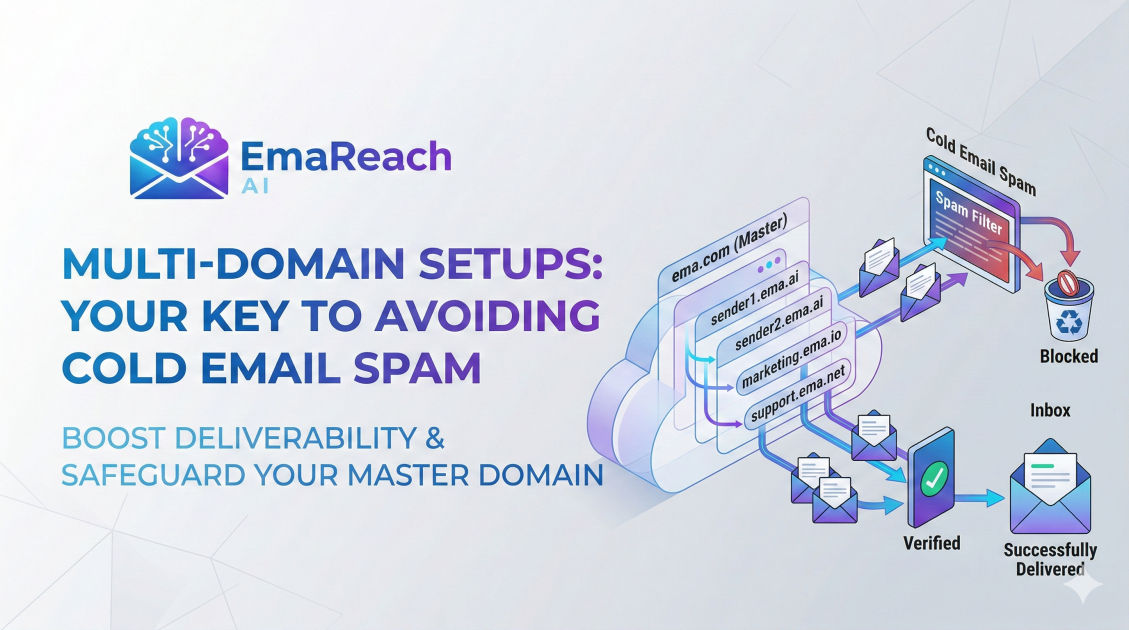
Multi-Domain Setups Designed to Avoid Cold Email Spam
cold emaildeliverabilityemail marketingdomain reputationoutreach strategylead generationemail infrastructure
The Evolution of Cold Email Deliverability
In the modern landscape of digital communication, the bridge between a successful outreach campaign and a failed one is often built on the foundation of technical infrastructure. Gone are the days when a salesperson could blast thousands of emails from a single corporate domain and expect to land in the primary inbox. Today, email service providers (ESPs) employ sophisticated algorithms that monitor sending patterns, engagement rates, and domain reputation with surgical precision.
To navigate this environment, sophisticated growth teams have moved toward multi-domain setups. This strategy involves distributing email volume across several secondary domains to protect the primary brand and ensure consistent deliverability. By isolating outreach activities from the main business domain, companies can scale their efforts without risking the essential communication channels they use for clients, partners, and internal operations.
Why Single-Domain Outreach is a Liability
Using your primary business domain (e.g., yourcompany.com) for cold outreach is a high-stakes gamble. If a segment of your audience marks your emails as spam, or if you hit a series of 'spam traps,' the reputation of your entire domain can plummet. Once a domain is blacklisted, every email sent from that domain—including invoices, support tickets, and internal memos—may be diverted to the recipient's spam folder or blocked entirely.
The 'Blast' Threshold
ESPs monitor the volume of outgoing mail. When a domain suddenly spikes from sending 50 emails a day to 500, it triggers red flags. Multi-domain setups allow you to stay under these 'velocity triggers' by spreading that same 500-email volume across ten different domains, sending only 50 from each. This mimics natural human behavior and keeps your sender reputation intact.
The Architecture of a Multi-Domain Setup
Building a robust multi-domain infrastructure requires careful planning and precise execution. It is not as simple as buying ten domains and hitting 'send.' A professional setup involves domain acquisition, DNS configuration, and a rigorous warm-up process.
Domain Selection and Extension Strategy
When purchasing domains for outreach, the goal is to look legitimate while remaining distinct from your main site. Common strategies include:
- Suffixes: Adding 'get', 'try', or 'app' (e.g., getcompany.com).
- Regional TLDs: Using .co, .io, or .net if your primary is .com.
- Industry Focus: Using keywords relevant to your niche within the domain name.
Avoid using domains that look like 'gibberish' or contain too many hyphens, as these are often flagged by automated filters as suspicious.
DNS Records: The Foundation of Trust
Every domain in your setup must be properly authenticated. Without these records, your emails are virtually guaranteed to hit the spam folder:
- SPF (Sender Policy Framework): Specifies which mail servers are authorized to send email on behalf of your domain.
- DKIM (DomainKeys Identified Mail): Adds a digital signature to your emails, ensuring the content hasn't been tampered with in transit.
- DMARC (Domain-based Message Authentication, Reporting, and Conformance): Tells the receiving server what to do if the SPF or DKIM checks fail.
- MX Records: Essential for receiving replies. Sending from a domain that cannot receive mail is a major spam signal.
The Technical Warm-up Process
A new domain is like a person with no credit history; it has neither a good nor a bad reputation. Sending high volumes from a 'cold' domain is a shortcut to the blacklist. The warm-up process involves gradually increasing the volume of emails sent and ensuring those emails receive positive engagement (opens, replies, and being marked as 'not spam').
This is where advanced solutions become invaluable. Tools like EmaReach help automate this process. EmaReach combines AI-written cold outreach with inbox warm-up and multi-account sending, ensuring your emails land in the primary tab and get replies. By automating the interaction between accounts, you build the 'social proof' your domains need to satisfy ESP algorithms.
Managing Sending Limits and Volume
To maintain high deliverability, you must respect the daily limits of your providers (like Google Workspace or Microsoft 365). While these providers might claim a limit of 2,000 emails per day, the 'safe' limit for cold outreach is significantly lower.
The Golden Rule of 50
A widely accepted best practice in the industry is to limit sending to roughly 50 cold emails per day per email account. If you need to send 1,000 emails a day, your setup should look like this:
- 20 Domains
- 1-2 Email Accounts per Domain
- 25-50 Emails per Account
This distribution ensures that even if one account is flagged, the other 19 continue to function, providing a 'fail-safe' for your lead generation pipeline.
Content Optimization: Avoiding the 'Spam Filter' Vocabulary
Technical setup is only half the battle; the content of your emails plays a massive role in whether you reach the inbox. ESPs scan for specific 'spam trigger words' and patterns that indicate unsolicited bulk mail.
Patterns to Avoid:
- Excessive Capitalization: 'ACT NOW FOR FREE GIFT' is an instant red flag.
- Too Many Links: Try to limit your email to one clear call-to-action link. Avoid using link shorteners (like bit.ly), as they are frequently used by scammers to hide malicious URLs.
- Image-Only Emails: Spammers often put text in images to bypass text filters. Maintain a high text-to-image ratio.
- Aggressive Sales Language: Phrases like 'guaranteed,' 'no cost,' and 'urgent' should be used sparingly, if at all.
The Power of Personalization
Modern filters check for 'uniqueness.' If you send the exact same template to 1,000 people, it looks like a mass blast. By using dynamic variables (First Name, Company, Industry) and AI-driven personalization, each email becomes a unique transaction, which significantly improves deliverability.
Tracking and Monitoring Your Setup
A multi-domain setup is not a 'set and forget' system. It requires active monitoring to ensure every 'spoke' in your wheel is spinning correctly.
Key Metrics to Track:
- Bounce Rate: Anything over 3% suggests your lead list is poor or your domain is being blocked.
- Open Rate: A sudden drop in open rates across a specific domain usually indicates that it has been 'shadowbanned' or its reputation has dipped.
- Spam Complaints: Even a small number of manual 'mark as spam' clicks can devastate a domain.
Rotation and Retirement
Domains eventually get 'tired.' Despite best practices, a domain may see declining performance after several months of use. Part of a sophisticated multi-domain strategy is having a 'bench' of warmed-up domains ready to swap in when an active domain needs a rest period.
Data Hygiene: The Unsung Hero of Deliverability
You can have the most expensive multi-domain setup in the world, but if you are sending emails to invalid addresses, you will fail. High bounce rates are the fastest way to destroy domain reputation.
Before any campaign goes live, your list must be scrubbed through a verification service to remove:
- Invalid Emails: Addresses that no longer exist.
- Catch-all Addresses: Addresses that accept all mail but might not be monitored.
- Spam Traps: 'Honeypot' emails used by providers to catch illegal scrapers.
Implementing Forwarding and Response Management
With 20 or 30 domains, managing replies can become a logistical nightmare. You don't want your sales team logging into 40 different inboxes every morning.
The Master Inbox Strategy
Set up a 'Master Inbox' or use a specialized CRM that aggregates replies from all secondary domains into a single view. However, when replying to a lead, it is crucial to reply from the same account that sent the initial email. This maintains the thread's integrity and prevents the lead from getting confused by a sudden change in sender address.
Compliance and Legal Considerations
While multi-domain setups are designed to navigate technical filters, they do not exempt you from legal requirements like the CAN-SPAM Act, GDPR, or CCPA.
- Identify Yourself: Include a physical business address in your footer.
- The Opt-Out: You must provide a clear and easy way for recipients to unsubscribe.
- Honest Subject Lines: Do not use deceptive 'Re:' or 'Fwd:' prefixes to trick users into opening an email.
Adhering to these rules doesn't just keep you legal; it keeps your reputation high. People who can easily unsubscribe won't mark you as spam, which protects your domain health.
Summary of the Multi-Domain Workflow
- Purchase secondary domains that mimic your brand.
- Configure SPF, DKIM, and DMARC records for every domain.
- Create professional email accounts (avoiding generic names like 'info' or 'sales').
- Warm-up the accounts for 2-4 weeks using an automated service.
- Verify your lead lists to ensure a 0% bounce rate.
- Distribute your daily volume so no single account exceeds 50 emails.
- Monitor health metrics and rotate domains as needed.
Conclusion
Mastering cold email in the current digital era requires a shift from 'mass marketing' to 'infrastructure management.' A well-designed multi-domain setup acts as an insurance policy for your business's growth. It allows you to reach new prospects at scale while safeguarding your primary domain and maintaining the high deliverability rates required to turn cold leads into warm conversations. By treating your email infrastructure with the same rigor as your product or service, you ensure that your message doesn't just get sent—it gets read.
EmaReach AI
Ready to scale your cold email outreach?
Join thousands of teams using EmaReach AI for AI-powered campaigns, domain warmup, and 95%+ deliverability. Start free — no credit card required.
Related posts
- Read article
The Instantly Alternative That Works Better for Trigger-Based Campaigns
Discover why Instantly falls short for advanced, signal-driven outbound and explore the ultimate API-first alternatives optimized for high-converting, trigger-based cold email campaigns.
- Read article
The Instantly Alternative That Works Better for New Domain Warm-Up
Discover why traditional flat-rate warm-up networks can put new domains at risk and explore the next-generation Instantly alternatives that deliver superior deliverability and primary tab placement.