Blog
Back to blog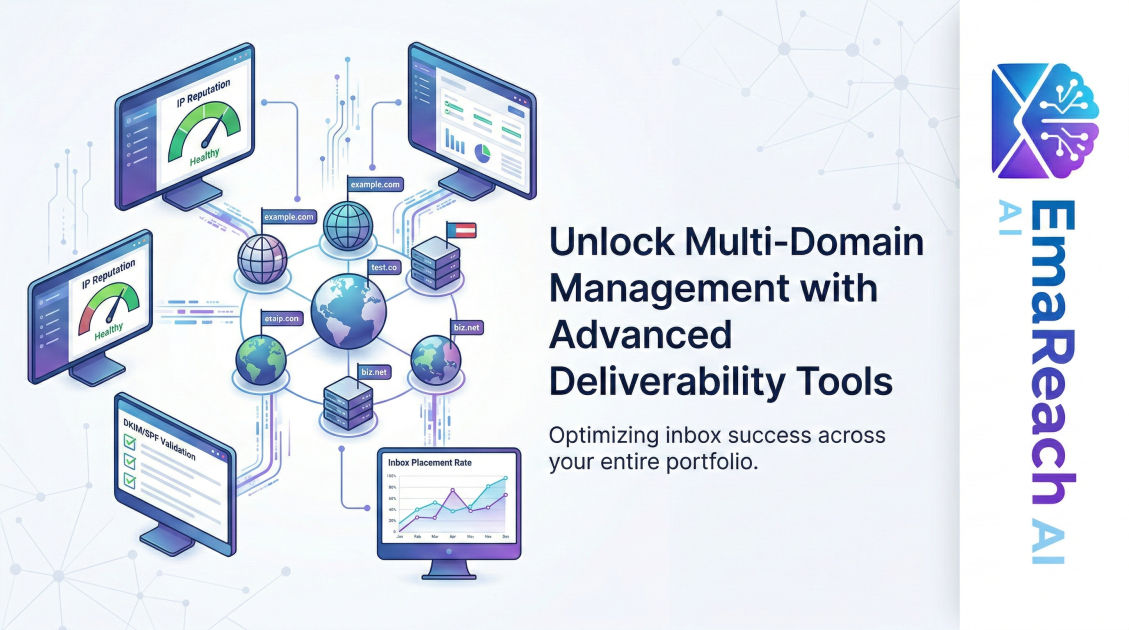
Multi-Domain Management via Deliverability Tools
email deliverabilitymulti-domain strategycold outreachinbox warm-upreputation managementemail marketingB2B sales
Introduction to Multi-Domain Management
In the modern landscape of digital communication, the strategy of relying on a single domain for all email operations is increasingly becoming a relic of the past. As email service providers (ESPs) like Google and Microsoft implement stricter filtering algorithms, businesses—especially those engaged in high-volume cold outreach or marketing—must pivot toward a multi-domain infrastructure. Managing multiple domains isn't just about redundancy; it is a sophisticated method of risk mitigation and deliverability optimization.
Multi-domain management involves the simultaneous oversight of several secondary domains and hundreds of individual email accounts. The primary goal is to distribute sending volume so that no single domain bears the brunt of spam filters or blacklists. However, without the right deliverability tools, this complex web of accounts can quickly become a logistical nightmare. This guide explores how to leverage deliverability tools to master multi-domain management and ensure your messages consistently land in the primary inbox.
The Architecture of a Multi-Domain Strategy
Before diving into the tools, it is essential to understand why this architecture is necessary. When you send emails from a single domain, your 'sender reputation' is tied exclusively to that domain's health. If a specific campaign triggers a high volume of 'Mark as Spam' reports, your entire business communication—including internal emails and client invoices—could be throttled or blocked.
By utilizing multiple 'look-alike' domains (e.g., using getcompany.com or companyapp.com alongside company.com), you isolate your outreach activities. If one domain encounters reputation issues, the others remain unaffected. This 'compartmentalization' is the cornerstone of modern deliverability. However, managing 10, 20, or 50 domains manually is impossible, which is where dedicated deliverability tools come into play.
Core Features of Multi-Domain Deliverability Tools
To effectively manage a multi-domain setup, your toolset must offer specific functionalities that go beyond simple inbox management. A comprehensive deliverability tool acts as a command center for your entire sending ecosystem.
1. Centralized Reputation Monitoring
One of the most critical aspects of multi-domain management is visibility. You need a dashboard that aggregates the health status of every domain in your portfolio. Advanced tools monitor blacklists, DNS health, and sender scores in real-time. Instead of checking each domain individually, the tool alerts you the moment a specific domain's reputation dips below a certain threshold.
2. Automated Inbox Warm-up
New domains are naturally treated with suspicion by ESPs. To build a positive reputation, you must 'warm up' the inbox by gradually increasing sending volume and ensuring a high engagement rate. Deliverability tools automate this by sending emails between a network of trusted accounts that automatically open, mark as important, and reply to your messages. When managing multiple domains, the tool should allow you to scale this process across all accounts simultaneously, ensuring every new domain is 'prime' for outreach before the first campaign even begins.
3. Unified Inbox and Multi-Account Sending
Managing replies across fifty different email addresses is a recipe for missed opportunities. Deliverability tools often feature a 'Master Inbox' or 'Unified Inbox' that pulls replies from every managed domain into a single interface. Furthermore, these tools allow for 'rotation'—automatically switching between different accounts and domains during a campaign to keep sending volumes per account low and within safe limits.
Streamlining Outreach with EmaReach
For those looking to simplify this entire process, EmaReach offers a powerful solution. EmaReach AI helps you stop landing in spam by providing cold emails that reach the inbox. It combines AI-written cold outreach with automated inbox warm-up and multi-account sending. By integrating these features, it ensures your emails land in the primary tab and get replies, effectively handling the complexities of multi-domain management so you can focus on closing deals.
DNS Management and Technical Setup
Effective multi-domain management starts at the DNS (Domain Name System) level. Every domain in your arsenal must be correctly configured to prove its legitimacy to receiving servers. Deliverability tools often include 'health checkers' that verify the following records:
- SPF (Sender Policy Framework): Specifies which mail servers are authorized to send email on behalf of your domain.
- DKIM (DomainKeys Identified Mail): Adds a digital signature to your emails, ensuring the content hasn't been tampered with in transit.
- DMARC (Domain-based Message Authentication, Reporting, and Conformance): Provides instructions to the receiving server on what to do if an email fails SPF or DKIM checks.
When managing multiple domains, a deliverability tool can bulk-verify these records, saving hours of manual labor and preventing the 'technical debt' that occurs when a single record is misconfigured.
The Role of AI in Multi-Domain Deliverability
Artificial Intelligence has revolutionized how we manage domain reputation. AI-driven tools can now analyze patterns in spam filters and adjust sending behaviors dynamically. For instance, if an AI detects that a particular domain is getting higher-than-average bounce rates, it can automatically throttle that domain's volume and increase the volume on a 'healthier' domain within the same pool.
AI also plays a role in content optimization. Since identical content sent from multiple domains can be flagged as a 'footprint' of a spammer, AI helps rewrite subject lines and body copy to ensure variance across your multi-domain campaigns. This 'spintax' on steroids ensures that every email looks unique to the recipient's ESP.
Strategies for Scaling Your Domain Portfolio
Scaling from two domains to twenty requires a shift in strategy. Here are the best practices for scaling using deliverability tools:
Staggered Domain Acquisition
Do not buy twenty domains on the same day. This can look suspicious to registrars and ESPs. Instead, acquire domains in batches and put them immediately into the warm-up phase provided by your tool. This creates a pipeline of 'ready-to-use' domains that you can rotate in as older domains need a 'rest' period.
Diversifying Providers
While it is tempting to host all your domains with one provider for ease of billing, it is safer to diversify. Use a mix of Google Workspace, Microsoft 365, and perhaps a few private SMTP servers. Modern deliverability tools are provider-agnostic, allowing you to manage this diverse infrastructure from a single pane of glass.
Monitoring Sentiment and Engagement
Deliverability isn't just about technical settings; it's about how users interact with your mail. Advanced tools track the 'sentiment' of replies. If a specific domain is generating a lot of 'unsubscribe' requests or negative sentiment, the tool can flag it for a content review. High engagement (opens and clicks) signals to ESPs that your multi-domain network is providing value, further boosting your collective reputation.
Common Pitfalls in Multi-Domain Management
Even with the best tools, mistakes happen. Understanding these pitfalls is crucial for long-term success:
- Over-warming: Some users believe that more warm-up is always better. However, a sudden drop from 100 warm-up emails a day to 100 cold outreach emails can look unnatural. Tools should allow for a 'blended' approach where warm-up continues even during active campaigns.
- Neglecting 'Burned' Domains: If a domain's reputation is permanently damaged, some people try to 'fix' it indefinitely. Often, it is more cost-effective to decommission the domain and rotate in a fresh one from your warmed-up pool.
- Inconsistent Branding: While the domains change, the branding should remain consistent. Ensure your deliverability tool supports custom tracking domains so that links in your emails point to a branded URL rather than a generic tool URL, which improves trust and click-through rates.
The Future of Deliverability Tools
As ESPs become more sophisticated, deliverability tools are evolving to become 'predictive.' Future iterations of these tools will likely be able to predict a reputation drop before it happens, using machine learning to analyze global email traffic patterns. We are also seeing a shift toward deeper integration with CRM systems, allowing for a seamless flow from lead generation to multi-domain outreach and finally to deal closure.
The 'cat and mouse' game between senders and filters will continue, but those equipped with robust multi-domain management tools will always stay a step ahead. By distributing risk, automating technical hurdles, and utilizing AI-driven insights, businesses can maintain a high-performance outreach engine that is resilient to the ever-changing rules of the email ecosystem.
Conclusion
Mastering multi-domain management is no longer an optional luxury for businesses—it is a foundational requirement for successful digital outreach. By leveraging deliverability tools, you transform a complex, high-risk process into a streamlined, scalable system. From automated warm-ups and DNS verification to AI-powered content rotation and unified inboxes, these tools provide the infrastructure necessary to navigate the complexities of modern email filtering. Investing in a multi-domain strategy today ensures that your voice continues to be heard in an increasingly crowded and filtered digital world.
EmaReach AI
Ready to scale your cold email outreach?
Join thousands of teams using EmaReach AI for AI-powered campaigns, domain warmup, and 95%+ deliverability. Start free — no credit card required.
Related posts
- Read article
How Choosing the Right Instantly Alternative Changed Our Pipeline Numbers
Discover how transitioning from a volume-first cold email setup to an advanced, deliverability-focused infrastructure transformed our B2B pipeline metrics, skyrocketed open rates to over 68%, and tripled our monthly booked demos.
- Read article
The Instantly Alternative That Impressed Even the Biggest Instantly Fans
Discover why top outbound growth marketers and lead generation agencies are migrating from legacy cold email platforms to advanced alternatives built for superior deliverability, white-label client management, and robust API workflows.