Blog
Back to blog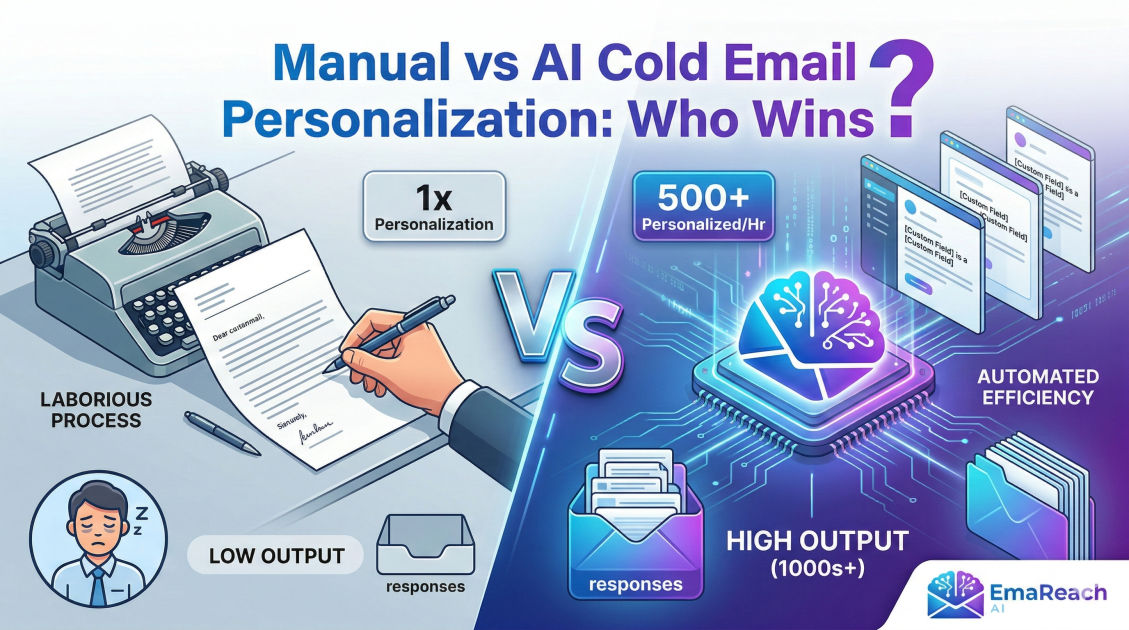
Manual vs AI Cold Email Personalization: Who Wins?
cold emailemail personalizationAI outreachsales automationemail deliverabilityB2B lead generation
Introduction
The debate between manual and artificial intelligence-driven cold email personalization is one of the most heavily discussed topics in modern sales, marketing, and lead generation. As decision-makers become increasingly blind to generic outreach, the necessity for highly tailored, individualized communication has never been more apparent. The 'spray and pray' methodology of sending thousands of identical messages and hoping for a tiny fraction of responses is entirely obsolete. Today, capturing a prospect's attention requires demonstrating that you understand their specific pain points, their industry, and their individual role.
However, a significant dilemma arises when scaling these personalized outreach efforts: do you rely on human intuition, deep manual research, and hand-crafted messaging, or do you leverage the speed, scalability, and evolving sophistication of AI tools? Both approaches have dedicated advocates. Proponents of manual personalization argue that nothing can replace the authentic nuance and genuine empathy of a human being. Conversely, advocates for AI personalization highlight the impossibility of scaling manual efforts without completely exhausting your sales development representatives.
This comprehensive guide explores the ultimate showdown between manual and AI cold email personalization. We will dissect the anatomy of both methodologies, analyze their distinct advantages and inherent drawbacks, and ultimately determine which strategy yields the highest return on investment. Furthermore, we will explore why merging these two approaches—while maintaining a strict focus on email deliverability—might be the definitive answer for modern outbound campaigns.
The Art of Manual Cold Email Personalization
Manual personalization is the traditional, artisanal approach to cold outreach. It involves a human researcher carefully investigating a prospect before writing a unique email tailored specifically to that individual. This process is meticulous, requiring a high degree of emotional intelligence and business acumen.
The Research Process
When executing manual personalization, a sales professional typically spends several minutes to an hour investigating a single prospect. This research spans across multiple platforms. They might review the prospect's LinkedIn profile to understand their career trajectory, recent promotions, or articles they have shared. They will scour the target company's website, read recent press releases, and analyze their quarterly earnings reports to identify overarching corporate goals or challenges. They might even listen to podcast interviews featuring the prospect or read blog posts they have authored.
The goal of this deep dive is to find a unique 'hook'—a piece of information that proves the sender has done their homework and is not just mass-emailing a purchased list. This hook is then woven into the opening lines of the cold email, establishing immediate rapport and credibility.
The Advantages of the Human Touch
- Unmatched Authenticity: Humans possess an innate ability to write with a natural, conversational tone that resonates with other humans. A manually written email rarely sounds robotic or templated. The phrasing, the subtle use of humor, and the specific framing of a value proposition are tailored to match the perceived personality of the recipient.
- Deep Contextual Understanding: While algorithms can identify keywords, human beings understand context. A human researcher can read a prospect's post about a recent corporate merger and infer the associated stress, operational challenges, and potential need for specific integration software. This leap of logic—connecting an abstract event to a concrete pain point—is incredibly difficult to automate perfectly.
- High Conversion Rates on Small Volumes: Because manual emails are hyper-targeted and deeply relevant, they typically boast exceptionally high open and reply rates. For enterprise-level sales targeting high-value accounts, where closing a single deal can generate massive revenue, the time invested in manual personalization pays massive dividends.
The Disadvantages: The Scaling Wall
- Extremely Time-Consuming: The most glaring drawback of manual personalization is the sheer amount of time it requires. If a representative spends just fifteen minutes researching and writing an email for each prospect, they can only reach a few dozen people per day. This severely limits the top of the sales funnel.
- High Cost Per Lead: Due to the time investment required, the labor cost associated with manual outreach is substantial. Employing a team of highly skilled researchers and writers to send a low volume of emails is an expensive proposition.
- Risk of Burnout: Performing deep research and writing unique copy for hours on end is mentally taxing. Sales representatives often experience creative fatigue, leading to a gradual decline in the quality of their personalization over time.
The Rise of AI Cold Email Personalization
Artificial intelligence has revolutionized outbound marketing by offering a solution to the scalability problem of manual outreach. By leveraging large language models and advanced web scraping technologies, AI platforms can simulate human research and generate personalized email copy at unprecedented speeds.
How AI Personalization Works
Modern AI personalization engines operate by ingesting large amounts of data about a prospect and their company. You provide the AI with a list of leads, their LinkedIn URLs, and company domains. The software then systematically scrapes these sources, extracting key information such as job titles, recent company news, technologies used, and even the prospect's recent social media activity.
Once the data is collected, the AI feeds this information into a language model, utilizing pre-defined prompts to generate personalized email copy. For instance, the prompt might instruct the AI to 'Write a casual opening line congratulating the prospect on their recent funding round and smoothly transition into our value proposition regarding financial compliance software.' The AI executes this instruction in seconds, generating thousands of unique emails in the time it would take a human to write just one.
The Advantages of Automation and AI
- Infinite Scalability: The primary advantage of AI is its ability to scale effortlessly. Whether you are targeting fifty prospects or five thousand, the software can generate personalized messaging for the entire list almost instantaneously. This allows companies to maintain a massive outbound volume without sacrificing the appearance of one-to-one communication.
- Speed and Efficiency: By automating the most time-consuming aspects of cold outreach—research and copywriting—AI frees up sales teams to focus on higher-level tasks, such as negotiating deals, taking discovery calls, and building relationships with prospects who have already replied.
- Dynamic A/B Testing: AI allows for rapid iteration and testing. You can easily instruct the software to generate three different styles of personalization (e.g., one focused on recent news, one focused on job title, one focused on shared connections) and deploy them simultaneously to see which approach yields the highest conversion rates.
- Cost-Effectiveness at Scale: While premium AI tools require an investment, the cost per email drops dramatically as volume increases, making it a highly economical choice for reaching broad markets.
The Pitfalls of Relying Solely on Algorithms
- The 'Uncanny Valley' of Copywriting: Despite massive advancements, AI-generated text can sometimes feel slightly off. It may use overly formal vocabulary, exhibit repetitive sentence structures, or force a transition between the personalized hook and the sales pitch that feels unnatural to the reader.
- Hallucinations and Inaccuracies: AI models occasionally misinterpret data or generate completely fabricated information—a phenomenon known as 'hallucinating.' Sending an email congratulating a prospect on an award they never won, or mentioning a competitor as if it were their own company, instantly destroys credibility and ruins the relationship.
- Surface-Level Personalization: While AI can easily scrape recent news, it often struggles to connect that news to a deep, complex business problem. The resulting personalization can feel superficial, proving that the sender used a tool rather than genuinely understanding the prospect's unique situation.
Deliverability: The Silent Decider
Before declaring a winner between manual and AI personalization, we must address the most critical factor in any cold email campaign: deliverability. The most eloquently written, perfectly researched manual email, or the most brilliantly prompted AI sequence, is entirely worthless if it lands in the recipient's spam folder.
Email service providers have become incredibly sophisticated at detecting commercial outreach. Sudden spikes in sending volume, using a new domain without proper warm-up, or sending heavily templated text can all trigger spam filters. When you scale up your outreach using AI, the risk of triggering these filters increases exponentially if you do not have the proper infrastructure in place.
This is where specialized tools become essential. Stop Landing in Spam. Cold Emails That Reach the Inbox. EmaReach AI combines AI-written cold outreach with inbox warm-up and multi-account sending—so your emails land in the primary tab and get replies. By utilizing a platform that natively understands the intricacies of sender reputation, you ensure that your personalized messages actually reach the eyeballs of your target audience.
Proper deliverability requires spreading your sending volume across multiple secondary domains, gradually increasing the number of emails sent each day, and maintaining a healthy ratio of sent-to-received emails through automated warm-up networks. Without this foundational layer, your personalization efforts are essentially shouting into the void.
The Hybrid Approach: The True Winner
So, who wins the battle of manual versus AI personalization? The reality is that viewing this as a binary choice is a strategic mistake. The most successful modern outbound campaigns do not strictly choose one over the other; instead, they implement a hybrid approach that leverages the strengths of both methodologies while mitigating their weaknesses.
Tiering Your Prospects
The foundation of the hybrid approach involves segmenting your total addressable market into distinct tiers based on their potential value and strategic importance to your business.
- Tier 1 (High Value / Enterprise): These are your dream accounts. Securing a deal with these companies would significantly impact your revenue. For Tier 1 prospects, manual personalization is absolutely mandatory. The potential payoff justifies the deep, time-consuming research required to craft a hyper-personalized, highly empathetic message. You cannot risk a machine hallucinating a detail when communicating with a high-stakes decision-maker.
- Tier 2 (Mid-Market / Strong Fit): These accounts are great fits for your product, but the individual deal size does not warrant hours of manual research. This is where AI excels. You can use AI to scrape their data, generate personalized opening lines based on recent company news, and dynamically insert relevant case studies. However, a human should quickly review these AI-generated emails before sending to ensure quality and natural tone.
- Tier 3 (Broad Market / Volume Play): These are smaller accounts or prospects where the qualification criteria are less strict. For this tier, you can rely heavily on fully automated AI personalization. The goal here is volume and identifying raised hands. By casting a wide, AI-personalized net, you can efficiently filter out the uninterested and focus your human capital on those who reply.
Establishing the Hybrid Workflow
Implementing this strategy requires a well-defined workflow. First, utilize data enrichment tools to build your lists and segment them into the aforementioned tiers. Next, configure your AI outreach platform to handle the heavy lifting for your Tier 2 and Tier 3 segments. Spend time meticulously refining your AI prompts—the better the prompt, the less robotic the output will be.
For the crucial Tier 2 segment, implement a 'human-in-the-loop' system. Generate the emails using AI, but have a sales development representative spend thirty seconds reading and tweaking each message before it goes out. This guarantees that glaring errors are caught and allows the representative to inject a tiny bit of human nuance that the AI might have missed. This simple step bridges the gap between massive scale and authentic communication.
Finally, ensure your Tier 1 prospects are handled with the utmost care. Sales representatives should personally research these individuals, perhaps even utilizing multi-channel approaches that include personalized video messages or direct mail, alongside highly tailored manual emails.
Conclusion
The debate over manual versus AI cold email personalization is ultimately resolved through strategic integration. Relying solely on manual outreach limits your growth potential, leaving valuable revenue on the table simply because you cannot reach enough prospects. Conversely, depending entirely on unchecked AI personalization risks damaging your brand reputation with robotic messaging and spam-triggering behaviors.
The true winner is the hybrid approach. By intelligently segmenting your audience, applying human empathy to high-value targets, leveraging AI to scale the rest, and securing your entire operation with robust deliverability infrastructure, you create an outbound engine that is both highly efficient and deeply resonant.
EmaReach AI
Ready to scale your cold email outreach?
Join thousands of teams using EmaReach AI for AI-powered campaigns, domain warmup, and 95%+ deliverability. Start free — no credit card required.
Related posts
- Read article
The Instantly Alternative That Works Better for Trigger-Based Campaigns
Discover why Instantly falls short for advanced, signal-driven outbound and explore the ultimate API-first alternatives optimized for high-converting, trigger-based cold email campaigns.
- Read article
The Instantly Alternative That Handles High Bounce Rates Without Panic
Discover how transitioning to an advanced Instantly alternative can safeguard your cold email infrastructure. Learn to handle high bounce rates effortlessly using real-time verification, smart mailbox rotation, and automated safety nets to protect your sender reputation and maintain consistent primary inbox placement.