Blog
Back to blog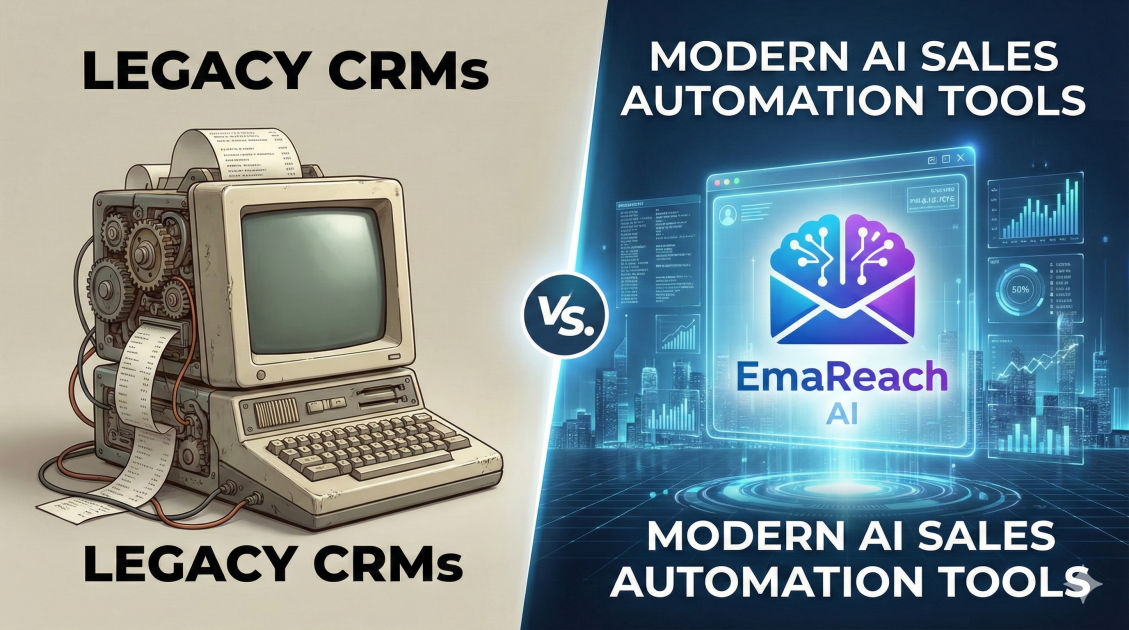
Legacy CRMs vs Modern AI Sales Automation Tools
sales automationCRM strategyAI in salessales productivitylead generationdigital transformation
Introduction: The Great Sales Tech Divide
For decades, the Customer Relationship Management (CRM) system has been the undisputed heart of the sales department. It was the digital filing cabinet where every lead, contact, and deal lived. However, as the pace of business accelerates, a quiet revolution is taking place. The traditional "Legacy CRM"—once a revolutionary tool—is increasingly being viewed as a burden by the very people it was meant to help.
Enter Modern AI Sales Automation Tools. These aren't just faster versions of old software; they represent a fundamental shift from reactive record-keeping to proactive, intelligent execution. While legacy systems focus on what happened in the past, modern AI tools focus on what should happen next. This article explores the deep structural differences between these two worlds and why the transition is no longer optional for high-growth teams.
Understanding the Legacy CRM: The Data Graveyard Problem
Legacy CRMs were designed in an era where data was scarce and the primary goal was centralization. They were built for managers who wanted visibility, not for reps who wanted to sell more effectively.
The Manual Entry Trap
The most significant hallmark of a legacy CRM is its reliance on manual data entry. For a legacy system to be useful, a sales representative must manually log every call, every email, and every update to a deal stage. This creates a "data graveyard"—a system filled with incomplete or outdated information because the friction of updating it is too high. Studies often show that sales reps spend upwards of 60% of their time on administrative tasks rather than talking to prospects.
Rigid Architecture and Silos
Legacy systems are often monolithic and rigid. Customizing a workflow or adding a new data field can require weeks of development or expensive consultants. Furthermore, these systems often exist in silos, disconnected from the actual communication channels where sales happen—like LinkedIn, email, or video conferencing tools.
The Rise of Modern AI Sales Automation
Modern AI sales automation tools are built on a completely different philosophy: The system should work for the user, not the other way around. These tools are "AI-native," meaning machine learning and natural language processing are baked into the core architecture, not just added as a cosmetic plugin.
From Record-Keeping to Autonomous Action
Unlike legacy systems that wait for a human to trigger an action, modern tools are becoming Agentic. They can identify high-intent signals across the web, automatically enrich a lead's profile with verified contact data, and even initiate the first touchpoint.
When it comes to outreach, the difference is stark. In a legacy environment, you might manually draft a follow-up. With modern automation, tools can handle the heavy lifting. For instance, if you are struggling with email deliverability and manual drafting, platforms like EmaReach (https://www.emareach.com/) allow you to stop landing in spam. By combining AI-written cold outreach with inbox warm-up and multi-account sending, these tools ensure your messages reach the primary tab and get replies—tasks that a legacy CRM simply cannot perform on its own.
Key Comparison: Legacy vs. AI-Native
| Feature | Legacy CRM | Modern AI Sales Automation |
|---|---|---|
| Primary Goal | Data Centralization & Reporting | Revenue Execution & Growth |
| Data Entry | Manual, human-dependent | Automated via sync and scraping |
| Insights | Reactive (What happened?) | Predictive (What will happen?) |
| Workflows | Static, rule-based | Adaptive, learning-based |
| User Adoption | Low (viewed as a chore) | High (viewed as a co-pilot) |
| Focus | Management oversight | Rep productivity |
The Core Pillars of Modern AI Sales Tools
To understand why modern tools are winning, we have to look at the three pillars that define them: Automation, Intelligence, and Integration.
1. Automated Data Capture and Enrichment
Modern tools live where the salesperson lives. They automatically sync with calendars and email inboxes. If a prospect mentions a budget change in an email, the AI identifies that intent and updates the deal status automatically. There is no more "I'll log that later." The data is captured in real-time, ensuring the "source of truth" is actually truthful.
2. Predictive Lead Scoring and Intent Mapping
Legacy CRMs score leads based on basic rules (e.g., "If they download a PDF, give them 10 points"). Modern AI tools use machine learning to analyze thousands of data points—including social media activity, hiring trends, and website behavior—to predict which leads are actually ready to buy. This allows sales teams to ignore the noise and focus on the 5% of the pipeline that will drive 80% of the revenue.
3. Generative Communication
Writing personalized emails is the most time-consuming part of sales. Modern tools use Large Language Models (LLMs) to draft highly relevant, context-aware messages. They don't just use "Hi [First_Name]"; they reference a recent post the prospect made or a specific pain point their industry is facing.
The Hidden Costs of Staying Legacy
Many organizations hesitate to switch because of the perceived "switching cost." However, the cost of staying on a legacy system is often much higher, hidden in the form of:
- Opportunity Cost: High-value leads that fall through the cracks because they weren't followed up on in time.
- Rep Turnover: Top-tier sales talent today expects modern tools. Forcing a high-performer to spend 10 hours a week on manual data entry is a fast track to burnout.
- Bad Data Decisions: If your CRM data is 30% inaccurate (a common statistic for legacy systems), your revenue forecasts and strategic decisions are built on a foundation of sand.
How to Transition to a Modern Stack
Moving away from a legacy system doesn't mean you have to delete everything overnight. The modern approach is often Modular.
Phase 1: The Integration Layer
Start by connecting AI automation tools to your existing legacy CRM. Use the legacy system as your system of record, but use AI tools as your system of engagement. This allows your team to get the benefits of AI-powered outreach and lead scoring without a massive data migration project.
Phase 2: Workflow Optimization
Identify the most manual processes in your current sales cycle. Is it lead sourcing? Is it follow-up? Replace these specific segments with autonomous agents. For example, if your outbound sequences are struggling, implementing a specialized tool for deliverability and warm-up can show immediate ROI.
Phase 3: The Full Migration
Once your team is comfortable with AI-driven workflows, you can move toward a unified AI-native platform that replaces the legacy database entirely. This results in a leaner tech stack with fewer silos and lower total cost of ownership.
The Future: From Tools to Agents
We are moving toward a world of Autonomous Sales Operations. In this future, the "CRM" isn't a place where you go to type; it's an intelligent agent that attends your meetings, takes notes, updates your pipeline, and suggests the exact wording for your next negotiation.
Legacy CRMs are designed for a world of static records. Modern AI sales automation tools are designed for a world of dynamic relationships. The choice between them will ultimately define which companies scale and which ones get bogged down by their own administrative weight.
Practical Takeaways for Sales Leaders:
- Audit your team's time: If they spend more than 20% of their day in the CRM, your system is a bottleneck.
- Prioritize Intent over Volume: Look for tools that tell you who to talk to, not just tools that let you email more people.
- Focus on the Inbox: Your sales happen in the inbox. Ensure your tools, like those offered by EmaReach, are optimized to keep you out of the spam folder and in front of your customers.
EmaReach AI
Ready to scale your cold email outreach?
Join thousands of teams using EmaReach AI for AI-powered campaigns, domain warmup, and 95%+ deliverability. Start free — no credit card required.
Related posts
- Read article
Beyond Instantly: The Cold Email Platforms Worth Taking Seriously
Discover the top advanced cold email platforms that go beyond basic multi-inbox rotation. Learn how to optimize your technical infrastructure, leverage advanced personalization, and scale your B2B sales pipeline safely without landing in the spam folder.
- Read article
What the Cold Email Community Actually Says About Instantly Alternatives
Discover what growth marketers, agency owners, and outbound practitioners across major cold email communities are saying about the top alternatives to Instantly. This comprehensive, research-driven guide breaks down the real-world pros, cons, and technical features of tools like Smartlead, EmaReach, Saleshandy, and Lemlist based on community consensus.