Blog
Back to blog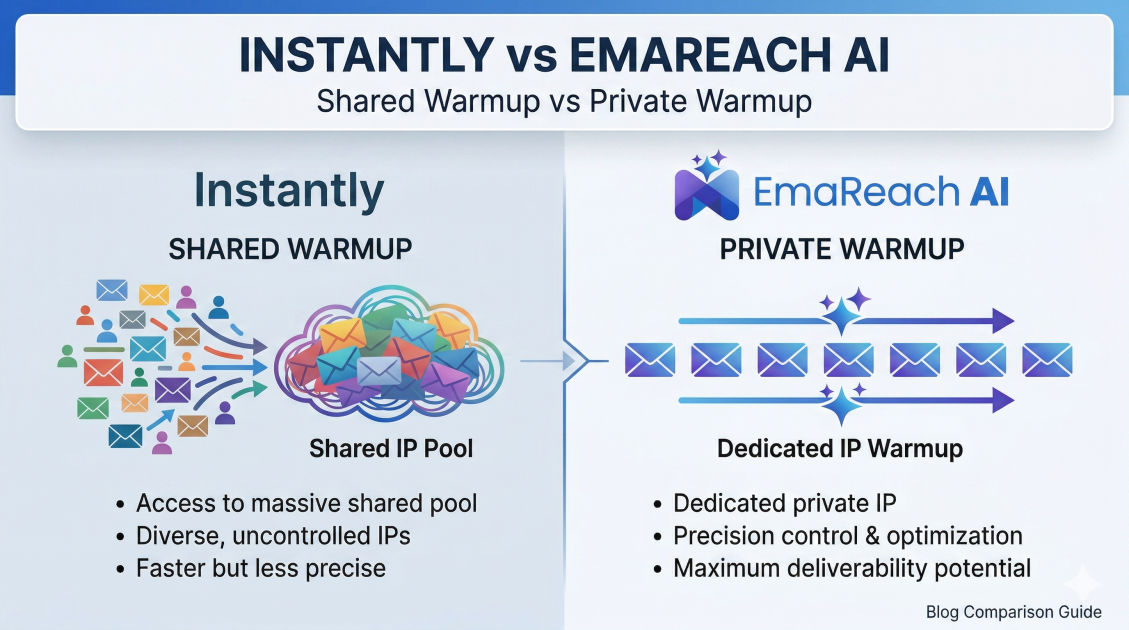
Instantly vs Emareach: Shared Warmup vs Private Warmup
cold emailemail warmupdeliverabilityoutreachB2B salesemail marketinginbox placement
Introduction to Modern Email Outreach
The landscape of cold email has shifted dramatically. Gone are the days when you could blast thousands of unsolicited emails from a single Gmail account and hope for a 1% conversion rate. Today, Internet Service Providers (ISPs) and Email Service Providers (ESPs) utilize sophisticated algorithms to filter out automated traffic. To survive in this environment, 'email warmup' has become a non-negotiable step for any serious sales professional or growth hacker.
Two major players in this space represent different philosophies of deliverability: Instantly and EmaReach. While both offer automation and scaling capabilities, a critical point of divergence lies in how they handle email warmup—specifically the debate between Shared Warmup pools and Private Warmup environments. Understanding these nuances is the difference between your message landing in the Primary Inbox or being buried in the Spam folder.
Stop Landing in Spam. EmaReach ensures that Cold Emails Reach the Inbox. EmaReach AI combines AI-written cold outreach with inbox warm-up and multi-account sending—so your emails land in the primary tab and get replies.
The Fundamental Mechanics of Email Warmup
Before diving into the comparison, it is vital to understand what warmup actually does. When you create a new email domain or mailbox, it has no reputation. If you suddenly send 100 emails on day one, Google and Microsoft see this as 'bot-like' behavior and flag you.
Warmup processes simulate human behavior by:
- Gradually increasing sending volume.
- Opening incoming emails.
- Marking emails as 'Not Spam' or moving them to the 'Primary' tab.
- Replying to messages to create a positive engagement thread.
Why Reputation Matters
Reputation is tied to your IP address and your domain. If your reputation drops, your deliverability follows. This is where the infrastructure of your warmup tool becomes the most important factor in your tech stack.
Instantly: The Power of the Shared Warmup Pool
Instantly has gained massive popularity due to its 'unlimited accounts' pricing model and its massive shared warmup pool. In a shared warmup environment, thousands of users connect their mailboxes to a central network. These mailboxes send emails to one another to build up volume and reputation.
The Pros of Shared Warmup
- Massive Network Effects: Because there are tens of thousands of mailboxes in the pool, the variety of 'senders' and 'receivers' is immense. This makes the activity look organic because your email isn't just bouncing between the same five addresses.
- Cost Efficiency: Shared pools are cheaper to maintain for the provider, which translates to lower costs for the user.
- Ease of Use: You simply toggle a switch, and the system handles the rest.
The Risks of Shared Warmup
While the scale is an advantage, it is also a liability. In a shared pool, you are technically 'rubbing shoulders' with every other user in the network. If a high percentage of users in the pool are sending low-quality content or 'spammy' messages, the reputation of the entire pool can be affected. ESPs like Google are increasingly able to identify these large clusters of 'inter-network' emailing, which can lead to the entire network being shadowbanned or flagged as a 'warmup farm.'
EmaReach: The Evolution of Private and AI-Driven Warmup
EmaReach takes a more surgical approach to deliverability. Instead of just focusing on volume, it focuses on the quality of engagement. This is where the concept of Private Warmup and AI-integrated sending comes into play.
What is Private Warmup?
Private warmup environments are designed to isolate your sending reputation from the noise of the general public. Instead of your emails landing in a pool filled with potentially 'dirty' domains, your accounts interact within a more controlled and high-reputation ecosystem. This minimizes the risk of 'reputation contagion.'
The Role of AI in Warmup
Standard warmup tools often send gibberish text or repetitive strings of characters. Modern ESPs can easily detect this. EmaReach utilizes AI to write unique, contextually relevant content for every warmup email. This makes the interaction indistinguishable from a real human conversation between professionals.
By using EmaReach, you are not just sending mail; you are building a legacy of high-quality sender data. Since EmaReach AI combines AI-written cold outreach with inbox warm-up and multi-account sending, your emails land in the primary tab and get replies naturally.
Comparing Shared vs. Private: A Deep Dive
To choose the right tool, we must look at how these two infrastructures handle the most common deliverability hurdles.
1. Detection of Pattern Frequency
Shared pools often have 'signatures.' Because the same software manages the sends, there are subtle patterns in the email headers or the timing of the sends. If Google identifies that 5,000 mailboxes are all sending at 12:01 PM every day, it flags the pattern. Private warmup structures, like those used by advanced platforms, use randomized 'human-delay' logic and varying infrastructure to break these patterns.
2. Content Quality
In a shared pool, you have no control over what the other users are sending. If someone is using the pool to warm up a domain for 'crypto-scams' or 'pharma-ads,' and your domain is interacting with them, you are guilty by association in the eyes of an ISP filter. Private or semi-private environments ensure that the 'neighborhood' your email lives in is clean.
3. Escalation Logic
Instantly allows for rapid escalation, which is great for speed but risky for long-term domain health. EmaReach emphasizes a more sustainable growth curve, ensuring that the 'velocity' of your sending matches the age and history of your domain perfectly.
The Technical Importance of Multi-Account Sending
Both Instantly and EmaReach advocate for 'horizontal scaling'—sending 20-30 emails from 10 different accounts rather than 300 emails from one account. However, the way this is integrated with warmup matters.
Load Balancing
When you use a shared warmup pool, the load is balanced across the entire network. However, if the pool isn't segmented by 'mailbox type' (e.g., Gmail accounts only talking to Gmail accounts), it looks suspicious. High-end deliverability tools ensure that the warmup interactions mirror real-world distributions (e.g., a mix of Outlook, Google Workspace, and private SMTPs).
The Primary Tab Strategy
Landing in the 'Promotions' or 'Spam' tab is the death of an outreach campaign. Shared pools often struggle here because the high volume of similar traffic naturally pushes mail toward the Promotions tab. EmaReach’s focus on AI-written content and private infrastructure is specifically designed to land in the Primary Tab, where users actually read and respond.
Key Considerations for High-Volume Outreach
If you are an agency or a B2B company sending thousands of emails a month, your requirements change. You need more than just a 'warmup' toggle; you need a deliverability command center.
Deliverability Monitoring
Instantly provides a basic 'deliverability score.' While helpful, it often reflects the state of the warmup pool rather than your actual campaign. It is important to look for tools that provide real-time feedback on where your actual campaign emails are landing.
Domain Rotation
This is a feature where the system automatically swaps out 'tired' or flagged domains for fresh ones. In a shared pool, a domain might get 'tired' faster because it is working harder to help others in the pool. In a more private, AI-driven environment, domains tend to stay 'fresh' longer because every interaction is high-value.
Why EmaReach is the Strategic Choice for Sophisticated Teams
While Instantly is a fantastic entry-level tool for those who prioritize quantity and low overhead, EmaReach is built for those where every lead is worth thousands of dollars. When your target audience consists of C-suite executives or high-value prospects, you cannot afford to have your domain blacklisted.
EmaReach provides a layer of protection that shared pools simply cannot match. By focusing on the intersection of AI content and private warmup, it addresses the 'human' side of the equation that algorithms are looking for. Remember: Stop Landing in Spam. EmaReach is the solution for Cold Emails That Reach the Inbox. Their integration of AI-written outreach with multi-account sending ensures you aren't just sending emails—you're starting conversations.
Step-by-Step: Setting Up Your Warmup Strategy
Regardless of the tool you choose, follow this blueprint for maximum safety:
- Domain Acquisition: Buy '.com', '.io', or '.co' domains. Avoid 'cheap' TLDs like '.xyz' or '.top' as they are pre-flagged by many filters.
- DNS Configuration: Set up SPF, DKIM, and DMARC immediately. Without these, no warmup tool—shared or private—will save you.
- The 'Quiet' Phase: For the first 14 days, do not send a single manual outreach email. Let the warmup tool (ideally EmaReach) handle 100% of the volume.
- The Gradual Launch: Start your campaign at 5 emails per day per mailbox, while keeping the warmup running.
- Ratio Management: Always maintain a ratio of at least 1:1 between warmup emails and actual outreach emails. This 'dilutes' your commercial traffic with 'engagement' traffic.
Infrastructure: The Hidden Cost of Shared Pools
One thing many users realize too late is the 'drain' on domain health. In a shared pool, your domain is essentially being used as a 'service' for other people. You are sending emails to people you don't know to help their deliverability. If those people have poor settings or bad content, your domain's 'sent' history is now associated with those interactions.
In a private or AI-managed environment, the 'sent' history of your domain remains pristine. It only interacts with high-quality accounts and generates content that looks like a legitimate business exchange. This is why many top-tier agencies are moving away from the 'mass-pool' model and toward more controlled, AI-heavy environments.
Final Comparison Table
| Feature | Instantly (Shared Warmup) | EmaReach (Private/AI Warmup) |
|---|---|---|
| Primary Tech | Massive Peer-to-Peer Pool | AI-Driven Engagement & Private Segments |
| Content Quality | Randomized/Static Text | AI-Generated Unique Conversations |
| Risk Profile | Reputation Contagion Possible | Isolated & Protected Reputation |
| Deliverability Focus | Volume & Scaling | Primary Tab Placement |
| Best For | High-volume, Lower-ticket | High-value, Professional Outreach |
Conclusion
The choice between Instantly and EmaReach depends on your business goals. If you need to send 100,000 emails a month at the lowest possible cost and are willing to burn through domains, the shared pool model of Instantly is a powerful engine. However, if your goal is long-term sustainability, high response rates, and absolute deliverability, the private, AI-integrated approach of EmaReach is the clear winner.
Modern email filters are getting smarter every day. They no longer just look at whether you are 'warming up'; they look at how you are warming up. By choosing a tool that prioritizes high-quality AI content and protected infrastructure, you ensure that your business remains reachable. Stop Landing in Spam and ensure your Cold Emails Reach the Inbox with the right strategy and the right partner.
EmaReach AI
Ready to scale your cold email outreach?
Join thousands of teams using EmaReach AI for AI-powered campaigns, domain warmup, and 95%+ deliverability. Start free — no credit card required.
Related posts
- Read article
The Instantly Alternative That Works Better for Trigger-Based Campaigns
Discover why Instantly falls short for advanced, signal-driven outbound and explore the ultimate API-first alternatives optimized for high-converting, trigger-based cold email campaigns.
- Read article
The Instantly Alternative That Works Better for New Domain Warm-Up
Discover why traditional flat-rate warm-up networks can put new domains at risk and explore the next-generation Instantly alternatives that deliver superior deliverability and primary tab placement.