Blog
Back to blog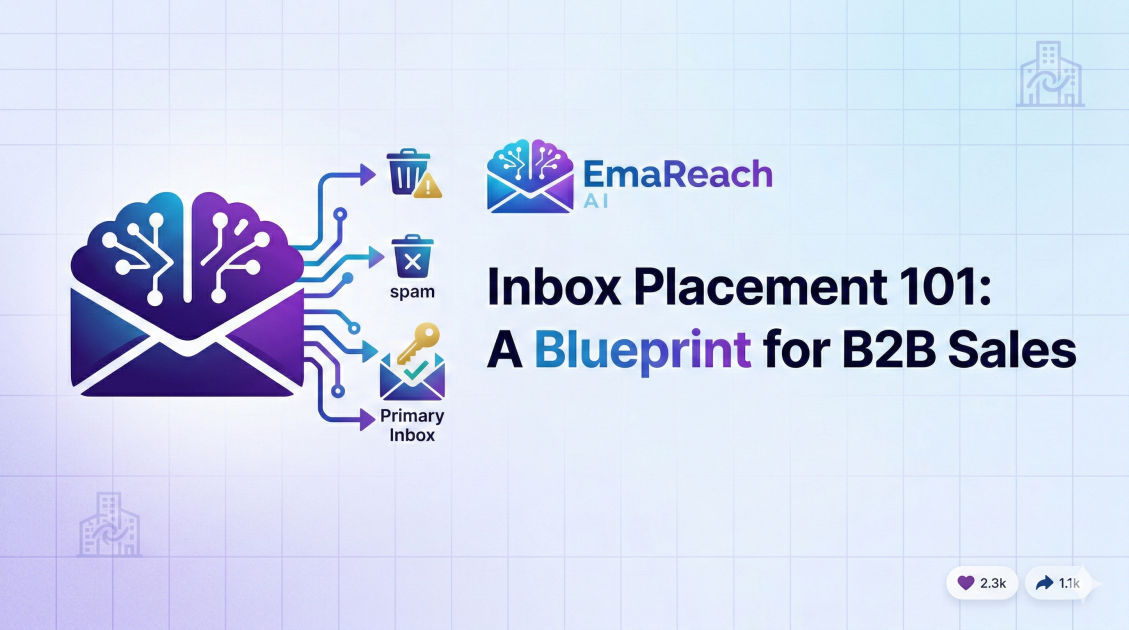
Inbox Placement 101: A Blueprint for B2B Sales
cold emailB2B salesemail deliverabilitysales outreachinbox placementemail marketinglead generation
Introduction to Inbox Placement
In the high-stakes world of B2B sales, your message is only as effective as its ability to be seen. You can craft the most compelling value proposition, offer a revolutionary solution, and target the perfect decision-maker, but if your email lands in the spam folder, it effectively does not exist. This is the challenge of inbox placement—the science and art of ensuring your outreach reaches the primary inbox of your prospect.
Inbox placement is distinct from simple email delivery. A 'delivered' email merely means the receiving server accepted the file; it says nothing about where that file was placed. For B2B sales professionals, the goal is the 'Primary' tab, far away from the 'Promotions' folder or the dreaded 'Spam' junk pile. This blueprint provides a comprehensive guide to mastering the technical, behavioral, and strategic elements required to maintain high deliverability and drive revenue.
The Technical Foundation: Authentication and Infrastructure
Before sending a single sales email, the technical infrastructure must be rock-solid. Mailbox providers (MBPs) like Google and Microsoft use authentication protocols to verify that you are who you say you are. Without these, your domain is viewed as a high-risk entity.
SPF, DKIM, and DMARC
- SPF (Sender Policy Framework): This is a DNS record that lists the IP addresses and domains authorized to send emails on your behalf. It prevents 'spoofing' by telling the recipient's server exactly which sources are legitimate.
- DKIM (DomainKeys Identified Mail): This adds a digital signature to your emails. It ensures that the content of the email hasn't been tampered with during transit. It acts as a seal of integrity for your outbound communications.
- DMARC (Domain-based Message Authentication, Reporting, and Conformance): This protocol uses SPF and DKIM to provide instructions to the receiving server on what to do if an email fails authentication. Setting DMARC to a 'reject' or 'quarantine' policy protects your domain reputation from being tarnished by bad actors.
Custom Tracking Domains
Most sales engagement platforms use shared tracking pixels to monitor opens and clicks. If another user on that shared platform is sending spam, the tracking domain can become blacklisted, dragging your deliverability down with it. Setting up a Custom Tracking Domain (a branded subdomain like link.yourcompany.com) isolates your reputation and signals to filters that you are a sophisticated, legitimate sender.
Domain Reputation: The Credit Score of Email
Your domain reputation is perhaps the most critical factor in inbox placement. Think of it as a credit score for your email sending habits. Once it is damaged, it is incredibly difficult to repair.
Avoiding Blacklists
Blacklists are databases of domains and IP addresses known for sending spam. Being added to a major blacklist like Spamhaus or Barracuda can cause your inbox placement to plummet instantly. To avoid this, you must keep your bounce rate low—ideally under 2%—and ensure you are not hitting 'spam traps' (email addresses maintained by providers specifically to catch reckless senders).
The Importance of Warm-up
When you start a new domain or a new email account, you cannot immediately send hundreds of emails. Doing so triggers red flags for 'burst' behavior common among spammers. You must gradually increase your volume over several weeks. This process, known as 'warming up,' builds trust with ISPs. For those looking to automate this critical phase, EmaReach provides a seamless way to stop landing in spam. EmaReach AI combines AI-written cold outreach with automated inbox warm-up and multi-account sending, ensuring your emails land in the primary tab and get replies.
Crafting Content for the Primary Inbox
Algorithms are increasingly adept at reading the 'intent' of an email. If your copy looks like a mass marketing blast, it will be treated as one.
The 'Spammy' Keyword Trap
Certain words act as triggers for spam filters. While one or two might not hurt, a high density of words like 'Free,' 'Guarantee,' 'Cash,' 'Act Now,' or excessive use of exclamation points and all-caps will trigger defensive filters. In B2B sales, keep your language professional, consultative, and focused on business value rather than hype.
Personalization at Scale
True personalization is more than just using a {first_name} tag. Modern filters look for unique content. If you send 500 identical emails, filters recognize the pattern and may throttle your delivery. By using dynamic snippets that reference a prospect's specific industry, recent company news, or a shared connection, you create unique 'hashes' for each email, making them appear more like 1-to-1 communication.
Engagement: The Ultimate Deliverability Signal
In the modern era of email, engagement is the strongest signal of quality. Mailbox providers monitor how recipients interact with your mail. Positive signals include:
- Opens: While less reliable due to privacy protections, consistent opens still signal relevance.
- Replies: This is the 'gold standard' of engagement. A reply tells the provider that the recipient found the content valuable enough to converse.
- Marking as 'Not Spam': If a user rescues your email from the junk folder, it sends a powerful positive signal to the ISP.
- Forwarding: Sending the email to another colleague indicates high-value content.
Conversely, negative signals like 'Mark as Spam' or 'Delete without Opening' will quickly degrade your reputation. This is why targeting is so important—sending to the wrong person isn't just a waste of time; it’s a risk to your infrastructure.
Data Hygiene and List Management
Your inbox placement strategy is only as good as your data. B2B professionals often fall into the trap of buying 'stale' lists that contain dead emails or abandoned accounts.
Email Verification
Before any campaign goes live, run your list through a verification service. These tools check if the mailbox actually exists without sending a physical email. This prevents 'Hard Bounces,' which are the fastest way to kill your domain reputation.
Managing the Opt-Out
While B2B cold outreach is generally permitted under regulations like GDPR (with legitimate interest) and CAN-SPAM (with an opt-out), you must make it easy for people to leave your list. Ironically, a visible 'Unsubscribe' link can actually improve deliverability because it prevents frustrated prospects from hitting the 'Spam' button—which is far more damaging than a simple opt-out.
Advanced Strategies: Multi-Inbox Sending
As B2B sales organizations scale, they often hit a ceiling with a single email account. Sending 100 emails a day from one account is generally safe; sending 500 is risky. The blueprint for modern B2B growth involves Multi-Inbox Sending.
By distributing your volume across multiple domains and accounts (e.g., user@getcompany.com, user@trycompany.com, user@company.net), you reduce the load on any single point of failure. If one account sees a dip in engagement, your entire sales operation doesn't grind to a halt. This horizontal scaling allows for high-volume outreach while maintaining the 'low and slow' sending patterns that ISPs love.
Monitoring and Maintenance
Inbox placement is not a 'set it and forget it' task. It requires constant vigilance.
- Seed List Testing: Use tools that allow you to send a test email to a 'seed list' of addresses across various providers (Outlook, Gmail, Zoho). This gives you a report on where your email landed before you launch a major campaign.
- Google Postmaster Tools: For those sending to Gmail users, this is an essential, free resource. It provides data on your spam rate, domain reputation, and encryption errors directly from Google's perspective.
- Response Rate Tracking: A sudden drop in response rates is often the first symptom of a deliverability issue. If your metrics fall off a cliff overnight, stop all sending and audit your technical setup.
The Psychology of the Inbox
The final piece of the blueprint is the human element. Even if you land in the primary inbox, you must win the click. This comes down to two things: the Sender Name and the Subject Line.
In B2B, the sender should always be a real person, not a department. 'John at Company' or just 'John Doe' feels more personal than 'Sales Team.' Your subject line should be 'boring' enough to look like an internal work email. Short, non-descript subject lines like 'question,' 'idea for [Company],' or 'feedback' often see the highest placement and open rates because they don't look like marketing material.
Conclusion
Mastering inbox placement is the fundamental prerequisite for B2B sales success. By building a robust technical foundation with SPF, DKIM, and DMARC, maintaining a pristine domain reputation through proper warm-up, and focusing on high-quality, personalized engagement, you turn email into a reliable revenue driver. Remember that deliverability is a marathon, not a sprint. Consistency, data hygiene, and a respect for the recipient's inbox will always outperform high-volume, low-quality tactics. Follow this blueprint, monitor your metrics closely, and ensure that your voice is heard where it matters most: the primary inbox.
EmaReach AI
Ready to scale your cold email outreach?
Join thousands of teams using EmaReach AI for AI-powered campaigns, domain warmup, and 95%+ deliverability. Start free — no credit card required.
Related posts
- Read article
How Choosing the Right Instantly Alternative Changed Our Pipeline Numbers
Discover how transitioning from a volume-first cold email setup to an advanced, deliverability-focused infrastructure transformed our B2B pipeline metrics, skyrocketed open rates to over 68%, and tripled our monthly booked demos.
- Read article
What Makes the Right Instantly Alternative Worth the Migration Effort
Discover why upgrading your cold email infrastructure to the right Instantly alternative can dramatically improve your deliverability, scale your personalization, and future-proof your sales pipeline against strict spam filters.