Blog
Back to blog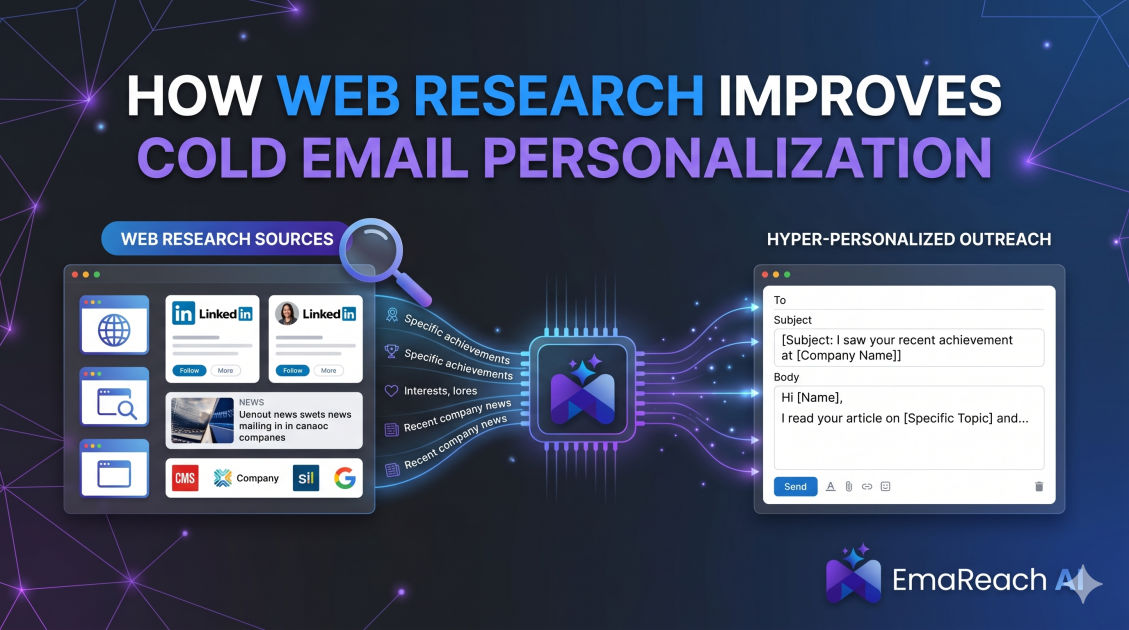
How Web Research Improves Cold Email Personalization
cold emaillead generationsales outreachpersonalizationb2b marketingemail deliverability
Introduction to Modern Personalization
In the current landscape of digital communication, the average professional receives dozens, if not hundreds, of unsolicited emails every week. The barrier to entry for sending a cold email is lower than it has ever been, which has led to a saturated market where generic templates are immediately recognized and discarded. To stand out, a sender must move beyond the superficial 'Hi [First_Name]' approach. True resonance in a crowded inbox is achieved through deep, meaningful personalization that proves the sender has done their homework. This is where comprehensive web research becomes the foundation of successful outreach.
Web research is the process of gathering contextual data about a prospect and their company from publicly available digital sources. It transforms a cold lead into a warm conversation by providing the specific triggers, pain points, and recent achievements that allow a sender to craft a message that feels bespoke. When done correctly, web research doesn't just improve open rates; it builds trust from the very first sentence.
The Evolution of the Cold Email
Historically, cold emailing was a numbers game—a brute-force method where high volume compensated for low relevance. However, as email service providers (ESPs) have become more sophisticated in their filtering algorithms, the 'spray and pray' method has become a liability. Sending irrelevant content at high volumes is a fast track to the spam folder.
Modern outreach demands a strategic shift toward quality over quantity. Personalization is no longer a 'nice-to-have' feature; it is a fundamental requirement for deliverability and engagement. By leveraging web research, marketers and sales professionals can align their value proposition with the current reality of the prospect’s business. This alignment is what separates a nuisance email from a valuable business inquiry.
Why Web Research is the Backbone of Personalization
Personalization without research is just guesswork. Web research provides the empirical evidence needed to justify why you are reaching out to a specific person at a specific time. It allows you to move through three distinct levels of personalization:
- Individual Level: Understanding the person's career path, recent promotions, or content they have shared.
- Company Level: Identifying recent funding rounds, product launches, or shifts in corporate strategy.
- Industry Level: Recognizing broader trends or regulatory changes affecting the prospect’s niche.
By synthesizing information from these three levels, your cold email becomes a diagnostic tool rather than a generic sales pitch. You aren't just selling a product; you are offering a solution to a verified problem.
Sources for Deep Web Research
To conduct effective research, one must know where to look. The internet offers a wealth of data if you know how to navigate its various layers.
Professional Networking Sites
Platforms like LinkedIn are gold mines for individual-level data. Beyond just job titles, look for the 'About' section to understand how a prospect describes their own goals. Check their 'Activity' feed to see what topics they care about or what posts they have recently commented on. If a prospect recently shared an article about the challenges of remote team management, mentioning that article in your email shows a level of attention that most senders ignore.
Company Newsrooms and Press Releases
Large and mid-sized companies often maintain a newsroom on their website. Press releases are an official record of what the company considers a priority. Whether it’s an expansion into a new territory or a strategic partnership, these events provide excellent 'hooks' for your outreach. Acknowledge these milestones to demonstrate that you are keeping pace with their growth.
Financial Reports and Earnings Calls
For publicly traded companies, quarterly reports and transcripts of earnings calls are invaluable. These documents reveal the high-level objectives and obstacles discussed by the C-suite. If a CEO mentions that 'reducing operational churn' is a top priority for the fiscal year, and your service helps with retention, you have a direct line to their current pain point.
Industry-Specific Forums and Communities
Communities like Reddit, Quora, or niche-specific Slack groups can provide insight into the common complaints and questions within an industry. Understanding the 'language' of the community allows you to write copy that feels authentic and informed.
Identifying Relevant 'Hooks' Through Research
A 'hook' is the specific piece of information that bridges the gap between your research and your message. Not all information is created equal; the best hooks are those that imply a need for your solution.
- The Recent Achievement Hook: 'I saw your team recently won the [Award Name]. Congratulations on that milestone.'
- The Shared Content Hook: 'Your recent article on [Topic] really changed how I think about [Related Subject].'
- The Growth Hook: 'I noticed [Company] is hiring heavily for your engineering department. Scaling that quickly often brings unique challenges with [Problem].'
Synthesizing Data into High-Conversion Copy
Once the research is gathered, the challenge lies in weaving it into the email naturally. Forced personalization can feel creepy or 'bot-like.' The goal is to show relevance, not just to prove you found their profile.
Instead of saying, 'I see you went to [University],' which is a low-value data point, try, 'I noticed your company is transitioning toward [Specific Technology], which is exactly what we helped [Competitor] navigate last year.' The latter shows industry competence and a direct value add.
The Importance of Infrastructure
While deep research prepares your content, your technical setup determines if that content is ever seen. This is where professional tools become essential. Stop Landing in Spam. Cold Emails That Reach the Inbox. EmaReach AI combines AI-written cold outreach with inbox warm-up and multi-account sending—so your emails land in the primary tab and get replies. Even the best-researched email will fail if it is blocked by a spam filter. By using a platform that manages deliverability, you ensure that your personalized messages actually reach the human on the other side.
Scaling Personalization Without Losing Quality
A common objection to deep research is that it isn't scalable. It is true that manually researching every prospect takes time, but the ROI on highly personalized emails is significantly higher than on generic ones. The key is to find the 'Goldilocks Zone' of research—enough to be relevant, but not so much that you spend an hour on a single lead.
Using Frameworks for Efficiency
Create a research checklist to standardize the process. Spend 5-10 minutes per high-value lead looking for three specific things: a recent professional win, a company-wide initiative, and a specific pain point mentioned in their industry.
For lower-tier leads, you can use 'bucketed' personalization. This involves researching a specific segment (e.g., Marketing Managers in the SaaS space) and identifying a universal challenge they are currently facing. This allows you to write a message that feels deeply personal to the group, even if it isn't unique to the individual.
The Role of AI in Web Research
Artificial Intelligence is revolutionizing how we conduct web research. AI tools can now scan thousands of data points across the web and summarize them into actionable insights. This significantly reduces the manual labor involved in personalization. AI can identify the most relevant LinkedIn posts, summarize news articles, and even suggest the best 'hook' based on the data it finds.
However, AI should be a co-pilot, not the sole pilot. Human oversight is necessary to ensure that the personalization feels genuine and that the tone aligns with the brand’s voice. Combining the speed of AI with human empathy creates a powerful outreach engine.
Common Pitfalls to Avoid in Personalization
Research-driven personalization is an art. If done poorly, it can backfire. Here are common mistakes to avoid:
- The 'Private Investigator' Trap: Mentioning details that are too personal or not publicly intended for professional use (like photos of their family from a private social media account) can make prospects uncomfortable.
- The Fake Compliment: Giving a generic compliment that clearly wasn't earned (e.g., 'I love your website' when the website hasn't been updated in years) destroys credibility.
- The Information Overload: Including too many research points can make the email cluttered. Stick to one or two strong hooks that lead directly into your value proposition.
- Misinterpreting the Data: Ensure you understand the context of the information you find. Congratulating someone on a 'merger' that was actually a hostile takeover is a sure way to get blocked.
Measuring the Success of Personalization
To understand the impact of your web research, you must track more than just open rates. While personalization often increases open rates, its true value is reflected in:
- Positive Reply Rate: Are people responding with interest, or just telling you to stop emailing them?
- Meeting Booked Rate: Does the personalization lead to actual sales conversations?
- Sales Cycle Length: Do highly personalized leads move through the funnel faster because of the initial trust established?
By monitoring these metrics, you can refine your research process and focus on the data points that yield the highest conversion.
Conclusion
Web research is the engine that drives high-performance cold email outreach. It transforms the cold email from a disruptive digital flyer into a strategic business communication. By investing time into understanding the prospect’s world—their successes, their challenges, and their industry context—you position yourself as a partner rather than a vendor.
In a world where automation is often used to cut corners, those who use it to deepen their research will always have the advantage. Successful outreach is about building relationships, and every strong relationship begins with showing the other person that you truly understand their needs. Combine deep research with a robust sending infrastructure, and you have a recipe for consistent, scalable growth.
EmaReach AI
Ready to scale your cold email outreach?
Join thousands of teams using EmaReach AI for AI-powered campaigns, domain warmup, and 95%+ deliverability. Start free — no credit card required.
Related posts
- Read article
The Instantly Alternative That Works Better for Trigger-Based Campaigns
Discover why Instantly falls short for advanced, signal-driven outbound and explore the ultimate API-first alternatives optimized for high-converting, trigger-based cold email campaigns.
- Read article
The Instantly Alternative That Handles High Bounce Rates Without Panic
Discover how transitioning to an advanced Instantly alternative can safeguard your cold email infrastructure. Learn to handle high bounce rates effortlessly using real-time verification, smart mailbox rotation, and automated safety nets to protect your sender reputation and maintain consistent primary inbox placement.