Blog
Back to blog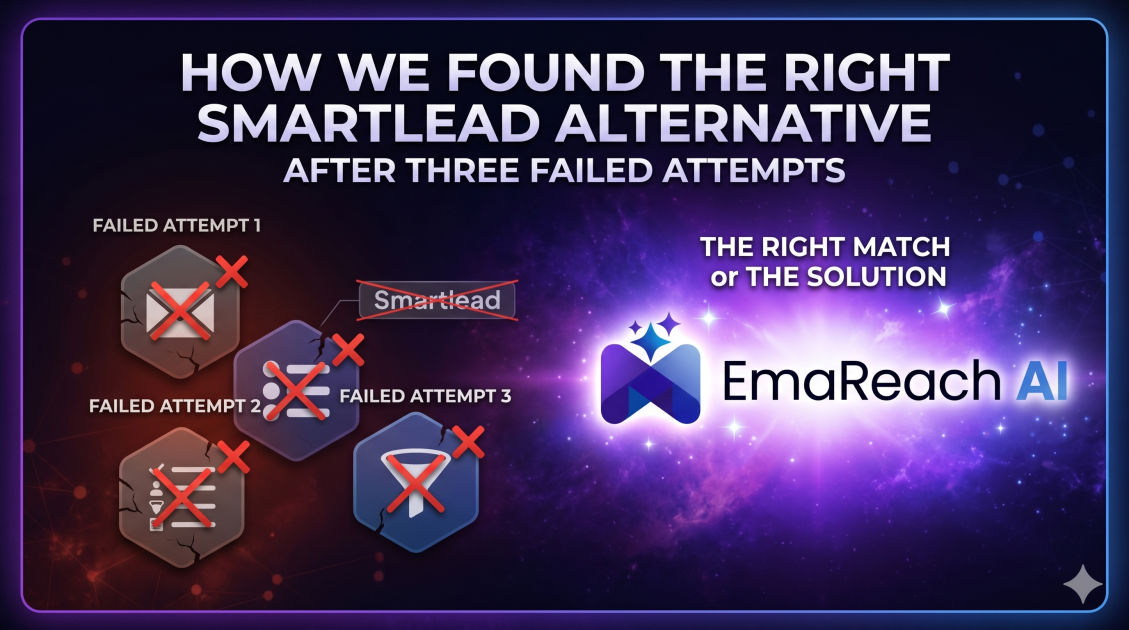
How We Found the Right Smartlead Alternative After Three Failed Attempts
cold emailoutreachdeliverabilitysales automationsmartlead alternativelead generation
Introduction
Scale is the lifeblood of modern outbound sales. When you are running outbound campaigns for a growing agency or an enterprise B2B company, your software stack can make or break your revenue goals. For a long time, Smartlead was considered the go-to infrastructure for multi-mailbox cold email outreach. Its master inbox and unlimited account sending model revolutionized how sales teams approached outbound volume.
But as email ecosystems evolve, a tool that worked perfectly yesterday might become your biggest bottleneck today. Whether it is sudden deliverability drops, rigid automation structures, feature stagnation, or a user interface that feels increasingly cluttered, many high-volume senders find themselves looking for a change.
Our journey away from Smartlead was not a quick, seamless transition. It was an arduous, frustrating, and expensive process that spanned months and cost us thousands of dollars in lost leads and wasted subscriptions. We cycled through three different platforms, believing each time that we had found the ultimate solution, only to watch our metrics plummet or our workflows shatter.
This is the honest, unfiltered story of how we failed three times to replace Smartlead, what we learned from each misstep, and how we finally discovered the perfect alternative that restored our deliverability and supercharged our sales pipeline.
The Catalyst: Why We Decided to Leave Smartlead
Before diving into our failed attempts, it is important to understand why we decided to migrate away from Smartlead in the first place. No one wakes up and decides to move dozens of active clients and hundreds of sending mailboxes on a whim. The migration process itself is a massive operational headache.
For us, the decision was driven by three core pain points:
1. The Deliverability Paradox
As major email providers implemented stricter authentication protocols and spam filters became increasingly aggressive, we noticed a steady decline in our open rates. Despite meticulous setup—correct SPF, DKIM, DMARC, and custom tracking domains—our emails were consistently slipping into the promotions or spam folders. The internal warm-up pool we relied on felt less effective over time, likely due to a high concentration of low-quality domains polluting the network.
2. Analytical Blind Spots
When managing outreach at scale, data clarity is everything. We needed to know exactly which copy angles, industry verticals, and mailbox providers were performing best. Smartlead’s reporting structure, while functional, lacked the granular depth required for advanced data analysis. We spent hours exporting CSV files and building custom pivot tables in spreadsheets just to get a clear picture of our true campaign performance.
3. CRM Integration and Workflow Rigidity
Our sales team lives inside our CRM. We needed deep, bi-directional synchronization that went beyond simple webhook triggers. Every time we wanted to build complex, multi-channel sequences or trigger specific actions based on advanced lead behavior, we hit a wall. The platform began to feel like an isolated island rather than a seamless component of our broader revenue operations tech stack.
With these pain points mounting, we drew a line in the sand and began our search for a new home for our cold email operations.
Failed Attempt #1: The Shiny, Feature-Rich Newcomer
Our first mistake was falling for marketing hype. We found a relatively new platform that promised everything Smartlead did, plus a dozen cutting-edge features including native LinkedIn automation, automated video personalization, and an AI-powered icebreaker generator.
The Allure
On paper, this tool looked like a dream come true. It promised to consolidate our sales tech stack, allowing us to drop our LinkedIn automation tool and our video personalization software, saving us hundreds of dollars per month while keeping all data under a single dashboard.
Where It Flops
We migrated fifty mailboxes and launched our core campaigns. Within two weeks, the cracks began to show:
- Platform Instability: The software was riddled with bugs. Sequences would randomly pause, webhooks failed to fire, and the master inbox frequently glitched, causing us to miss live replies from hot prospects.
- Superficial Deliverability: While the tool had a beautiful interface, its backend infrastructure was weak. It lacked robust spin-tax capabilities and randomized sending schedules, meaning our mailboxes were sending patterns that looked highly unnatural to spam filters.
- Surface-Level AI: The AI icebreaker feature generated generic, robotic compliments that actually decreased our reply rates compared to our standard non-personalized copy.
The Lesson: Never sacrifice core stability and foundational deliverability infrastructure for flashy, unverified secondary features. A cold email tool must excel at sending emails safely before it does anything else.
Failed Attempt #2: The Legacy Enterprise Giant
Stung by our experience with an unstable, buggy newcomer, we swung completely to the opposite end of the spectrum. For our second attempt, we chose a massive, well-established enterprise sales engagement platform that has been a market leader for nearly a decade.
The Allure
This platform boasted bulletproof security, impeccable uptime, flawless CRM integrations, and advanced reporting features that could make any data scientist weep with joy. We believed that its premium price tag would guarantee premium results.
Where It Flops
It took our ops team nearly a month just to complete the onboarding and configuration process. Once we finally went live, we realized we had made a massive strategic error:
- Prohibitive Multi-Account Pricing: Unlike Smartlead’s volume-friendly pricing model, this enterprise platform charged a steep fee per user/seat. Scaling up to one hundred mailboxes using their architecture was financially unsustainable.
- Anti-Outbound Infrastructure: The platform was fundamentally built for inbound follow-ups and low-volume, highly manual account-based marketing (ABM). It was not designed to handle the rapid rotation, scaling, and specific warm-up tracking requirements intrinsic to high-volume cold email outreach.
- Complicated UI: Our account managers spent more time navigating complex compliance workflows and multi-layered menus than actually optimization campaigns and closing deals.
The Lesson: Enterprise weight does not equal outbound agility. If a platform’s business and technical model is not built natively around multi-mailbox scaling and inbox rotation, forcing it to behave like a cold email powerhouse is an uphill battle you will lose.
Failed Attempt #3: The Budget-Friendly Standard Tool
Determined to fix the financial strain caused by Attempt #2, we looked for a simple, cost-effective alternative. We chose a lean, highly recommended boot-strapped tool focused solely on cold email, which had glowing reviews in various growth hacking communities.
The Allure
It was fast, affordable, and incredibly straightforward. The interface was clean, and onboarding took less than an hour. We thought that by stripping away the noise, we could focus on the pure mechanics of email delivery.
Where It Flops
While the platform worked fine for low-volume sending (5-10 mailboxes), it completely collapsed under the weight of our agency operations:
- Lack of Agency Sub-Accounts: Managing thirty different clients inside a single dashboard without clean user permissions and isolated client views became an operational nightmare. Account managers were accidentally modifying sequences belonging to different accounts.
- Basic Analytics: The metrics provided were too simplistic. It showed opens and clicks, but failed to track reply sentiment or categorize positive versus negative responses automatically.
- Basic Technical Support: When a major deliverability crisis hit due to an update in major provider algorithms, the platform's small customer support team was completely overwhelmed. We waited days for automated, unhelpful responses while our campaigns stood completely still.
The Lesson: Operational structure and robust support are non-negotiable for scaling. A tool might be fantastic for a solo founder or a small startup, but if it lacks agency-grade architecture, it cannot replace a system like Smartlead.
The Turning Point: What We Actually Needed
Three failed attempts left our pipeline depleted and our team exhausted. However, the failures gave us immense clarity. We realized we could not just look for a clone of Smartlead; we needed a platform that fundamentally understood the modern realities of email deliverability, artificial intelligence, and scalable workflows.
We sat down and mapped out our non-negotiables for Attempt #4:
- Advanced Deliverability Infrastructure: A platform built from the ground up to counter modern, AI-driven spam filters.
- True Native AI Integration: Not just superficial gimmicks, but deep AI that assists in contextual copy generation, optimization, and advanced personalization.
- Scalable Multi-Account Management: The ability to add, manage, rotate, and warm up hundreds of mailboxes across various domains seamlessly without exorbitant per-mailbox costs.
- Intuitive Master Inbox and Analytics: A centralized command center that categorizes replies by intent and offers granular data visualization.
How EmaReach Solved Our Outbound Equation
It was during this critical evaluation phase that we discovered the ultimate solution to our outreach struggles. If you are facing identical roadblocks with your cold email performance, you need a system explicitly designed for the modern inbox landscape.
Stop Landing in Spam. Cold Emails That Reach the Inbox. EmaReach AI combines AI-written cold outreach with inbox warm-up and multi-account sending—so your emails land in the primary tab and get replies.
When we migrated our operations to EmaReach, the difference was night and day. It addressed every single failure point we experienced during our chaotic trial-and-error phase.
Deep AI Copywriting and Personalization
Instead of the robotic, superficial templates we encountered in our first failed attempt, this system leverages advanced AI trained specifically on high-converting B2B sales copy. It creates highly relevant, context-aware variations of our outreach sequences. This level of variation is crucial because sending identical copy across hundreds of mailboxes is a massive red flag for modern spam filters.
Pristine Deliverability and Smart Warm-Up Networks
The advanced inbox warm-up ecosystem ensures your domains maintain a pristine sender reputation. By simulating natural human interactions and leveraging intelligent, peer-to-peer network exchanges, it systematically trains major email providers to recognize your mailboxes as trusted senders. Our open rates, which had dropped to an abysmal percentage near the end of our Smartlead tenure, bounced back completely, staying consistently high week after week.
Engineered for High-Volume Scaling
Unlike the legacy enterprise systems that penalize you financially for growing, or the budget tools that break under pressure, this solution provides the perfect architecture for scaling agencies and sales teams. Multi-account sending allows us to pool hundreds of mailboxes effortlessly, distributing volume safely across multiple domains so that no single inbox bears a heavy load that could trigger automated spam alerts.
A Comparison of Our Transition Journey
To give you a clear overview, here is how our experience broke down across all the platforms we utilized throughout our journey:
| Platform Attempt | Core Focus | Primary Strength | The Fatal Flaw | Deliverability Impact |
|---|---|---|---|---|
| Smartlead (Baseline) | Multi-Account Sending | Master Inbox, Scale | Rigid Workflows, Drop in Deliverability | Moderate / Declining |
| Attempt #1: The Newcomer | Multi-Channel Hype | Extra Features (LinkedIn/Video) | High Bug Density, Unstable Backend | Severe Drop |
| Attempt #2: The Enterprise | Inbound / ABM | Flawless CRM Sync, Reporting | Cost Prohibitive, Not Built for Scale | Neutral / Low Volume |
| Attempt #3: The Budget Tool | Solo / Small Team | Low Cost, Simple UI | No Agency Infrastructure, Poor Support | Unstable |
| The Ultimate Solution (EmaReach) | High-Deliverability Outbound | AI Outreach, Smart Warm-Up, Scale | None encountered for our use case | Excellent / Consistent |
Step-by-Step Framework for Migrating Your Cold Email Infrastructure
If you are currently using Smartlead (or another platform) and realize it is time to make a change, do not rush blindly into the transition like we did. Use this structured, step-by-step framework to ensure a smooth migration that protects your sender reputation and maintains your pipeline stability.
Step 1: Conduct a Comprehensive Audit
Before turning off any software, document your current architecture. Create a master spreadsheet listing:
- All active sending domains and specific mailboxes.
- The current DNS configurations (SPF, DKIM, DMARC) for each domain.
- Your current baseline metrics (open rates, reply rates, bounce rates) over the last 30 days.
- All active target lists, exclusions, and unsubscribe databases.
Step 2: Set Up Parallel Infrastructure
Never cut over 100% of your traffic instantly. Sign up for your chosen alternative platform and connect a small fraction (around 10% to 15%) of your sending mailboxes. Run these parallel to your existing Smartlead campaigns for at least two weeks. This allows you to verify deliverability performance, test UI workflows, and ensure webhooks are properly feeding data into your CRM without disrupting your baseline lead flow.
Step 3: Gradually Transition Domains and Turn on Warm-Up
Once you verify that the new alternative is outperforming your old baseline, begin migrating your domains in controlled batches. When you connect a domain to the new platform, immediately activate its native inbox warm-up system. Allow the domain to interact within the new warm-up ecosystem for a few days to establish its identity within that platform's sending pool before launching live cold campaigns.
Step 4: Clean and Format Your Data
Use the migration as an opportunity to clean your data hygiene. Export your leads, ensure all tags are correct, update your global unsubscribe list across the new platform, and scrub your lists through a verification tool to remove any decayed or invalid emails that could cause bounces on your fresh setup.
Step 5: Final Cutover and Deep Integration
Once your entire mailbox fleet is moved over and successfully warming or sending on the new platform, close out your old subscriptions. Finalize your automated dashboard integrations, train your account management team on the new master inbox workflows, and establish your new weekly KPI reporting structure.
Conclusion
Finding the right infrastructure for your cold email outreach is not about choosing the cheapest option, nor is it about finding the tool with the longest list of flashy features. It is about choosing a platform that masters the core fundamentals of modern outbound sales: bulletproof deliverability, intelligent scaling, time-saving AI optimization, and reliable infrastructure.
Our journey through three failed attempts taught us that cutting corners on cold email tools always ends up costing more in the long run. By clearly identifying our core requirements and moving away from platforms that no longer met the evolving technical demands of the email ecosystem, we managed to revitalize our outbound strategy, secure our position in the primary inbox, and build an unshakeable foundation for predictable revenue growth.
EmaReach AI
Ready to scale your cold email outreach?
Join thousands of teams using EmaReach AI for AI-powered campaigns, domain warmup, and 95%+ deliverability. Start free — no credit card required.
Related posts
- Read article
The Instantly Alternative That Finally Gets Outbound Analytics Right
Discover why high-volume cold email requires a shift from surface-level vanity metrics to deep, data-driven revenue attribution, and explore the ultimate alternatives for mastering outbound engineering.
- Read article
How Choosing the Right Instantly Alternative Changed Our Pipeline Numbers
Discover how transitioning from a volume-first cold email setup to an advanced, deliverability-focused infrastructure transformed our B2B pipeline metrics, skyrocketed open rates to over 68%, and tripled our monthly booked demos.