Blog
Back to blog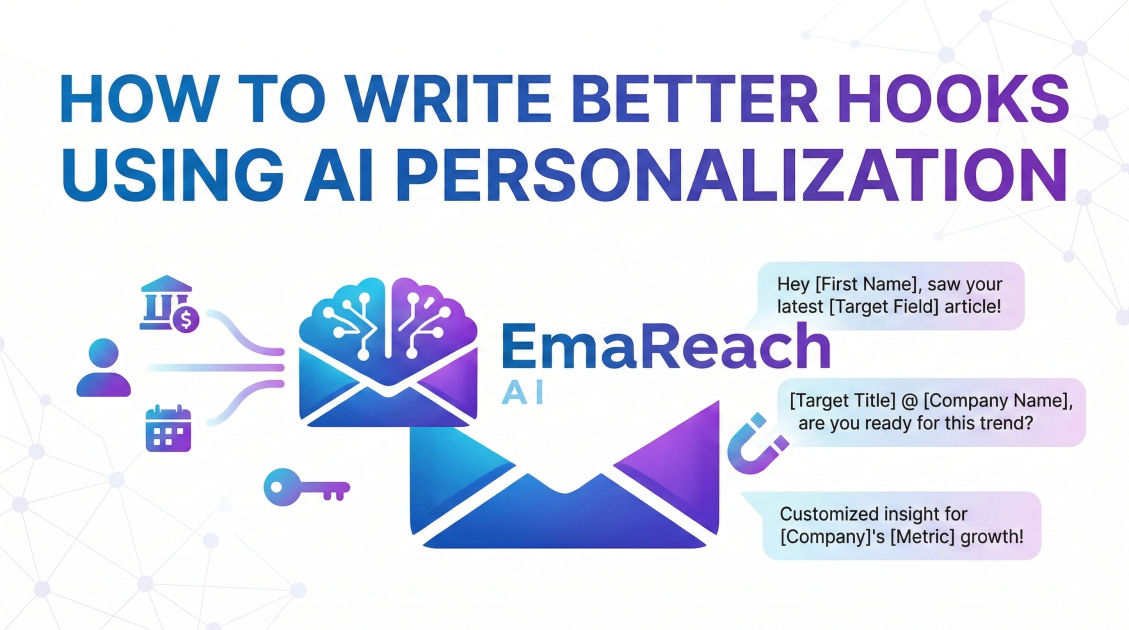
How to Write Better Hooks Using AI Personalization
AI PersonalizationCold OutreachEmail MarketingCopywritingLead GenerationSales Strategy
The Evolution of the First Impression
In the digital age, the window to capture an audience's attention has shrunk from seconds to milliseconds. Whether it is an email, a LinkedIn message, or a blog post, the "hook"—that very first sentence—carries the heavy burden of determining whether the recipient continues reading or hits the delete key. Traditional copywriting relied on broad emotional triggers, but today’s audience is fatigued by generic templates. The solution lies in AI personalization.
Using AI to craft hooks isn't just about inserting a [First_Name] tag; it is about leveraging data to create a bridge between your message and the recipient's current reality. By analyzing social signals, company news, and individual achievements, AI allows for a level of hyper-personalization that was previously impossible at scale. This guide explores the deep mechanics of using AI to write hooks that don't just get read, but get remembered.
Why Most Hooks Fail in the Modern Inbox
Before diving into the AI-driven solutions, we must understand the anatomy of a failing hook. Most outreach fails because it is self-centric. It starts with "I am writing to..." or "My company does..." This immediately signals to the reader that the sender's needs come before their own.
Another common pitfall is the pseudo-personalization trap. This is when an automated system pulls a generic piece of data—like a job title—and weaves it into a sentence that feels clinical. Readers have developed a "sixth sense" for these patterns. They know when a bot is simply filling in the blanks. To break through this barrier, the hook must demonstrate genuine research and contextual relevance.
The Architecture of an AI-Powered Personalized Hook
A high-performing hook built with AI typically follows a three-part structure:
- The Observation: A specific fact about the recipient (e.g., a recent podcast appearance, a LinkedIn post, or a company milestone).
- The Insight: A logical connection between that observation and a broader industry trend or challenge.
- The Pivot: A seamless transition into the value proposition of your message.
AI excels at the first two stages. Large Language Models (LLMs) can process thousands of data points from a LinkedIn profile or a company’s annual report to find the one "nugget" that feels personal. When you use tools like EmaReach, you are essentially giving your outreach a brain that can scan the web to ensure your emails land in the primary tab with a message that feels hand-written.
The Role of Social Listening
AI personalization starts with data ingestion. AI can monitor social media platforms to identify what your prospects are talking about now. If a CTO posts about the challenges of migrating to a serverless architecture, an AI-powered hook would reference that specific pain point.
Instead of: "I see you are the CTO at TechCorp."
AI-Enhanced Hook: "Your recent point about the hidden latencies in serverless migrations really resonated—it seems like a hurdle many are ignoring right now."
Advanced Strategies for AI Personalization
To write truly better hooks, you need to move beyond the surface. Here are the advanced strategies that separate top-tier performers from the rest.
1. Sentiment-Based Hooks
AI can analyze the sentiment of a prospect's recent content. Are they frustrated with a current industry regulation? Are they celebrating a new funding round? By matching the sentiment of your hook to the recipient's current state of mind, you create instant rapport.
If the AI detects a celebratory tone from a recent award announcement, the hook should be high-energy and congratulatory. If the tone is more reflective or academic, the hook should be intellectual and inquisitive.
2. The "Common Ground" Algorithm
One of the most effective psychological triggers is the "In-Group" bias. AI can scan for shared connections, mutual alma maters, or even shared interests mentioned in obscure interviews. Highlighting a shared experience in the first line creates an immediate sense of trust. AI can find these connections across vast databases much faster than a human researcher could.
3. Hyper-Contextual Company News
Generic hooks often mention "congrats on the growth." Better hooks mention the specific reason for the growth. AI can parse through press releases to identify a new product launch or a strategic partnership.
"Saw the news about your partnership with the Global Green Initiative—it’s rare to see a logistics firm pivot toward sustainability that aggressively."
This shows the reader that you haven't just looked at their website; you understand their strategic direction.
Fine-Tuning the AI Output
While AI is powerful, it requires human oversight to ensure the "voice" remains authentic. The goal of AI personalization is to remove the mechanical labor of research, not the human element of communication.
Avoiding the "Uncanny Valley"
The "Uncanny Valley" in AI writing refers to content that is almost human but feels slightly off, creating a sense of unease. To avoid this in your hooks, ensure the AI is programmed to use natural syntax. Avoid overly formal language or excessive use of adjectives. A good hook should sound like something you would say to a colleague over coffee.
Balancing Specificity and Privacy
There is a fine line between being personalized and being intrusive. AI can find a lot of information, but mentioning a prospect’s personal family vacation (even if it was posted publicly) can feel like a breach of professional boundaries. Focus the AI on professional achievements, public opinions, and corporate data to stay on the right side of the "creepiness" scale.
Integrating AI Personalization into Your Workflow
To implement this at scale, you need a system that connects data sources to your delivery engine. This is where the synergy between AI writing and deliverability becomes crucial. If you write the perfect hook but your email ends up in the spam folder, the effort is wasted.
EmaReach helps solve this by combining AI-written cold outreach with inbox warm-up. This ensures that the hyper-personalized hooks you’ve crafted actually reach the primary tab, where they have the chance to convert. By using multi-account sending, you can scale these personalized interactions without risking the reputation of your main domain.
A/B Testing Your AI Hooks
One of the greatest advantages of AI is the ability to generate multiple variations of a hook instantly. You should always be testing different personalization angles:
- Test A: Personalization based on a LinkedIn post.
- Test B: Personalization based on a company news article.
- Test C: Personalization based on a shared professional interest.
By analyzing which hook type yields the highest reply rate, you can refine your AI prompts to favor the most effective data sources for your specific industry.
The Psychology of the Hook: Why Personalization Works
At its core, a personalized hook works because of the Reciprocity Principle. When a recipient sees that you have invested time (or used sophisticated tools to simulate that investment) to understand their world, they feel a subconscious obligation to acknowledge that effort.
Furthermore, personalization triggers the Cocktail Party Effect. This is the phenomenon where the brain can tune out a noisy room but immediately snap to attention when it hears its own name or a topic of personal relevance. In a crowded inbox, a personalized hook acts as that signal through the noise.
Creating Urgency Without Pressure
AI can also help tailor the urgency of a hook. Instead of using fake scarcity ("Only 2 spots left!"), AI can identify real-world triggers that create natural urgency. For example, if a company is hiring for a specific role, it implies they have a problem that needs solving. A hook referencing that specific job opening creates relevance and urgency simultaneously.
"Noticed you’re looking for a new Head of Growth—usually that means the existing systems are hitting a ceiling, which is exactly why I’m reaching out."
Future Trends in AI Personalization
As AI models become more sophisticated, we will see a move toward Multi-Modal Personalization. This involves hooks that reference not just text, but images or videos the prospect has engaged with. AI will be able to summarize a 20-minute video interview into a single, punchy opening sentence that captures the essence of the prospect's message.
We will also see Predictive Personalization. Based on historical data, AI will be able to predict what type of hook a specific persona is most likely to respond to. For example, a CFO might prefer a hook based on ROI data, while a Creative Director might prefer a hook based on a recent portfolio piece.
Actionable Steps to Improve Your Hooks Today
- Define Your Data Sources: Identify where your best prospects leave their digital footprints. Is it LinkedIn, Twitter, industry forums, or company blogs?
- Clean Your Data: AI is only as good as the input. Ensure your CRM data is clean before feeding it into an AI personalization engine.
- Prompt Engineering: Focus on teaching your AI to be concise. A hook should rarely be more than two sentences. The goal is to open the door, not walk through it yet.
- Monitor Deliverability: Use a specialized service to ensure your personalized messages are actually reaching the inbox. Technical setup is just as important as the copy.
- Iterate Constantly: The digital landscape changes rapidly. What worked six months ago might be ignored today. Use AI to keep your hooks fresh and relevant.
Conclusion
Writing better hooks is no longer a matter of creative genius alone; it is a matter of leveraging technology to show your audience that you see them, you understand them, and you value their time. AI personalization allows you to scale the "human touch," turning cold outreach into warm conversations. By focusing on specific observations, genuine insights, and seamless transitions, you can transform your opening lines from ignored text into powerful keys that unlock new professional opportunities. The future of communication is personalized, and AI is the engine that makes it possible.
EmaReach AI
Ready to scale your cold email outreach?
Join thousands of teams using EmaReach AI for AI-powered campaigns, domain warmup, and 95%+ deliverability. Start free — no credit card required.
Related posts
- Read article
The Instantly Alternative That Works Better for Trigger-Based Campaigns
Discover why Instantly falls short for advanced, signal-driven outbound and explore the ultimate API-first alternatives optimized for high-converting, trigger-based cold email campaigns.
- Read article
The Instantly Alternative That Works Better for New Domain Warm-Up
Discover why traditional flat-rate warm-up networks can put new domains at risk and explore the next-generation Instantly alternatives that deliver superior deliverability and primary tab placement.