Blog
Back to blog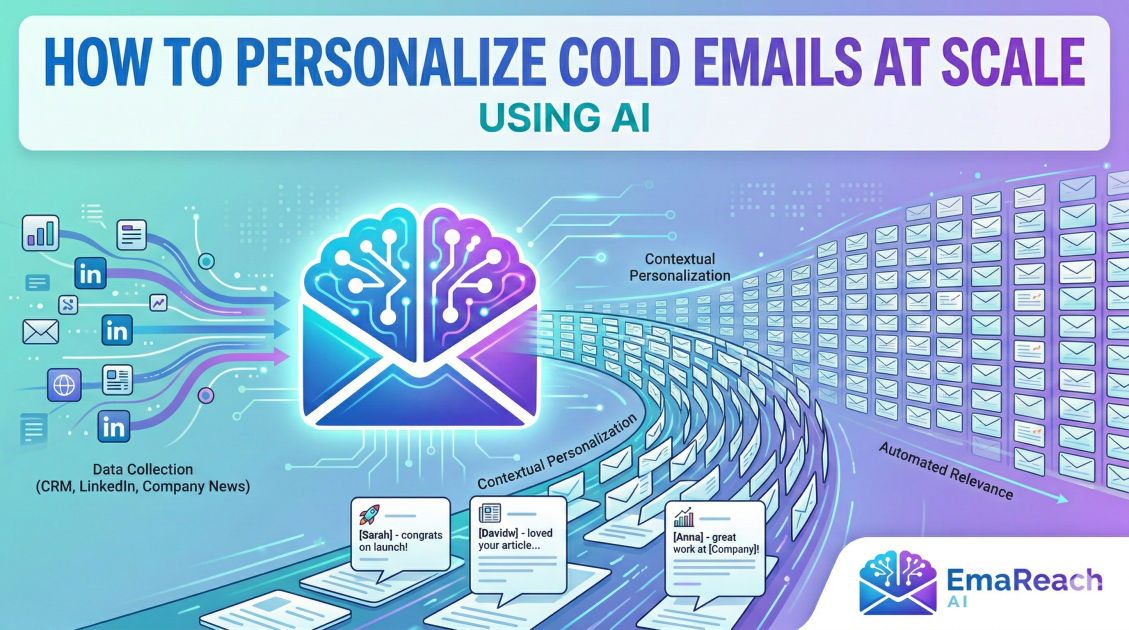
How to Personalize Cold Emails at Scale Using AI
cold emailAI marketingsales automationlead generationemail deliverabilitypersonalization
The New Era of Cold Outreach: Personalization at Scale
In the competitive landscape of modern sales and business development, the traditional 'spray and pray' method of cold emailing is not just ineffective; it is actively damaging to your brand’s reputation and your domain’s deliverability. Decision-makers are inundated with hundreds of generic emails daily. To stand out, your message must resonate instantly. This is where personalization becomes the ultimate differentiator.
Historically, personalization was a manual, labor-intensive process. A salesperson would spend fifteen minutes researching a prospect’s LinkedIn profile, reading their recent articles, or watching their interviews just to write a single compelling opening line. While effective, this approach does not scale. If you need to reach thousands of prospects, manual research is impossible.
Enter Artificial Intelligence. AI has bridged the gap between the high conversion rates of 1-to-1 manual outreach and the high volume of automated sequences. By leveraging Large Language Models (LLMs) and data scraping, businesses can now synthesize unique, highly relevant insights for every single recipient in their database.
The Psychology of Why Personalization Works
Before diving into the technical 'how,' it is crucial to understand the 'why.' Humans are biologically wired to pay attention to information that is relevant to them. This is often referred to as the 'cocktail party effect'—the ability to focus one's auditory attention on a particular stimulus while filtering out a range of other stimuli, such as hearing one's name in a noisy room.
When a prospect sees a cold email that mentions a specific challenge their company is facing, a recent promotion they received, or a niche interest they shared online, their brain moves from a state of 'ignore/delete' to 'curiosity.' AI-driven personalization allows you to trigger this psychological response at scale, making the recipient feel like you have done your homework, which builds immediate rapport and professional trust.
Step 1: Data Enrichment—The Foundation of AI Personalization
AI is only as good as the data you feed it. To personalize at scale, you need more than just a name and a company. You need 'intent signals' and 'contextual data.'
Identifying Key Data Points
To build a personalized campaign, you should gather data across several dimensions:
- Professional Milestones: Recent promotions, company anniversaries, or new job starts.
- Company News: Mergers and acquisitions, funding rounds, new product launches, or quarterly earnings reports.
- Content Consumption/Creation: Recent LinkedIn posts, podcast appearances, or blog articles authored by the prospect.
- Technographic Data: The specific software stack the company uses (e.g., knowing they use Salesforce vs. HubSpot).
Using AI to Scrape and Clean Data
Modern AI tools can browse the live web to find these nuggets of information. Instead of a static CSV file, your lead list becomes a living dataset. AI can take a raw LinkedIn URL and extract the last three posts a person made, summarizing their core themes. This data serves as the 'prompt engineering' fuel for your email generation.
Step 2: Architecting the AI Prompt for Email Generation
Once you have enriched data, the next step is using an AI model to draft the personalized elements of the email. The most effective way to do this is not to ask the AI to write the entire email, but to write a 'Personalized First Line' or a 'Contextual Bridge.'
The Anatomy of a High-Converting AI Prompt
A successful prompt for cold email personalization usually follows this structure:
- Role Assumption: 'You are an expert sales development representative with a tone that is helpful, brief, and non-pushy.'
- Input Data: 'Using the following LinkedIn post summary: [Input Data], write a one-sentence opening for an email.'
- Constraint Setting: 'Do not use clichés like "I hope this email finds you well." Do not mention that you are an AI. Keep it under 15 words.'
- Output Goal: 'Connect the prospect’s interest in [Topic] to the general theme of [Your Value Proposition].'
By focusing the AI on a single specific segment of the email, you maintain control over the overall messaging while ensuring the 'hook' is unique to every recipient.
Step 3: Integrating AI into Your Outreach Workflow
Scaling this process requires a seamless tech stack. The workflow typically looks like this:
- Lead Sourcing: Exporting a list from a B2B database.
- AI Enrichment: Running that list through a tool that generates the personalized snippets.
- Quality Control: Using a 'Human-in-the-Loop' (HITL) system to quickly scan and approve the AI-generated lines.
- Deployment: Importing the approved lines into your sending platform.
For those looking to streamline this entire ecosystem, platforms like EmaReach offer a comprehensive solution. EmaReach specializes in ensuring these personalized messages actually reach the inbox by combining AI-written outreach with essential inbox warm-up and multi-account sending. This ensures that the effort you put into AI personalization isn't wasted by landing in the spam folder.
Step 4: Beyond the First Line—Deep Personalization Strategies
While opening lines are the most common use case for AI, there are deeper ways to personalize:
Problem-Agitation-Solution (PAS) with AI
AI can analyze a prospect’s job description to identify their likely 'pain points.' If you are selling a cybersecurity solution, the AI can look at a CTO's public comments about data privacy and tailor the 'Problem' section of your email to match their specific expressed concerns.
Hyper-Personalized Case Studies
Instead of sending a generic case study, use AI to select and summarize the case study most relevant to the prospect’s industry. If you are emailing a lead in the Fintech space, the AI can automatically insert a sentence about how you helped a similar Fintech firm increase their ROI by 20%.
Step 5: Maintaining Deliverability While Scaling
Scaling volume often triggers spam filters. If you send 1,000 identical emails, Google and Microsoft’s algorithms will flag you. One of the hidden benefits of AI personalization is that every email is technically unique. Because the text varies from one email to the next, it is much harder for spam filters to identify your outreach as a bulk 'blast.'
However, personalization alone isn't enough. You must also manage your sender reputation. This involves:
- SPF, DKIM, and DMARC: Proper technical setup of your email domain.
- Inbox Warm-up: Gradually increasing sending volume to show providers you are a legitimate sender.
- Multi-Account Rotation: Spreading your volume across multiple 'from' addresses to keep daily limits low per account.
This is why a holistic approach—like that provided by EmaReach—is essential. By ensuring your personalized, AI-crafted emails land in the primary tab, you maximize the return on your personalization efforts.
Common Pitfalls to Avoid in AI Outreach
Despite the power of AI, there are several ways to get it wrong:
1. The 'Hallucination' Problem
AI can sometimes invent facts. It might claim a prospect won an award they didn't win or mention a product their company doesn't actually sell. Always perform a spot-check on your AI-generated data before hitting send.
2. Over-Personalization
There is a fine line between 'I did my research' and 'I am stalking you.' Avoid mentioning deeply personal information that isn't publicly shared in a professional context. Stick to LinkedIn, professional blogs, and company news.
3. The 'Robot' Tone
Even with AI, the goal is to sound human. If your AI-generated line is too formal or uses overly complex vocabulary, it will scream 'automation.' Instruct your AI to write at a 5th-grade reading level to ensure maximum clarity and a natural feel.
Measuring the Success of Your AI Campaigns
To know if your AI personalization is working, you must track more than just open rates. Focus on:
- Positive Reply Rate: The percentage of people who respond with interest.
- Meeting Booked Rate: The ultimate goal of most cold outreach.
- Response Time: Do personalized emails get faster replies?
Compare a 'control' group (generic emails) against your AI-personalized group. Most users see a 2x to 3x increase in positive response rates when switching to AI-driven personalization.
The Future of Cold Emailing
As AI continues to evolve, we will move toward 'autonomous agents' that don't just write the email, but also handle the follow-ups, handle objections, and find the best time to send the message based on the recipient's past behavior. The barrier to entry for high-quality outreach is lowering, which means the volume of noise will increase.
In this future, the winners will be those who use AI not just to send more emails, but to send better emails. By focusing on relevance, value, and human-centric messaging—powered by the efficiency of AI—you can build a sustainable outbound engine that drives consistent growth.
Conclusion
Personalizing cold emails at scale is no longer a luxury reserved for massive corporations with unlimited SDR resources. With the right AI strategy, a single individual can launch a campaign that feels as personal and researched as a high-touch executive outreach program. By focusing on quality data enrichment, clever prompting, and robust deliverability practices, you can transform your cold outreach from a numbers game into a relationship-building machine. Start small, test your prompts, and always prioritize the recipient's experience. The inbox is a crowded place, but there is always room for a message that is genuinely relevant.
EmaReach AI
Ready to scale your cold email outreach?
Join thousands of teams using EmaReach AI for AI-powered campaigns, domain warmup, and 95%+ deliverability. Start free — no credit card required.
Related posts
- Read article
The Instantly Alternative That Works Better for Trigger-Based Campaigns
Discover why Instantly falls short for advanced, signal-driven outbound and explore the ultimate API-first alternatives optimized for high-converting, trigger-based cold email campaigns.
- Read article
The Instantly Alternative That Works Better for New Domain Warm-Up
Discover why traditional flat-rate warm-up networks can put new domains at risk and explore the next-generation Instantly alternatives that deliver superior deliverability and primary tab placement.