Blog
Back to blog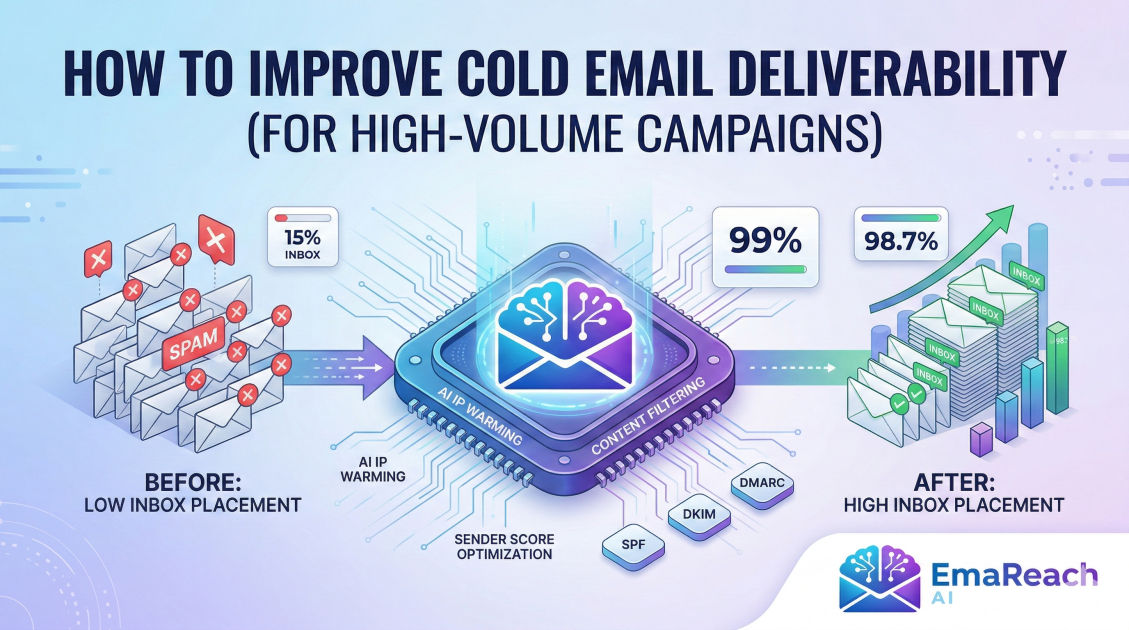
How to Improve Cold Email Deliverability for High-Volume Campaigns
cold emailemail deliverabilityoutreach strategylead generationemail marketingspam filters
Introduction
In the world of outbound sales, high-volume cold email campaigns are a double-edged sword. On one hand, they offer the scale necessary to generate a consistent pipeline of leads; on the other, they present a significant technical challenge: deliverability. As email service providers (ESPs) like Google and Microsoft become increasingly sophisticated, the margin for error has shrunk.
Sending thousands of emails is no longer a matter of simply clicking 'send.' It requires a robust infrastructure, meticulous list hygiene, and a strategic approach to engagement. Failure to optimize for deliverability doesn't just mean your emails go unread—it can lead to your domain being blacklisted, permanently damaging your brand's ability to communicate. This guide explores the comprehensive strategies required to ensure your high-volume campaigns land in the primary inbox rather than the dreaded spam folder.
The Foundation: Technical Setup and Authentication
Before a single word of copy is written, the technical foundation of your email operations must be flawless. Authentication acts as your digital passport; it tells receiving servers that you are who you say you are.
SPF, DKIM, and DMARC
These three protocols are the pillars of email security.
- SPF (Sender Policy Framework): This is a DNS record that specifies which mail servers are authorized to send email on behalf of your domain. Without it, receiving servers may view your high-volume bursts as a spoofing attempt.
- DKIM (DomainKeys Identified Mail): This adds a digital signature to your emails. It ensures that the content of the email hasn't been tampered with in transit.
- DMARC (Domain-based Message Authentication, Reporting, and Conformance): This ties SPF and DKIM together. It provides instructions to the receiving server on what to do if an email fails authentication (e.g., 'none', 'quarantine', or 'reject'). For high-volume senders, a 'p=quarantine' or 'p=reject' policy is essential for maintaining a high sender reputation.
Custom Tracking Domains
Most cold email tools use shared tracking domains to monitor opens and clicks. If another user on that shared domain sends spam, your deliverability suffers by association. By setting up a Custom Tracking Domain, you isolate your reputation. This involves creating a CNAME record in your DNS settings that points to your tracking provider, ensuring that all links in your email are branded to your specific domain.
Scaling with Infrastructure: The Multi-Inbox Strategy
One of the biggest mistakes in high-volume outreach is sending too many emails from a single account. ESPs monitor the volume of outgoing mail; if a single inbox suddenly jumps from 20 emails a day to 500, it triggers an immediate red flag.
Inbox Rotation and Multi-Account Sending
To achieve high volume safely, you must distribute the load. Instead of sending 1,000 emails from one account, send 50 emails from 20 different accounts. This strategy, known as Inbox Rotation, mimics natural human behavior and keeps each individual account under the radar of spam filters.
Using a platform like EmaReach can simplify this process. EmaReach allows for multi-account sending and automated inbox warm-up, ensuring that your outreach is distributed across various addresses while maintaining a high sender reputation.
Using Secondary Domains
Never send cold emails from your primary company domain (e.g., yourcompany.com). If your deliverability takes a hit, it could prevent your internal team from communicating with existing clients or partners. Instead, purchase 'look-alike' domains (e.g., getyourcompany.com or yourcompany.io). This creates a 'firewall' that protects your primary business operations.
The Importance of Professional Warm-up
An inbox needs to be 'seasoned' before it can handle high-volume campaigns. Sending hundreds of emails from a brand-new domain is a guaranteed way to get flagged.
The Warm-up Process
Warm-up involves gradually increasing the volume of outgoing mail while ensuring a high engagement rate. This is typically done through automated networks where inboxes 'talk' to each other, opening emails, marking them as important, and moving them out of the spam folder if they land there.
For a new domain, the process usually looks like this:
- Week 1: 5–10 emails per day with manual replies.
- Week 2: 15–25 emails per day.
- Week 3: 30–50 emails per day.
By the time you reach high-volume levels, the ESPs recognize your domain as a legitimate sender with a history of positive interactions.
Data Quality and List Hygiene
Your deliverability is only as good as your data. High bounce rates are one of the quickest ways to kill a sender reputation. If more than 3-5% of your emails bounce, ESPs will start throttling your messages.
Verification and Validation
Every list, regardless of the source, must be cleaned before use. Use verification tools to check for:
- Syntax errors: Incorrectly formatted email addresses.
- Disposable emails: Temporary addresses used to bypass gated content.
- Catch-all addresses: Domains that accept all mail, which can be risky for deliverability.
- Spam traps: Email addresses set up by providers specifically to catch scrapers and spammers.
Regular Scrubbing
List hygiene isn't a one-time event. You should regularly remove 'ghost' subscribers—those who haven't opened or clicked an email in 60-90 days. High engagement signals to ESPs that your content is valuable, which improves your placement in the primary tab.
Crafting Content that Bypasses Filters
Modern spam filters don't just look at headers; they analyze the body of the email. To improve deliverability, your content must feel personal and avoid 'salesy' triggers.
Avoiding Spam Trigger Words
Words like 'Free,' 'Guarantee,' 'Cash,' and 'Act Now' are heavily scrutinized. While using one or two won't necessarily land you in spam, a high density of these terms—especially in the subject line—will increase your spam score. Focus on benefit-driven language rather than high-pressure sales tactics.
The Power of Spintax and Personalization
When sending high-volume campaigns, sending the exact same template to 5,000 people is a mistake. ESPs look for repetitive patterns. Spintax (Spinning Syntax) allows you to vary your word choice automatically. For example:
{Hi|Hello|Hey} {{first_name}}, I {noticed|saw|observed} your post on LinkedIn.
This creates thousands of unique variations of the same message, making your campaign look like individual 1-to-1 outreach rather than a mass blast. Beyond just names, try to personalize by industry, recent news, or specific pain points.
Monitoring and Maintaining Deliverability
Deliverability is not a "set it and forget it" metric. It requires constant monitoring to catch issues before they escalate.
Key Metrics to Track
- Bounce Rate: Keep this under 3%.
- Open Rate: While privacy changes have made this less accurate, a sudden drop is still a strong indicator of a deliverability issue.
- Reply Rate: This is the ultimate signal of relevance. High reply rates tell ESPs that people want to hear from you.
- Spam Complaint Rate: This should be near zero. Even a handful of 'Mark as Spam' clicks can tank your reputation.
Tools for Reputation Management
Use tools like Google Postmaster Tools to see how Google views your domain. It provides data on IP reputation, domain reputation, and encryption success. If you see your domain reputation dipping into the 'Medium' or 'Low' categories, it’s time to pause your campaigns and return to a warm-up phase.
Advanced Strategies: Timing and Frequency
How and when you send your emails matters just as much as what you send.
Throttling and Spacing
Avoid sending 100 emails at exactly 9:00 AM. Instead, use a sending tool that allows you to 'drip' emails throughout the day with random intervals between them (e.g., 90 to 300 seconds). This mimics human typing and sending patterns, which is far less suspicious to automated filters.
Feedback Loops
Register for feedback loops provided by various ISPs (like Yahoo and Microsoft). These services notify you when a recipient marks your email as spam, allowing you to automatically remove them from your list and prevent further damage to your reputation.
Conclusion
Mastering cold email deliverability for high-volume campaigns is an ongoing process of technical precision and content relevance. By establishing a solid foundation with SPF, DKIM, and DMARC, utilizing a multi-account strategy with tools like EmaReach, and maintaining strict list hygiene, you can scale your outreach without sacrificing your reputation. Remember, the goal of cold email is not just to send—it is to be seen. In an era of crowded inboxes and vigilant spam filters, the senders who prioritize deliverability are the ones who will ultimately see the highest return on their investment. Focus on quality, even at scale, and your campaigns will continue to find their way to the primary inbox.
EmaReach AI
Ready to scale your cold email outreach?
Join thousands of teams using EmaReach AI for AI-powered campaigns, domain warmup, and 95%+ deliverability. Start free — no credit card required.
Related posts
- Read article
The Instantly Alternative That Finally Gets Outbound Analytics Right
Discover why high-volume cold email requires a shift from surface-level vanity metrics to deep, data-driven revenue attribution, and explore the ultimate alternatives for mastering outbound engineering.
- Read article
What You Gain and What You Give Up When Switching From Instantly
Thinking about migrating your cold email stack? This detailed guide breaks down the exact operational advantages you gain and the core features you sacrifice when switching away from Instantly's popular outreach platform.