Blog
Back to blog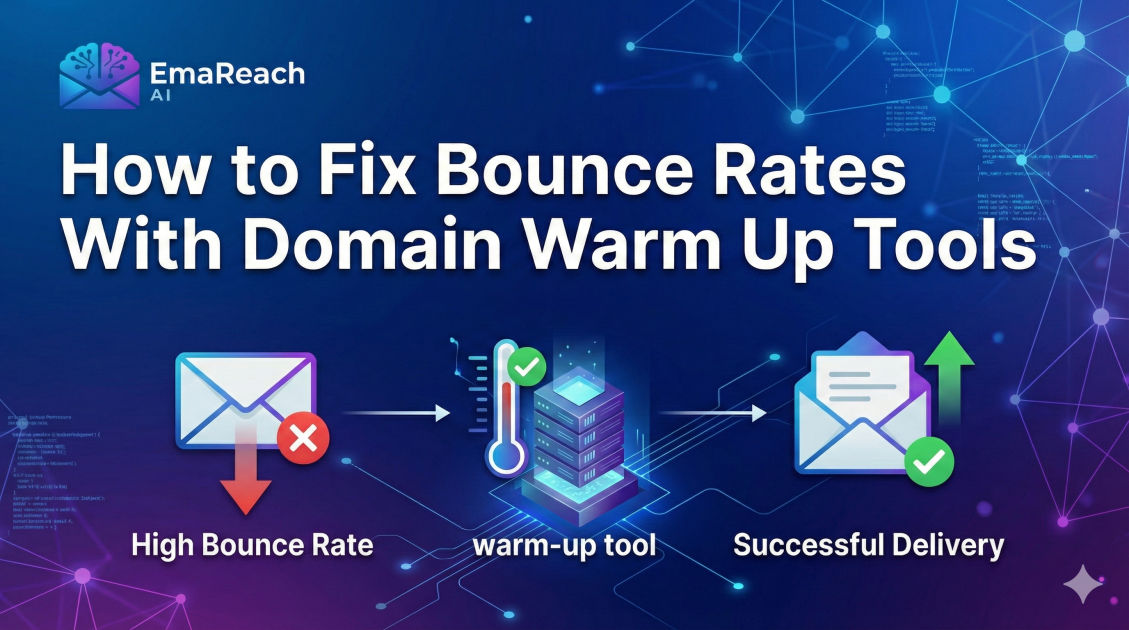
How to Fix Bounce Rates With Domain Warm Up Tools
email deliverabilitydomain warm upbounce ratecold emailemail marketingsender reputationoutreach strategy
Introduction to Email Deliverability and Bounce Rates
In the modern digital landscape, email remains the backbone of professional communication, marketing, and sales outreach. However, the path from hitting 'send' to appearing in a recipient's primary inbox is fraught with technical hurdles. One of the most significant metrics that marketers and sales professionals track is the bounce rate. A high bounce rate is more than just a missed connection; it is a red flag to Internet Service Providers (ISPs) that your sending practices may be sub-par or, worse, spammy.
While many factors contribute to email bounces, the reputation of your sending domain is paramount. If you are using a new domain or an underused one to send high volumes of mail, ISPs like Google and Outlook are likely to block your messages or send them straight to the spam folder. This is where domain warm-up tools become essential. By systematically building a positive reputation, these tools help you fix bounce rates before they destroy your campaign's ROI.
Understanding the Different Types of Bounces
Before diving into the mechanics of warm-up tools, it is crucial to distinguish between the two primary types of email bounces: Hard Bounces and Soft Bounces. Both impact your sender reputation, but they stem from different issues.
Hard Bounces
A hard bounce occurs when an email is permanently rejected. This usually happens because the email address does not exist, the domain name is invalid, or the recipient's mail server has completely blocked your IP or domain. Hard bounces are critical because they indicate a poor quality email list. If you continue to send to addresses that hard bounce, ISPs will quickly blacklist your domain.
Soft Bounces
A soft bounce is a temporary delivery failure. This could be due to a full recipient mailbox, a server that is temporarily down, or the message being too large. However, in the context of deliverability, soft bounces often occur because the recipient's ISP is 'greylisting' your emails. They are essentially saying, 'We don't know who you are yet, so we aren't letting this through right now.' Domain warm-up tools are specifically designed to address this lack of familiarity, turning those soft-rejections into successful deliveries.
The Role of Domain Reputation in Email Delivery
Your domain reputation is a 'score' assigned by ISPs based on your sending history. It is the digital equivalent of a credit score for your email address. If you have a history of sending emails that people open, reply to, and move to their primary folders, your reputation increases. If your emails are ignored, marked as spam, or sent to non-existent addresses, your reputation plummets.
ISPs use complex algorithms to determine whether your domain is trustworthy. They look at:
- Consistency: Are you sending 10 emails one day and 10,000 the next?
- Engagement: Do people interact with your content?
- Spam Complaints: How many recipients are hitting the 'Report Spam' button?
- Authentication: Have you properly set up SPF, DKIM, and DMARC records?
When you start with a fresh domain, you have no reputation. To an ISP, no reputation is almost as bad as a poor one. Without a history of positive engagement, high-volume sending is perceived as a 'spam burst.'
What is a Domain Warm Up Tool?
A domain warm-up tool is an automated software solution designed to increase your email sending volume gradually while generating positive engagement signals. Instead of you manually sending a handful of emails every day to friends and colleagues, the tool connects your email account to a network of other real accounts (often called a 'warm-up pool').
These tools simulate human-like behavior. They send emails from your account to other accounts in the network, which then automatically open the emails, mark them as 'not spam,' move them to the primary inbox, and sometimes even reply. This sequence tells ISPs that your domain is managed by a real person sending valuable content that people want to read.
How Warm Up Tools Specifically Reduce Bounce Rates
Fixing bounce rates is not just about cleaning a list; it is about ensuring the recipient's server accepts the mail you send. Here is how warm-up tools facilitate that process:
1. Establishing Trust with ISPs
By starting with a low volume (e.g., 5-10 emails per day) and slowly scaling up to 50, 100, or 500, you mirror the natural growth of a business. This gradual increase prevents the 'trigger' that causes ISPs to bounce mail from unknown senders.
2. Generating Positive Engagement Loops
When a warm-up tool moves your email from the spam folder to the primary folder, it sends a powerful signal to the ISP's algorithm. It essentially 'trains' the filter to recognize your domain as a high-quality sender. As your reputation grows, the likelihood of your emails being bounced or filtered decreases significantly.
3. Monitoring Blacklists
Many advanced domain warm-up tools provide real-time monitoring. If your domain suddenly appears on a blacklist (which would cause an immediate spike in hard bounces), the tool alerts you so you can pause your campaigns and resolve the issue before more damage is done.
Integrating AI for Better Deliverability
As spam filters become more sophisticated, they can sometimes detect repetitive, 'bot-like' warm-up patterns. This is where AI-driven solutions become a game-changer. Platforms like EmaReach take the concept further by combining AI-written cold outreach with specialized inbox warm-up. By using EmaReach, you ensure your emails land in the primary tab and get replies because the content is unique and the warm-up process is intelligently managed. This holistic approach is the most effective way to stop landing in spam and fix bounce rates permanently.
Step-by-Step Guide: Fixing Your Bounce Rate with Warm-Up Tools
Step 1: Technical Foundation
Before turning on any tool, ensure your technical records are flawless. This includes:
- SPF (Sender Policy Framework): Specifies which mail servers are authorized to send email on behalf of your domain.
- DKIM (DomainKeys Identified Mail): Adds a digital signature to emails, ensuring they haven't been tampered with in transit.
- DMARC (Domain-based Message Authentication, Reporting, and Conformance): Tells servers what to do if SPF or DKIM fails.
Without these, even the best warm-up tool cannot save your bounce rate.
Step 2: Selecting the Right Tool
Choose a tool that offers a 'peer-to-peer' network. This means your emails are being sent to real, aged accounts rather than fake 'bot' accounts. Real accounts on platforms like Google Workspace and Microsoft 365 carry much more weight in the eyes of ISPs.
Step 3: The Ramp-Up Period
Allow for a minimum of 2 to 4 weeks for the warm-up process. During the first week, the tool should send no more than 10-20 emails. By the fourth week, you can safely scale toward your target volume. Resisting the urge to rush this process is the key to fixing long-term bounce issues.
Step 4: Maintaining the 'Warmth'
Warm-up is not a one-time event. Even after your main campaigns are running, it is wise to keep your warm-up tool active at a lower volume. This provides a consistent 'baseline' of positive engagement that can offset the occasional 'Report Spam' click from a disgruntled recipient.
Common Mistakes to Avoid
Even with a tool in place, certain habits can cause bounce rates to climb:
- Sending Without Verifying Lists: A warm-up tool improves your reputation, but it doesn't remove dead email addresses from your CSV file. Always use a list verification service alongside your warm-up tool.
- Ignoring the Content: If your warm-up emails are great but your actual marketing emails are 'spammy' (full of all-caps, excessive links, or trigger words), you will still face deliverability issues.
- High Frequency/Low Value: Sending too many emails to the same recipient in a short period is a fast track to being blocked.
The Impact of Poor Deliverability on Business Growth
A high bounce rate is a silent killer for growth. If 20% of your emails are bouncing, you are not just losing 20% of your potential leads—you are actively damaging the 80% that remain. Once an ISP decides your domain is untrustworthy, even your transactional emails (like password resets or invoices) may stop reaching your customers.
By investing in domain warm-up tools, you are essentially buying 'delivery insurance.' You ensure that your sales team's time is spent on prospects who actually see their messages, rather than shouting into a digital void.
Advanced Strategies: Multi-Account Sending
To further minimize bounce risks, many experts recommend 'inbox rotation.' Instead of sending 500 emails from one domain, you send 50 emails from 10 different sub-domains or secondary domains. When combined with a warm-up tool for each account, this distributes the sending load and makes your outreach appear even more natural. Tools like EmaReach are built to handle this multi-account complexity, ensuring that each individual inbox remains 'warm' and healthy.
Measuring Success: KPIs to Watch
After implementing a domain warm-up strategy, you should monitor these metrics to ensure your bounce rate is truly 'fixed':
- Bounce Rate: Should ideally stay below 2%.
- Inbox Placement Rate: What percentage of non-bounced mail lands in the Primary tab vs. the Promotions or Spam folders?
- Open Rate: A sudden drop in open rates often precedes an increase in bounces, signaling a reputation dip.
- Reply Rate: The ultimate signal of domain health. Real replies are the strongest positive signal you can send to an ISP.
Conclusion
Fixing bounce rates is a multifaceted challenge that requires a blend of technical precision and strategic patience. Domain warm-up tools serve as the bridge between a suspicious, 'cold' domain and a trusted, high-authority sender. By automating the ramp-up process, generating authentic engagement, and providing a safety net for your sender reputation, these tools allow you to focus on what matters most: crafting messages that resonate with your audience.
Whether you are a startup launching your first outbound campaign or an established enterprise looking to optimize your deliverability, a systematic approach to domain warming is no longer optional—it is a foundational requirement for success in the inbox. Start slow, prioritize engagement, and use the right tools to ensure your voice is heard.
EmaReach AI
Ready to scale your cold email outreach?
Join thousands of teams using EmaReach AI for AI-powered campaigns, domain warmup, and 95%+ deliverability. Start free — no credit card required.
Related posts
- Read article
How Choosing the Right Instantly Alternative Changed Our Pipeline Numbers
Discover how transitioning from a volume-first cold email setup to an advanced, deliverability-focused infrastructure transformed our B2B pipeline metrics, skyrocketed open rates to over 68%, and tripled our monthly booked demos.
- Read article
The Instantly Alternative That Wins for Teams With Strict IT Policies
Discover why traditional cold email tools fail strict IT security audits and explore the ultimate enterprise-grade alternative built for secure, compliant, and high-performance outbound sales teams.