Blog
Back to blog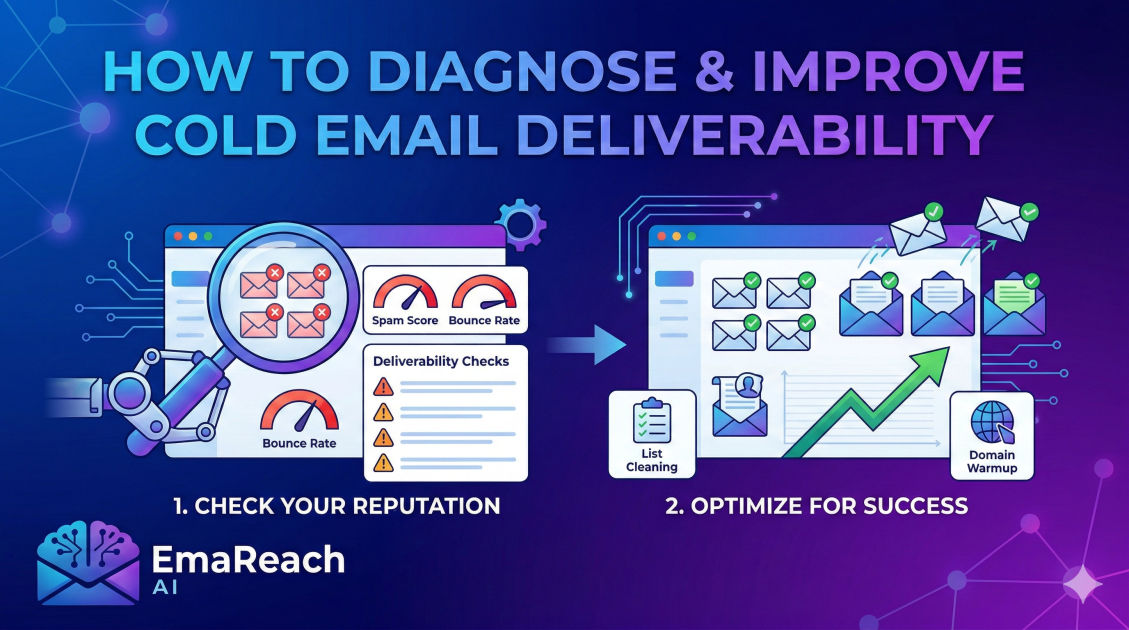
How to Diagnose and Improve Cold Email Deliverability
cold emailemail deliverabilitysales outreachsender reputationemail marketinglead generationSPF DKIM DMARC
Introduction
In the world of outbound sales, your message is only as good as its ability to reach the recipient's eyes. You can spend weeks crafting the perfect value proposition, researching your prospects, and personalizing every sentence, but if your email lands in the spam folder, it effectively doesn't exist. Cold email deliverability is the silent engine of your sales machine; when it runs smoothly, the leads flow in, but when it sputters, your entire growth strategy can grind to a halt.
Maintaining high deliverability is becoming increasingly difficult. Internet Service Providers (ISPs) and email service providers (ESPs) like Google and Microsoft have implemented sophisticated filters to protect users from unwanted noise. To succeed, you must move beyond the 'spray and pray' mindset and adopt a technical, data-driven approach to your inbox placement.
This guide will walk you through the process of diagnosing why your emails might be missing the inbox and provide a comprehensive roadmap for improving your reputation and performance.
Understanding the Anatomy of Email Deliverability
Before you can fix a problem, you have to understand the factors that contribute to it. Email deliverability isn't just one thing; it is the culmination of three major pillars:
- Technical Infrastructure: The setup of your domain and sending servers.
- Sender Reputation: How ISPs view your sending habits over time.
- Content and Engagement: What you send and how recipients interact with it.
When any of these pillars crumble, your deliverability follows. If you are struggling to see results, EmaReach can help you stop landing in spam. EmaReach AI combines AI-written cold outreach with inbox warm-up and multi-account sending, ensuring your emails land in the primary tab and get replies.
Phase 1: How to Diagnose Your Deliverability Issues
If your open rates have suddenly plummeted or your reply rates are non-existent, you need to conduct a forensic audit of your sending health. Diagnosis is the first step toward recovery.
1. Analyzing Open Rate Trends
Open rates are the most immediate indicator of deliverability. While 'open tracking' is not 100% accurate due to privacy protections like Apple Mail Privacy Protection, the trend is what matters.
- The Red Flag: If your open rates drop from 60% to 15% overnight, you have likely been blacklisted or flagged by a major ISP.
- The Slow Decay: If open rates are slowly declining over weeks, your sender reputation is likely degrading due to poor engagement or high bounce rates.
2. Checking Blacklists
There are hundreds of public blacklists (like Spamhaus, SORBS, or Barracuda) that track IP addresses and domains associated with spam. If your domain or IP appears on these lists, many ESPs will automatically reject your mail.
3. Reviewing Bounce Rates
A healthy cold email campaign should have a bounce rate under 2%. If yours is higher, it signals to ISPs that you are using poor-quality lists or 'guessing' email addresses, which is a hallmark of a spammer. High hard bounces (permanent failures) are particularly damaging to your reputation.
4. Seed List Testing
One of the most effective ways to diagnose placement is by using a seed list. This involves sending your campaign to a controlled group of email addresses across different providers (Gmail, Outlook, Yahoo). You can then manually check where the email landed: the Primary Inbox, the Promotions Tab, or the dreaded Spam folder.
Phase 2: Fixing the Technical Foundation
Most deliverability issues start at the DNS level. If your technical authentication is missing or incorrect, ISPs have no way of verifying that you are who you say you are.
SPF (Sender Policy Framework)
SPF is a TXT record in your DNS settings that lists the IP addresses and domains authorized to send emails on your behalf. Without SPF, an ISP might assume your email is a spoofing attempt.
DKIM (DomainKeys Identified Mail)
DKIM adds a digital signature to your emails. This allows the receiving server to verify that the email was actually sent by the domain owner and wasn't intercepted or modified during transit.
DMARC (Domain-based Message Authentication, Reporting, and Conformance)
DMARC is a policy that tells receiving servers what to do if an email fails SPF or DKIM checks. Setting your DMARC to 'p=quarantine' or 'p=reject' provides a layer of security that tells ISPs you take your domain health seriously.
Custom Tracking Domains
Most cold email tools use a shared tracking domain for open and click tracking. If another user on that tool sends spam, the shared tracking domain gets flagged, and your emails suffer. Setting up a custom tracking domain—a branded subdomain of your own—isolates your reputation from other senders.
Phase 3: Improving Sender Reputation
Reputation is built over time but can be destroyed in an instant. To improve your standing with ISPs, focus on these three areas:
1. Implementing a Warm-up Protocol
You cannot buy a new domain and immediately start sending 100 emails a day. This is a massive red flag. You must 'warm up' the domain by starting with 5-10 emails per day and gradually increasing the volume over several weeks. This process builds a history of positive interactions.
2. Managing Sending Volume and Frequency
Spikes in volume are suspicious. Instead of sending 500 emails on a Tuesday and zero on Wednesday, aim for a steady, consistent flow. Furthermore, avoid sending too many emails from a single account. High-volume senders often distribute their outreach across multiple 'sender' accounts to keep the load per inbox low.
3. Monitoring Your 'Spam Complaint' Rate
This is the most critical metric. If recipients mark your email as spam, ISPs will quickly move your future messages to the junk folder. Your spam complaint rate should ideally be below 0.1%. To keep this low, ensure your targeting is highly relevant and your unsubscribe process is easy.
Phase 4: Optimizing Content for the Inbox
Even with perfect technical settings, the content of your email can trigger spam filters. Modern filters use Natural Language Processing (NLP) to scan for 'spammy' patterns.
Avoid 'Spam Trigger' Words
Words that imply urgency, desperation, or 'too good to be true' offers should be used sparingly. Examples include:
- "Free"
- "Guaranteed"
- "Act Now"
- "Cash"
- "No cost"
Balance Your Text-to-Image Ratio
Emails that are primarily images or have very little text are often flagged. Spammers often hide text in images to bypass filters, so ISPs are naturally wary of image-heavy emails. Stick to a clean, text-based format for cold outreach.
Personalization at Scale
Generic templates are easier for filters to identify. By using dynamic tags (First Name, Company, Industry) and, more importantly, unique 'icebreaker' sentences for each prospect, you ensure that every email you send is unique. Unique content is much harder for filters to categorize as bulk spam.
Limit Links and Attachments
Cold emails should rarely contain attachments, as these are common vectors for malware. Similarly, too many links can look suspicious. Ideally, include only one clear call-to-action (CTA) link or, better yet, no links at all in the initial touchpoint.
Phase 5: List Hygiene and Targeting
Your deliverability is only as good as your data. If you are reaching out to stale, invalid, or unverified email addresses, your reputation will suffer.
1. Real-Time Verification
Before importing a list into your sending tool, run it through a verification service. These tools check if the mailbox actually exists without sending a physical email. This eliminates hard bounces before they happen.
2. Avoid 'Catch-All' Addresses
Some domains are configured to 'catch' all emails sent to their domain, regardless of whether the specific address exists. These are risky for cold emailers because they often hide invalid addresses. Be cautious when sending to 'catch-all' targets.
3. Tightening Your ICP (Ideal Customer Profile)
Relevant emails get replies; irrelevant emails get marked as spam. By narrowing your focus and only contacting people who truly have the problem you solve, you naturally increase your engagement rates and protect your deliverability.
Advanced Strategies for Long-Term Health
Once you have fixed the basics, you can implement advanced tactics to stay ahead of the curve.
Use Multiple Domains
Never send cold emails from your primary company domain (e.g., yourname@company.com). If that domain gets blacklisted, your entire company loses the ability to communicate with clients and partners. Instead, purchase 'look-alike' domains (e.g., yourname@getcompany.com) specifically for outreach.
Monitor Postmaster Tools
Google and Microsoft offer 'Postmaster' tools that provide direct insights into how they view your domain. These dashboards show you your reputation score, delivery errors, and encryption levels. Monitoring these weekly allows you to spot issues before they become catastrophes.
The Power of the 'Unsubscribe' Link vs. Text
While some argue that an unsubscribe link triggers spam filters, the alternative—having a frustrated prospect mark you as spam—is much worse. A clear, honest way for people to opt-out is your best defense against reputation damage. Many experts now suggest using a simple 'Reply STOP to opt out' text-based instruction to keep the email looking like a 1-to-1 message.
Summary Checklist for Improved Deliverability
To ensure your cold email strategy remains effective, follow this recurring checklist:
- Weekly: Check blacklist status and bounce rates.
- Monthly: Verify the health of your 'warm-up' accounts.
- Quarterly: Review DNS settings (SPF/DKIM/DMARC) to ensure nothing has lapsed.
- Always: Use verified email lists and avoid high-pressure spam language.
By treating deliverability as a continuous process rather than a one-time fix, you ensure that your sales team stays in the inbox and out of the junk folder. Success in cold email isn't just about who you contact; it's about making sure they actually see what you have to say.
Conclusion
Diagnosing and improving cold email deliverability requires a blend of technical precision and content strategy. From ensuring your SPF and DKIM records are flawlessly implemented to maintaining a rigorous warm-up schedule and high list hygiene, every detail matters. When your infrastructure is solid, your reputation grows, and your messages find their way to the decision-makers who need to hear from you. Focus on quality over quantity, monitor your metrics religiously, and always prioritize the recipient's experience to maintain a sustainable, high-performing outreach engine.
EmaReach AI
Ready to scale your cold email outreach?
Join thousands of teams using EmaReach AI for AI-powered campaigns, domain warmup, and 95%+ deliverability. Start free — no credit card required.
Related posts
- Read article
The Instantly Alternative That Works Better for Trigger-Based Campaigns
Discover why Instantly falls short for advanced, signal-driven outbound and explore the ultimate API-first alternatives optimized for high-converting, trigger-based cold email campaigns.
- Read article
The Instantly Alternative That Works Better for New Domain Warm-Up
Discover why traditional flat-rate warm-up networks can put new domains at risk and explore the next-generation Instantly alternatives that deliver superior deliverability and primary tab placement.