Blog
Back to blog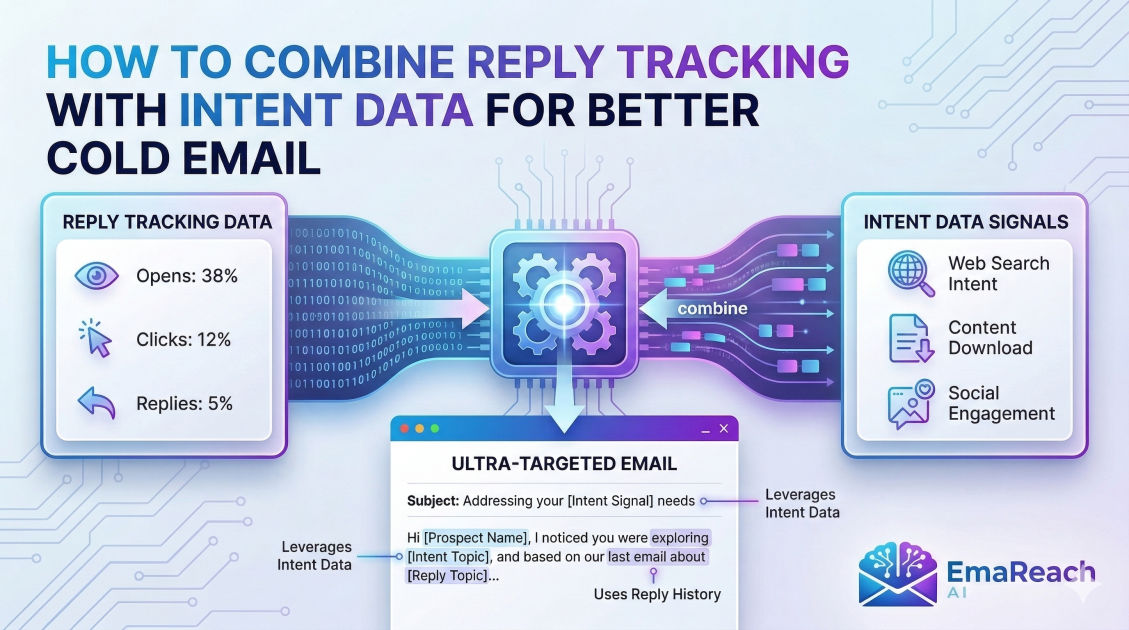
How to Combine Reply Tracking With Intent Data for Better Cold Email
cold emailintent datasales automationlead generationoutreach strategyemail deliverability
Introduction: The New Era of Cold Outreach
In the early days of digital prospecting, cold email was a numbers game. You scraped a list, wrote a generic template, and hit send to thousands of recipients. Success was measured in fractions of a percent. Today, that model is not just inefficient—it is a recipe for a damaged domain reputation. Modern outreach requires a surgical approach, blending the precision of intent data with the feedback loop of reply tracking.
Combining these two powerhouses allows sales teams to move from 'guessing' to 'knowing.' Intent data tells you who is looking for a solution like yours right now, while reply tracking tells you how your message is landing and which segments are converting. When these two systems talk to each other, you create a self-optimizing sales machine.
To ensure these highly targeted emails actually land where they belong, platforms like EmaReach can be invaluable. EmaReach helps you stop landing in spam by combining AI-written cold outreach with inbox warm-up and multi-account sending, ensuring your emails land in the primary tab and get the replies you’re tracking.
Understanding Intent Data: The 'Who' and 'When'
Intent data is the set of behavioral signals that indicate a prospect is in-market for a specific product or service. Instead of targeting a company simply because they fit your Ideal Customer Profile (ICP), intent data allows you to target them because they are actively exhibiting buying behaviors.
Types of Intent Data
- First-Party Intent: This is data you collect on your own properties. It includes website visits, whitepaper downloads, or interactions with your previous emails. This is the 'hottest' data because the prospect already knows your brand.
- Third-Party Intent: This is data collected from across the web. It includes prospects searching for specific keywords on Google, reading reviews on B2B software sites, or engaging with topics related to your industry on news outlets.
- Technographic Intent: Signals that a company has just installed a competitor's software or a complementary tool, indicating a shift in their tech stack.
- Job Change Intent: When a new decision-maker enters a role, they are often looking to make an impact quickly, making them highly receptive to new solutions.
Why Intent Data Matters for Cold Email
Without intent data, your cold email is an interruption. With intent data, it becomes a timely solution to a problem the prospect is currently experiencing. It allows you to lead with relevance, which is the single most important factor in modern deliverability and engagement.
The Role of Reply Tracking: The 'What' and 'How'
Reply tracking is often overlooked as a simple metric, but in a sophisticated outreach strategy, it serves as the ultimate source of truth. It involves monitoring not just whether someone replied, but the sentiment and velocity of those replies.
Beyond the 'Open Rate'
Open rates have become increasingly unreliable due to privacy changes and automated mail filters. Reply tracking, however, is a concrete action. It proves that a human engaged with your content. By tracking replies, you can identify:
- Which scripts resonate: Comparing the reply rates of different value propositions.
- Objection patterns: Understanding common reasons for 'no' so you can update your marketing collateral.
- Optimal timing: Identifying when your prospects are most likely to engage in a conversation.
The Synergy: How to Combine Intent and Tracking
Combining these two elements creates a closed-loop system. Intent data fuels the top of your funnel with high-quality prospects, and reply tracking provides the data needed to refine those intent signals.
1. Intent-Based Segmentation
Instead of one massive campaign, use intent signals to create 'micro-campaigns.'
- The Problem-Specific Sequence: If your intent provider shows a company is researching 'data security breaches,' your email should focus exclusively on your security features.
- The Competitor Displacement Sequence: If the signal shows they are looking at a competitor's pricing page, your email should highlight your unique differentiators over that specific competitor.
2. Using Reply Sentiment to Refine Intent Filters
Not all intent signals are created equal. Sometimes, a 'high intent' signal from a provider results in a high volume of 'Not interested' or 'Unsubscribe' replies.
By tracking the sentiment of replies back to the original intent source, you can grade your data providers. If 'Keyword A' leads to a 10% positive reply rate, but 'Keyword B' leads to 0% despite high search volume, you should shift your budget and focus toward Keyword A.
3. Dynamic Follow-Up Sequences
Reply tracking allows you to pause automation the moment a human joins the conversation. When combined with intent, you can set 'resumption' rules. If a prospect shows intent but doesn't reply, your follow-up sequence should get progressively more specific to the intent signal that triggered the outreach in the first place.
Step-by-Step Implementation Strategy
Step 1: Define Your High-Value Intent Triggers
Don't try to track everything. Start with the three signals that most closely correlate with a closed deal in your historical data. For many B2B companies, this is a combination of 'Leadership Changes' and 'Specific Product Category Research.'
Step 2: Build the Infrastructure
You need a tech stack where data flows freely. Your intent data provider must push leads into your sending platform, and your sending platform must push reply data back into your CRM.
To maximize the effectiveness of this stack, using a tool like EmaReach ensures that the high-intent leads you've identified actually receive your messages. By utilizing multi-account sending and AI-driven personalization, you minimize the risk of your carefully researched emails being filtered by spam algorithms.
Step 3: Map Intent to Messaging
For every intent trigger, you need a dedicated 'bridge' sentence. This is the first line of your email that connects the signal to your value prop.
- Intent: Prospect visited your pricing page.
- Bridge: "I noticed your team was exploring our platform options, and I wanted to share a quick case study on how [Competitor] users are transitioning for better ROI."
Step 4: Analyze and Pivot
Every 30 days, review your reply tracking dashboard. Look for the 'Intent-Reply Gap.' This is where high intent signals are failing to generate positive replies. This gap usually indicates that either the intent signal is a 'false positive' or your messaging for that specific signal is off-target.
Advanced Tactics: Intent Velocity and Multi-Channel Tracking
Once you have the basics down, you can move into advanced territory.
Intent Velocity
Intent isn't binary; it has a speed. A company that searches for your service once a month has low velocity. A company that searches ten times in a week, visits your LinkedIn page, and has three employees looking at your 'About' page has high velocity.
Track your replies based on velocity tiers. You will likely find that high-velocity intent leads require a much shorter, more direct email, whereas low-velocity leads require more educational content to 'warm them up.'
The Feedback Loop for Content Creation
If reply tracking shows that prospects in the 'Comparison' intent stage keep asking about a specific feature, that is a signal to your marketing team to create a dedicated whitepaper or video for that feature. You can then use that new asset in your next intent-based cold email campaign.
Common Pitfalls to Avoid
- Over-Automation: Just because you have the data doesn't mean the email should feel robotic. The goal of intent data is to make the email feel more human and timely.
- Stale Intent Data: Intent has a half-life. A prospect searching for a solution today might buy one tomorrow. If your intent data is more than a week old, the 'cold' email will feel truly cold.
- Ignoring Negative Replies: Tracking 'Unsubscribes' is just as important as tracking 'Yes.' A high unsubscribe rate on a specific intent trigger is a warning that your data source is noisy or your messaging is intrusive.
- Poor Deliverability: All the data in the world won't help if your emails land in the 'Promotions' tab or spam folder. This is why a balanced approach—using intent for targeting and tools like EmaReach for deliverability—is the winning combination.
Measuring Success: The Metrics That Matter
When you combine these two disciplines, your KPIs should shift. Move away from 'Total Emails Sent' and focus on:
- Positive Reply Rate per Intent Signal: Which behaviors actually lead to meetings?
- Intent-to-Meeting Ratio: How many high-intent leads do you need to generate one qualified discovery call?
- Cost Per Positive Reply: Integrating intent data costs money. Tracking this ensures your ROI remains positive compared to traditional broad-spectrum cold calling.
Conclusion
The future of cold email is personal, relevant, and data-driven. By treating intent data as your compass and reply tracking as your GPS, you can navigate the complex landscape of modern B2B sales with confidence. You stop shouting into the void and start participating in conversations that are already happening in the minds of your prospects.
Start small: pick one intent signal, track every reply it generates, and refine your approach based on what the market tells you. The results in your pipeline will speak for themselves.
EmaReach AI
Ready to scale your cold email outreach?
Join thousands of teams using EmaReach AI for AI-powered campaigns, domain warmup, and 95%+ deliverability. Start free — no credit card required.
Related posts
- Read article
The Instantly Alternative That Works Better for Trigger-Based Campaigns
Discover why Instantly falls short for advanced, signal-driven outbound and explore the ultimate API-first alternatives optimized for high-converting, trigger-based cold email campaigns.
- Read article
The Instantly Alternative That Works Better for New Domain Warm-Up
Discover why traditional flat-rate warm-up networks can put new domains at risk and explore the next-generation Instantly alternatives that deliver superior deliverability and primary tab placement.