Blog
Back to blog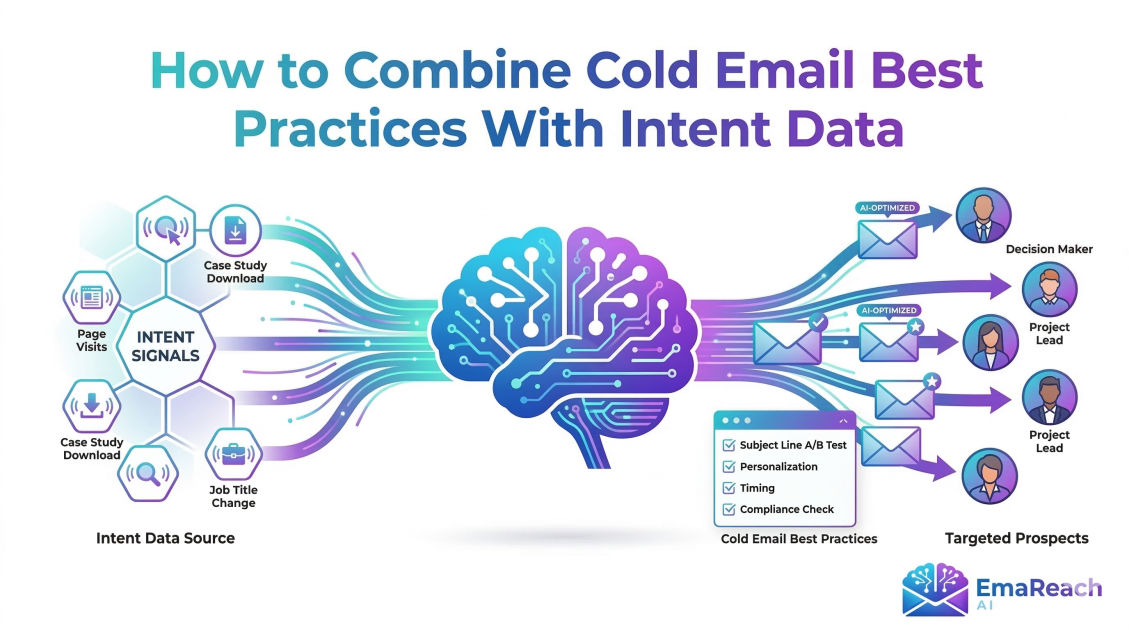
How to Combine Cold Email Best Practices With Intent Data
cold emailintent dataB2B saleslead generationemail deliverabilitysales automation
Introduction to Intent-Driven Outreach
Cold email has undergone a massive transformation. The days of 'spray and pray'—sending thousands of generic messages to a static list of email addresses—are long gone. Today, the most successful sales organizations have shifted toward a more sophisticated approach that combines classic cold email best practices with the power of intent data.
Intent data acts as a digital breadcrumb trail. It reveals which companies are actively researching solutions, visiting your website, or engaging with industry-specific content. When you marry this intelligence with high-level cold email execution, you stop being an uninvited guest in someone’s inbox and start being a timely problem solver. This guide explores how to integrate these two powerful forces to skyrocket your conversion rates.
Understanding the Layers of Intent Data
Before diving into the 'how-to,' it is crucial to understand what intent data actually is. It generally falls into two primary categories: first-party and third-party intent.
First-Party Intent (Internal Data)
First-party intent is data you own. It is generated when a prospect interacts directly with your brand’s digital properties. Examples include:
- Visiting specific product or pricing pages on your website.
- Downloading a whitepaper or case study.
- Attending a webinar.
- Clicking a link in a previous marketing email.
Third-Party Intent (External Data)
Third-party intent is gathered from across the broader web. It tracks the behavior of users on sites you don’t own, such as review platforms (G2, Capterra), news outlets, or specialized B2B forums. This data tells you when a company is researching a category of software or a specific pain point before they ever land on your site.
The Pillars of Cold Email Best Practices
Intent data is a catalyst, but it cannot fix a broken foundation. To succeed, you must first ensure your cold email fundamentals are airtight.
1. Technical Deliverability
Your email can be perfectly written, but it won’t matter if it lands in the spam folder. Maintaining a high sender reputation requires:
- SPF, DKIM, and DMARC: Ensuring your DNS records are correctly configured to authenticate your domain.
- Domain Warm-up: Gradually increasing sending volume to show ESPs (Email Service Providers) that you are a legitimate sender.
- Multiple Sending Accounts: Spreading volume across various accounts to avoid hitting rate limits.
For those looking to automate this complex process, EmaReach is a powerful ally. It helps you stop landing in spam by combining AI-written cold outreach with inbox warm-up and multi-account sending, ensuring your emails land in the primary tab where they belong.
2. Radical Personalization
Personalization is more than just using a {first_name} tag. It involves demonstrating that you have researched the prospect's company, their recent milestones, and their specific challenges. Intent data provides the 'why now' for this personalization.
3. Concise and Value-Driven Copy
Decision-makers are busy. A high-performing cold email should be under 150 words, easy to read on a mobile device, and focused entirely on the recipient’s benefit rather than your product features.
Strategizing the Integration: Intent Meets Outreach
Combining intent data with cold email best practices requires a structural shift in how you build your lead lists and write your sequences.
Identifying the 'Buying Committee'
Intent data usually identifies an account (a company) rather than a specific individual. Once you know a company is showing intent, your next step is to use cold email best practices to map out the buying committee. You should identify:
- The Champion: The person most likely to use your solution.
- The Decision Maker: The executive with budget authority.
- The Influencer: Technical or operational leaders who care about implementation.
Timing the Outreach
Intent data is perishable. If a prospect is researching a solution today, they might make a decision next week. The best practice is to trigger your cold email sequence within 24 to 48 hours of an intent signal being detected. This ensures your solution is top-of-mind while the problem is still acute.
Crafting the Intent-Based Cold Email
When you have intent data, your opening line changes. You are no longer guessing what they care about; you have a data-backed hypothesis.
Scenario A: Research-Based Intent
If your data shows a prospect has been researching 'cloud security protocols' on third-party sites, your email should lead with education.
- Subject: Thoughts on [Company Name]'s cloud security strategy
- The Hook: "I noticed that your team has been exploring new frameworks for cloud security recently."
- The Value: "We recently helped a similar firm reduce their vulnerability window by 40% using a specific automation layer."
- The CTA: "Would you be open to a 5-minute chat about how we might apply that to your current infrastructure?"
Scenario B: Comparison-Based Intent
If a prospect is visiting your profile on a review site or comparing you to a competitor, the email should be more direct.
- Subject: Quick question regarding [Competitor Name]
- The Hook: "Since you’re looking into [Category] solutions, I wanted to share a quick comparison of where we differ from [Competitor]."
- The Value: "Most teams switch to us because of our [Specific Feature] which saves roughly 10 hours a week."
- The CTA: "Can I send over a one-pager on the ROI our users see?"
Advanced Segmentation and Dynamic Sequences
One of the most effective best practices is to segment your audience based on the intensity of their intent. Not all signals are created equal.
| Intent Level | Signal Example | Outreach Strategy |
|---|---|---|
| Low | Reading a general blog post | Soft, educational content; low-friction CTA. |
| Medium | Visiting a pricing page twice | Case studies and specific ROI calculators. |
| High | Searching for 'Brand vs. Brand' | Direct invite for a demo or specialized trial. |
By segmenting your cold email campaigns this way, you ensure that your tone and offer match the prospect's stage in the buyer's journey. High-intent prospects get high-impact, direct emails, while low-intent prospects receive value-add sequences that build trust over time.
Managing Data Hygiene and Privacy
Using intent data requires a commitment to data hygiene. Inaccurate data leads to 'uncanny valley' personalization—where you mention something that is slightly off, making the recipient feel tracked rather than helped.
Verifying Signals
Always cross-reference intent signals. If a company shows intent for 'hiring software' but their LinkedIn page shows they just laid off 20% of their staff, the intent signal is likely 'noisy' or irrelevant. Combining data points creates a holistic view that prevents embarrassing outreach mistakes.
Compliance is King
Whether you are operating under GDPR, CCPA, or other regional regulations, the combination of intent data and cold email must be handled with care. Always provide a clear opt-out mechanism and ensure that your reason for reaching out (the 'legitimate interest') is clearly articulated in the email.
Measuring Success Beyond Open Rates
When you integrate intent data, your metrics will change. Because you are targeting a smaller, more relevant group, your total volume may decrease, but your efficiency should increase.
Key Performance Indicators (KPIs) to Track:
- Positive Reply Rate: This is the ultimate metric for intent-based outreach. It measures how many recipients actually engaged in a conversation.
- Opportunity-to-Lead Ratio: How many of your intent-qualified leads turned into actual sales opportunities?
- Sales Cycle Length: Does using intent data shorten the time from first contact to closed-won? (Typically, it should).
- Cost Per Acquisition (CPA): While intent data tools can be expensive, the reduction in wasted outreach often leads to a lower overall CPA.
Avoiding Common Pitfalls
Even with the best data, errors happen. Here are three common mistakes to avoid when merging these strategies:
- Being 'Creepy': Don't say, "I saw you were on my pricing page at 2:00 PM yesterday." Instead, use the data to inform your topic, not to prove you are watching them. Say, "I thought you might be interested in our pricing structure for mid-market teams."
- Ignoring the Follow-up: Intent signals can be fleeting. A common mistake is sending one great intent-based email and then stopping. Use a multi-touch sequence (5-7 steps) that continues to provide value even if they don't respond to the first 'intent-triggered' message.
- Static Messaging: Intent data is dynamic. If a company's intent shifts from 'Product A' to 'Product B' mid-sequence, your automated emails should be agile enough to pivot the messaging accordingly.
Conclusion
The integration of cold email best practices and intent data represents the pinnacle of modern B2B sales. By focusing on deliverability, personalization, and value—and then powering those efforts with real-time behavioral insights—you create an outreach engine that is both efficient and respectful of the prospect's time.
When you stop guessing who to email and start responding to the signals the market is already sending, your cold emails transform from a numbers game into a strategic advantage. Focus on the human at the other end of the screen, use your data to be helpful, and maintain the technical standards required to stay out of the spam folder. This balanced approach is the key to sustainable growth and meaningful professional relationships.
EmaReach AI
Ready to scale your cold email outreach?
Join thousands of teams using EmaReach AI for AI-powered campaigns, domain warmup, and 95%+ deliverability. Start free — no credit card required.
Related posts
- Read article
The Instantly Alternative That Works Better for Trigger-Based Campaigns
Discover why Instantly falls short for advanced, signal-driven outbound and explore the ultimate API-first alternatives optimized for high-converting, trigger-based cold email campaigns.
- Read article
The Instantly Alternative That Handles High Bounce Rates Without Panic
Discover how transitioning to an advanced Instantly alternative can safeguard your cold email infrastructure. Learn to handle high bounce rates effortlessly using real-time verification, smart mailbox rotation, and automated safety nets to protect your sender reputation and maintain consistent primary inbox placement.