Blog
Back to blog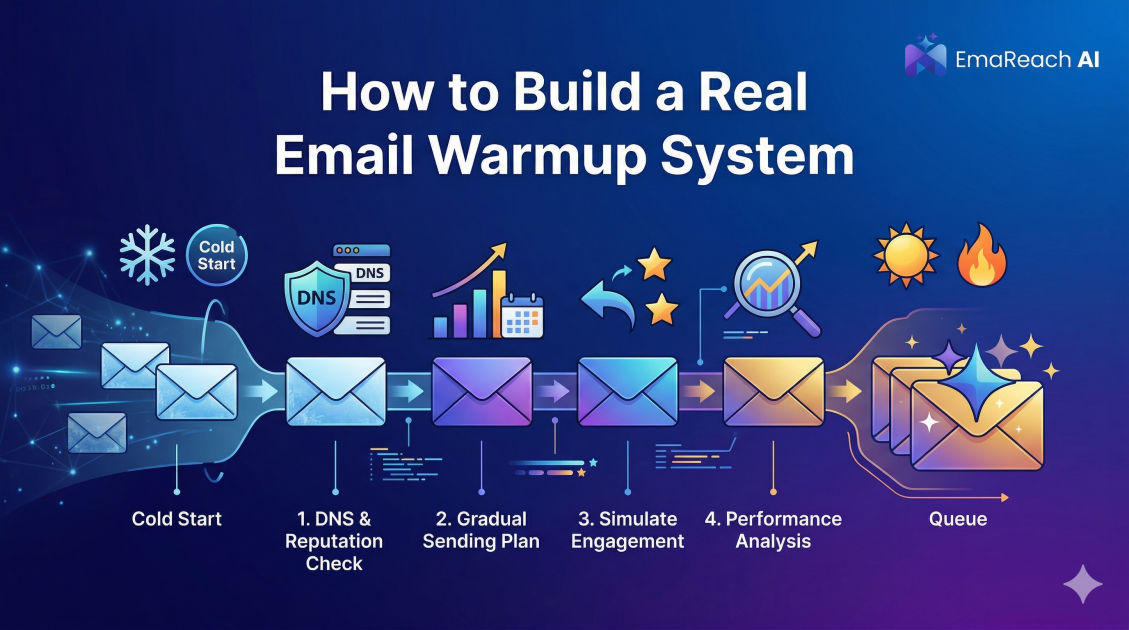
How to Build a Real Email Warmup System
email deliverabilityemail warmupcold outreachsender reputationemail infrastructureb2b marketing
Introduction
In the modern landscape of digital communication and outbound marketing, landing in the primary inbox is no longer guaranteed—it is a privilege earned through trust. Internet Service Providers (ISPs) and email clients have developed incredibly sophisticated, AI-driven filtering algorithms designed to protect their users from spam, phishing, and unsolicited bulk emails. If you register a brand new domain, set up an email workspace, and immediately begin sending hundreds of cold emails, your domain reputation will plummet, and your messages will be relegated to the spam folder or blocked entirely.
To bypass these strict filters and establish trust with major email providers, you need a robust email warmup process. While many marketers rely on commercial solutions, understanding the underlying mechanics of how to build a real email warmup system from scratch provides unparalleled insight into email deliverability. This comprehensive guide will dissect the architecture, algorithms, infrastructure, and behavioral simulations required to engineer an effective email warmup system.
The Anatomy of Sender Reputation
Before writing a single line of code or setting up infrastructure, it is vital to understand what an email warmup system is actually trying to achieve. The core objective is to artificially but authentically build your "Sender Reputation."
Sender Reputation is a dynamic score assigned to your domain and sending IP addresses by receiving mail servers. This score dictates whether your email goes to the Inbox, the Promotions tab, the Spam folder, or gets rejected outright. An effective warmup system positively influences this score by systematically managing the following metrics:
- Volume Consistency: Slowly increasing sending limits rather than creating massive, irregular spikes in volume.
- Engagement Rates: Simulating high open rates, read times, and reply rates.
- Spam Complaints: Ensuring your emails are never manually marked as spam, and actively rescuing them if they land in the spam folder.
- Authentication Alignment: Proving to servers that you are who you say you are through cryptographic signatures.
Building a system requires orchestrating a network of seed accounts that interact with your sender accounts in a highly controlled, measurable manner.
Phase 1: Foundational Infrastructure and Authentication
A warmup system is entirely useless if your foundational infrastructure is flawed. Mail servers check your technical setup before they even look at the content of your message.
Domain and IP Setup
When building a warmup infrastructure, you should ideally use dedicated sending IPs or carefully vetted shared IPs. The domain itself must be aged. A brand-new domain has a neutral or suspicious reputation. Your warmup system must begin slowly during the first few weeks of a domain's life.
Implementing the Holy Trinity of Email Authentication
Your warmup system must verify that every single email sent from the network passes three critical authentication protocols:
- SPF (Sender Policy Framework): This DNS record acts as a public guest list. It tells receiving servers exactly which IP addresses and services are authorized to send emails on behalf of your domain. Your system must validate SPF alignment on every outbound ping.
- DKIM (DomainKeys Identified Mail): This protocol attaches a cryptographic signature to every outgoing email. The receiving server uses the public key stored in your DNS records to decrypt the signature, verifying that the email was not tampered with in transit.
- DMARC (Domain-based Message Authentication, Reporting, and Conformance): DMARC acts as the enforcement policy. It tells the receiving server what to do if an email fails SPF or DKIM checks (e.g., do nothing, quarantine, or reject). A proper system will monitor DMARC aggregate reports to identify unauthorized sending attempts.
Phase 2: Architecting the Peer-to-Peer Seed Network
The most critical component of a real email warmup system is the network of inboxes that receive, open, and reply to the warmup emails. Older, primitive warmup tools simply sent emails to inactive catch-all accounts. Modern spam filters easily detect this. Today, you must build a peer-to-peer (P2P) network.
How a P2P Network Functions
In a P2P warmup system, every user who connects their email account to the platform becomes a node in the network. Your account sends warmup emails to other users' accounts, and their accounts send emails to yours. This distributed architecture creates a massive, organic web of interactions across different IPs, domains, and email clients (Google Workspace, Microsoft 365, Zoho, etc.).
OAuth Integration
To automate interactions without requiring users to hand over their passwords, your system must utilize OAuth 2.0. By creating an application in Google Cloud Console and Microsoft Azure, you can request specific scopes from users:
mail.read: To scan the inbox and spam folders for warmup emails.mail.send: To dispatch outbound warmup emails and replies.mail.modify: To move emails from Spam to the Inbox and mark them as read or important.
This programmatic access allows the warmup engine to act as an invisible hand, managing email flows without disrupting the user's actual daily workflow.
Phase 3: The Algorithmic Ramp-Up
Warmup is a game of patience and mathematics. A sudden spike in volume from a new domain triggers automated rate-limiting and blacklisting. Your system requires a sophisticated scheduling algorithm.
The Daily Increment Logic
A standard algorithm follows a linear or slight exponential curve. For example, the system might start by sending 2 emails on day one. It then increases the volume by 1 to 3 emails per day, plateauing at a target volume (e.g., 40 emails per day).
Your database must track the exact age of the warmup cycle and dynamically adjust limits. It must also incorporate Jittering.
The Importance of Jittering
If your script fires exactly 10 emails at 9:00 AM every single day, ISP algorithms will instantly flag this as non-human bot behavior. Your system must incorporate "jitter"—randomized delays and scheduling.
Instead of sending all emails at once, the system should distribute the day's total volume randomly across business hours. A send might happen at 9:04 AM, another at 9:42 AM, and another at 11:15 AM. This random distribution mathematically mimics human sending patterns.
Phase 4: Simulating Human Engagement and The Spam Rescue
Sending volume is only half the battle. The true power of a real warmup system lies in how the seed accounts interact with the received emails. High engagement tells the ISP, "This sender provides valuable content that users want to read."
Automated Inbox Actions
When a seed account in your P2P network receives a warmup email, the system's background worker must execute a sequence of actions via API:
- Search and Locate: Scan the primary inbox, promotions tab, and spam folder for the unique hidden identifier attached to the warmup email.
- Spam Rescue (The Most Crucial Step): If the email landed in spam, the API must forcefully move it to the primary inbox. This sends a massive positive signal to the ISP's filtering algorithm, effectively saying, "Your filter made a mistake; this is legitimate mail."
- Mark as Read: The email is opened.
- Star/Mark Important: The system flags the email as priority.
- Threaded Replies: The most significant positive signal an ISP can receive is a conversational reply. The system must automatically generate and send a reply back to the sender, creating an active thread.
Generating Natural Language Content
Old systems used gibberish text or scraped Wikipedia articles for warmup content. Modern filters read the content and analyze it for coherence. Your warmup system needs to integrate a Large Language Model (LLM) to generate highly realistic, conversational threads. The emails should read like normal business communication, casual inquiries, or networking introductions.
Build vs. Buy: Strategic Considerations
Building a system of this magnitude requires extensive engineering resources, constant maintenance of OAuth tokens, API rate limit management, and massive server infrastructure to handle millions of background jobs per day.
If you want the benefits of ultimate deliverability without the engineering overhead, leveraging a proven platform is the most strategic move. This is where dedicated infrastructure becomes essential.
To ensure maximum deliverability, EmaReach provides an exceptional solution: "Stop Landing in Spam. Cold Emails That Reach the Inbox." EmaReach AI combines AI-written cold outreach with inbox warm-up and multi-account sending—so your emails land in the primary tab and get replies. By handling the complex P2P network, the algorithmic ramping, and the AI-driven human behavior simulation, platforms like EmaReach allow you to focus entirely on closing deals rather than managing mail server reputation.
Phase 5: Monitoring, Analytics, and Continuous Warmup
A real warmup system does not run blind. It requires a robust analytics dashboard to monitor the health of the domains continuously.
Key Metrics to Track
Your system's database should aggregate daily data points, calculating:
- Spam Rate: The percentage of warmup emails that landed in the spam folder before being rescued.
- Inbox Rate: The percentage that naturally landed in the primary inbox.
- Authentication Failures: Real-time alerts if an SPF or DKIM check fails due to a DNS misconfiguration.
- Bounce Rates: Tracking hard bounces (invalid addresses) and soft bounces (rate limits).
Integration with Postmaster Tools
An advanced system should utilize APIs to pull in data from major providers. This external validation ensures that the internal metrics of your warmup system align with the actual reputation scores assigned by the mail providers.
The Myth of the "Finished" Warmup
A critical design principle for your system is understanding that warmup is never truly "finished." While the initial ramp-up phase might take 30 to 45 days, you must maintain a baseline of automated engagement. If you stop the warmup process and rely solely on cold outreach (which inherently has lower engagement rates), your reputation will slowly degrade over time. The system should transition from a "ramp-up" phase to a "maintenance" phase, perpetually sending a lower volume of highly engaged emails to balance out the cold outreach.
Handling Edge Cases and Error Management
Building this system requires anticipating inevitable points of failure.
- Token Expiration: OAuth tokens expire or get revoked by users changing their passwords. The system must gracefully handle authentication failures, automatically pause the affected node, and send a re-authentication request to the user without crashing the network.
- Rate Limiting: Mail providers impose strict API limits. If your system makes too many requests to move emails or send replies, it will be temporarily blocked. You must implement exponential backoff algorithms and message queuing systems (like Redis or RabbitMQ) to manage API traffic efficiently.
- Spam Trap Detection: If your P2P network accepts any user without vetting, malicious actors might connect "spam trap" emails to sabotage the network. The system must analyze the incoming nodes and isolate accounts that demonstrate toxic behavior or abnormal bounce rates.
Conclusion
Building a real email warmup system is an exercise in complex software engineering, API orchestration, and behavioral simulation. It requires a deep understanding of how global mail servers analyze, categorize, and filter digital communication. By constructing a secure P2P network, utilizing dynamic scheduling algorithms, automating human-like inbox interactions, and continuously monitoring key reputation metrics, you can mathematically prove to ISPs that your domain is a trustworthy sender. Whether you choose to engineer this intricate architecture from the ground up or leverage advanced, purpose-built platforms, maintaining top-tier email deliverability remains the foundational pillar of any successful modern outreach strategy.
EmaReach AI
Ready to scale your cold email outreach?
Join thousands of teams using EmaReach AI for AI-powered campaigns, domain warmup, and 95%+ deliverability. Start free — no credit card required.
Related posts
- Read article
The Instantly Alternative That Works Better for Trigger-Based Campaigns
Discover why Instantly falls short for advanced, signal-driven outbound and explore the ultimate API-first alternatives optimized for high-converting, trigger-based cold email campaigns.
- Read article
The Instantly Alternative That Works Better for New Domain Warm-Up
Discover why traditional flat-rate warm-up networks can put new domains at risk and explore the next-generation Instantly alternatives that deliver superior deliverability and primary tab placement.