Blog
Back to blog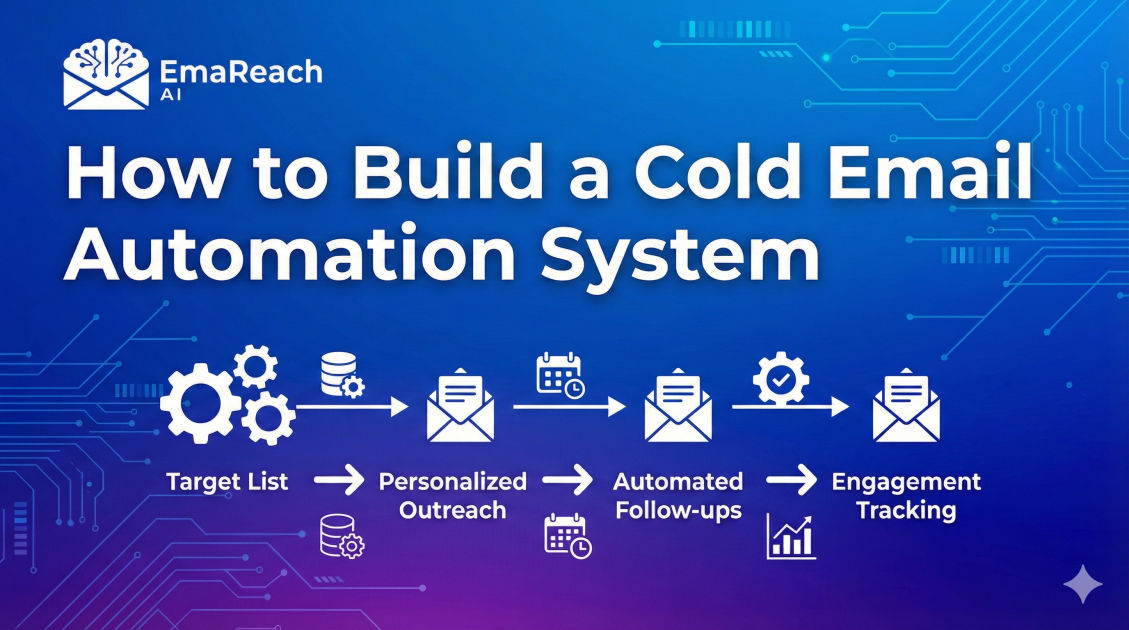
How to Build a Cold Email Automation System
cold emailemail automationsales outreachlead generationdeliverabilityb2b marketingemail infrastructure
Introduction
In the modern digital landscape, cold email remains one of the most effective and scalable channels for outbound sales and business development. However, the days of 'spray and pray'—sending thousands of identical emails from a single account—are long over. Today, building a cold email automation system requires a sophisticated blend of technical infrastructure, data management, and psychological triggers.
A truly robust automation system does more than just send messages; it protects your sender reputation, ensures high deliverability, and personalizes content at scale. This guide explores the foundational pillars and advanced strategies required to build a world-class cold email engine from the ground up.
Phase 1: Technical Infrastructure and Domain Setup
The most common mistake in cold email is sending from your primary company domain. If your outreach gets flagged as spam, your internal business communications (invoices, client updates) will also land in spam folders.
1. Domain Diversification
To build a resilient system, you must purchase secondary domains that are similar to your main brand. For example, if your domain is company.com, you might register getcompany.com or trycompany.com. This creates a 'firewall' between your primary operations and your outbound efforts.
2. DNS Authentication Protocols
Without proper authentication, mailbox providers like Google and Outlook will immediately view your automated emails with suspicion. You must configure three specific records:
- SPF (Sender Policy Framework): Specifies which mail servers are authorized to send email on behalf of your domain.
- DKIM (DomainKeys Identified Mail): Adds a digital signature to your emails, proving they weren't tampered with in transit.
- DMARC (Domain-based Message Authentication, Reporting, and Conformance): Tells receiving servers what to do if an email fails SPF or DKIM checks.
3. Forwarding and Profiles
Once your secondary domains are live, set up catch-all forwarding to your main inbox so you never miss a reply. Additionally, ensure every sending account has a professional profile picture and a realistic human name to improve trust scores with automated filters.
Phase 2: Inbox Warm-up and Reputation Management
A new domain has no 'credit score' in the eyes of internet service providers. If you start sending 50 emails a day immediately, you will be blacklisted.
The Warm-up Process
Warm-up involves a gradual increase in sending volume paired with high engagement rates. In a manual or automated warm-up cycle, your accounts send small batches of emails to other 'trusted' accounts that open the mail, mark it as important, and reply. This signals to algorithms that your content is valuable.
Maintaining Deliverability
To sustain long-term success, you need a system that monitors bounce rates and spam reports in real-time. Aim to keep your bounce rate below 2%. If it climbs higher, your automation should trigger an immediate pause to investigate the lead source.
For those looking to streamline this complex technical setup, EmaReach offers a powerful solution. EmaReach AI combines AI-written cold outreach with inbox warm-up and multi-account sending, ensuring your emails land in the primary tab rather than the promotions or spam folders.
Phase 3: Data Sourcing and Lead Intelligence
An automation system is only as good as the fuel you feed it. Building a lead list requires a balance of quantity and precision.
Identifying the Ideal Customer Profile (ICP)
Before scraping data, define your parameters: industry, company size, revenue, and specific job titles. Automation allows you to segment these lists so that a 'CEO of a Tech Startup' receives a fundamentally different message than a 'VP of Sales at a Manufacturing Firm.'
Verification and Cleaning
Data decays rapidly. Before any lead enters your automation sequence, it must pass through a verification layer. This process checks if the email server exists and if the specific mailbox is active. Removing 'catch-all' or 'invalid' addresses before sending is the single best way to protect your domain health.
Phase 4: Crafting the Automation Sequence
A single email is rarely enough to convert a prospect. A successful system utilizes a multi-touch sequence designed to build familiarity over time.
The Structure of a Sequence
- The Opener: Focus on a specific pain point or a genuine observation about the prospect’s business.
- The Value-Add: Send a case study, a helpful resource, or an insight without asking for anything in return.
- The Social Proof: Mention similar companies you have helped and the specific results achieved.
- The 'Break-up' Email: A polite final note acknowledging that now might not be the right time, which often triggers a response from prospects who were simply busy.
Timing and Cadence
Don't overwhelm the prospect. A standard cadence might look like:
- Day 1: Initial Email
- Day 3: Follow-up 1 (Threaded to the first)
- Day 7: Follow-up 2 (New angle)
- Day 14: Follow-up 3 (Value-add)
- Day 25: Final check-in
Phase 5: Personalization at Scale with Variables
Modern automation allows for 'dynamic tags' that insert specific information into each email. While {{first_name}} and {{company_name}} are standard, advanced systems use 'Custom Variables' to stand out.
Advanced Variable Strategies
- {{Competitor_Name}}: Mentioning a specific rival of the prospect.
- {{Recent_News}}: Referencing a recent funding round or product launch.
- {{Pivotal_Problem}}: Highlighting a challenge specific to their niche.
By using structured data in your lead lists, your automation engine can generate thousands of emails that feel like they were hand-written by a researcher.
Phase 6: Handling Replies and Sentiment Analysis
The goal of automation is to get a human response. Once a reply comes in, the automation for that specific contact must stop immediately to prevent awkward 'ghost' follow-ups.
Automated Inbox Management
Sophisticated systems use sentiment analysis to categorize replies:
- Positive: 'Let’s talk next Tuesday.'
- Information Seeking: 'Can you send over a deck?'
- Negative/Ooo: 'Not interested' or 'I am on vacation until next month.'
By tagging these automatically, your sales team can prioritize high-intent leads and spend their time closing deals rather than sorting through 'Out of Office' notifications.
Phase 7: Analytics and Continuous Optimization
You cannot improve what you do not measure. A high-performing cold email system tracks specific Key Performance Indicators (KPIs).
Essential Metrics
- Open Rate: Reflects the quality of your subject lines and sender reputation (Aim for 60%+).
- Reply Rate: Measures the resonance of your offer and personalization (Aim for 5-15%).
- Positive Reply Rate: The ultimate metric—how many of those replies are actual leads?
- Unsubscribe Rate: If this is high, your targeting is off.
A/B Testing Protocols
Never stop testing. Run split tests on:
- Subject lines (Short vs. Long)
- Calls to Action (Soft ask vs. Hard ask)
- Sending times (Morning vs. Afternoon)
- Personalization levels
Conclusion
Building a cold email automation system is a marathon, not a sprint. It requires a meticulous setup of technical foundations, a commitment to data cleanliness, and a constant pulse on deliverability metrics. When done correctly, it becomes a predictable revenue engine that generates opportunities while you sleep.
Remember that the 'automation' part of the system is the vehicle, but the 'human' part—the strategy, the value, and the empathy—is the fuel. By combining technical excellence with genuine communication, you can break through the noise of a crowded inbox and build meaningful business relationships at scale.
EmaReach AI
Ready to scale your cold email outreach?
Join thousands of teams using EmaReach AI for AI-powered campaigns, domain warmup, and 95%+ deliverability. Start free — no credit card required.
Related posts
- Read article
The Instantly Alternative That Finally Gets Outbound Analytics Right
Discover why high-volume cold email requires a shift from surface-level vanity metrics to deep, data-driven revenue attribution, and explore the ultimate alternatives for mastering outbound engineering.
- Read article
What You Gain and What You Give Up When Switching From Instantly
Thinking about migrating your cold email stack? This detailed guide breaks down the exact operational advantages you gain and the core features you sacrifice when switching away from Instantly's popular outreach platform.