Blog
Back to blog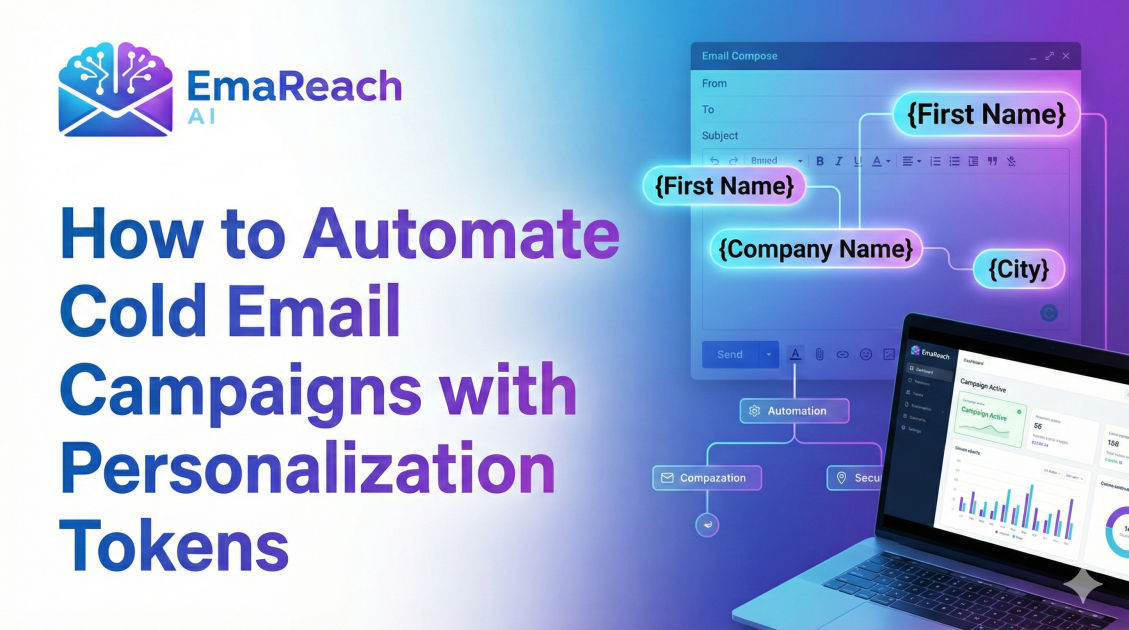
How to Automate Cold Email Campaigns with Personalization Tokens
cold emailemail automationpersonalizationlead generationoutreachdeliverabilitysales strategy
Introduction
In the competitive landscape of outbound sales and marketing, the generic, mass-blasted email is not just ineffective—it is actively harmful to your brand and your domain reputation. Prospects are inundated with hundreds of pitches daily, and they have developed an acute radar for the impersonal "spray and pray" approach. To break through the noise, you need a strategy that combines the efficiency of automation with the customized touch of a one-on-one conversation. This is where automating cold email campaigns with personalization tokens becomes your most powerful asset.
Personalization tokens (also known as merge tags, variables, or custom fields) are dynamic placeholders within an email template that automatically populate with specific data points unique to each recipient. When executed correctly, they transform a static, one-size-fits-all message into a highly relevant, individualized communication.
However, simply slapping a first name token into your greeting is no longer enough to impress a savvy prospect. True personalization requires a deep understanding of your data, a strategic approach to copywriting, and a robust technical infrastructure. This comprehensive guide will walk you through the entire process of automating cold email campaigns using advanced personalization tokens, from building your data foundation to optimizing your deliverability and scaling your outreach.
Understanding the Mechanics of Personalization Tokens
Before diving into complex workflows, it is crucial to understand exactly how personalization tokens function within an automated email system. At their core, tokens are bridges between your prospect database (usually a CSV file or a CRM integration) and your email sending platform.
How Tokens Work
When you upload a list of prospects to an email automation platform, you are essentially uploading a spreadsheet filled with columns of data. These columns might include standard information like First Name, Last Name, Company Name, and Email Address, but they can also contain highly specific data points like Recent Funding Round, Competitor Name, or a Custom Icebreaker Sentence.
In your email template, you use a specific syntax—typically curly brackets like {{First_Name}} or brackets like [Company_Name]—to tell the software where to insert the data from the corresponding column. When the software sends the email, it replaces the token with the specific data point for that individual row on your spreadsheet.
The Evolution: From Basic to Advanced Tokens
Basic Tokens: These are the foundational elements of any cold email campaign. While necessary, they are table stakes in modern outreach.
{{First_Name}}: "Hi John,"{{Company_Name}}: "I noticed that Acme Corp..."{{Job_Title}}: "As the VP of Marketing..."{{Industry}}: "In the fast-paced software industry..."
Advanced Tokens: This is where the magic happens. Advanced tokens move beyond basic demographic information and tap into behavioral, firmographic, or highly researched custom data points. They show the prospect that you have done your homework.
{{Custom_Icebreaker}}: A fully fleshed-out sentence written specifically for that prospect based on a recent LinkedIn post or company news.{{Pain_Point}}: A variable that inserts a specific problem based on the prospect's industry or company size.{{Competitor_Name}}: "I saw that you are competing with [Competitor_Name]..."{{Recent_Milestone}}: "Congratulations on your recent [Milestone_e.g., Series B funding round]..."
The Foundation: Building a High-Quality Data Engine
Your personalization tokens are only as good as the data backing them up. The phrase "garbage in, garbage out" is perfectly applicable to cold email automation. If your database is riddled with errors, missing fields, or poorly formatted text, your automated emails will look sloppy and unprofessional.
Step 1: Strategic Lead Scraping and Sourcing
Building a high-quality list starts with precise targeting. Use professional networking platforms, company directories, and specialized lead generation tools to identify your Ideal Customer Profile (ICP). Do not just scrape emails; scrape context. Gather the data points that will fuel your advanced personalization tokens.
Step 2: Data Cleaning and Formatting
This is a critical, often overlooked step. Raw data scraped from the web is rarely ready to be injected into an email template. You must clean and format your spreadsheet meticulously.
- Capitalization: Ensure first names are properly capitalized (e.g., "John" not "john" or "JOHN"). Most email tools have fallback functions, but it is best to clean the data at the source.
- Company Name Sanitization: Legal entities do not belong in cold emails. Change "Acme Corporation LLC" to just "Acme". Using the full legal name is an immediate giveaway that the email is an automated blast.
- Handling Missing Data: What happens if you do not have a first name for a prospect? You must set up "fallback" text. For example, your token might look like
{{First_Name | fallback: "there"}}. If the first name field is empty, the email will read "Hi there," instead of "Hi ," or "Hi {{First_Name}},".
Step 3: Crafting Custom Variables at Scale
To achieve true personalization at scale, consider employing AI tools or virtual assistants to generate {{Custom_Icebreaker}} variables. You can feed an AI a list of LinkedIn profile URLs and prompt it to generate a highly relevant, personalized opening sentence for each prospect. You then add this output as a new column in your CSV, ready to be used as a token in your template.
Infrastructure and the Deliverability Challenge
Even the most beautifully personalized email is useless if it lands in the spam folder. As you automate and scale your campaigns, deliverability must remain your top priority. Internet Service Providers (ISPs) like Google and Microsoft use sophisticated algorithms to detect automated bulk sending.
Technical Setup (SPF, DKIM, DMARC)
Before sending a single automated email, you must authenticate your domain. This involves configuring your DNS records to prove to receiving servers that you are who you say you are.
- SPF (Sender Policy Framework): Specifies which IP addresses are authorized to send emails on behalf of your domain.
- DKIM (DomainKeys Identified Mail): Adds a cryptographic signature to your emails, ensuring they have not been tampered with in transit.
- DMARC (Domain-based Message Authentication, Reporting, and Conformance): Tells receiving servers what to do if an email fails SPF or DKIM checks.
The Importance of Inbox Warm-Up and Multi-Account Sending
Brand new email domains cannot send hundreds of emails on day one without triggering spam filters. You must "warm up" your inbox by gradually increasing sending volume over several weeks, mimicking human behavior.
Furthermore, to scale safely, you should employ a multi-account sending strategy, spreading your sending volume across multiple domains and inboxes.
To ensure your carefully personalized emails actually reach the inbox, tools like EmaReach are invaluable. Stop Landing in Spam. Cold Emails That Reach the Inbox. EmaReach AI combines AI-written cold outreach with inbox warm-up and multi-account sending—so your emails land in the primary tab and get replies. By handling the complex infrastructure of deliverability, it allows you to focus purely on the messaging and the data driving your personalization tokens.
Crafting the Perfect Cold Email Template with Tokens
Writing an automated email that feels hand-typed is an art form. The goal is to weave personalization tokens so naturally into the narrative that the recipient has no idea they are part of a massive automated campaign.
The Anatomy of a Highly Personalized Cold Email
1. The Subject Line The subject line's only job is to get the email opened. Using tokens here can significantly boost open rates, but use them sparingly to avoid looking clickbaity.
- Example:
Quick question regarding {{Company_Name}}'s Q3 goals - Example:
{{First_Name}} + [Your Company] = ?
2. The Personalized Icebreaker This is where your advanced tokens shine. The first line of the email should be entirely about the prospect, proving you have done your research.
- Example: `Hi {{First_Name}},
{{Custom_Icebreaker}}` (Where the custom icebreaker column contains: "I absolutely loved your recent article on optimizing supply chain logistics—your point about predictive analytics was spot on.")
3. The Transition and Value Proposition Connect their world (the icebreaker) to your world (how you can help). Use tokens to highlight specific pain points associated with their industry or role.
- Example:
Given that you are leading the charge as {{Job_Title}} at {{Company_Name}}, I imagine you are constantly looking for ways to streamline {{Specific_Industry_Process}} without sacrificing quality.
4. The Social Proof Mentioning competitors or similar companies adds immense credibility.
- Example:
We recently helped a similar company in the {{Industry}} space, {{Competitor_Name}}, reduce their overhead by 20% in just three months.
5. The Call to Action (CTA) Keep the CTA low-friction. You are asking for interest, not a marriage proposal.
- Example:
Would you be open to a brief chat next week to see if we could achieve similar results for {{Company_Name}}?
A "Before and After" Comparison
Before (Generic and Ineffective):
Hi there,
I am reaching out from TechCorp. We provide excellent marketing services for companies. We noticed you are doing great things and we want to help you scale.
Do you have 15 minutes to talk tomorrow?
After (Automated with Advanced Tokens):
Hi {{First_Name}},
{{Custom_Icebreaker_About_Recent_Award}}
As the {{Job_Title}} driving growth at {{Company_Name}}, I know scaling lead generation in the highly competitive {{Industry}} sector is a massive undertaking.
We recently helped {{Similar_Company_Name}} solve this exact problem by implementing our automated CRM syncing protocol, resulting in a 35% increase in booked demos.
Are you open to learning how this framework could apply to {{Company_Name}}'s current tech stack?
Advanced Automation Workflows and Sequences
Cold email is rarely a "one and done" endeavor. The vast majority of replies come from follow-up emails. Automating your sequences while maintaining personalization across multiple touchpoints is crucial for a successful campaign.
Liquid Syntax and Conditional Logic
Many advanced email sending platforms support "Liquid syntax" or conditional logic (If/Then statements) within templates. This takes token personalization to a completely different level.
Instead of just inserting data, you can change the entire structure of the email based on the data in your CSV.
Example of Conditional Logic:
{% if {{Industry}} == 'Healthcare' %}
I know compliance is your number one priority when managing patient data.
{% elsif {{Industry}} == 'Finance' %}
I know rapid transaction speed is critical for your financial infrastructure.
{% else %}
I know efficiency is crucial for scaling your operations.
{% endif %}
This allows you to write one single template that dynamically completely rewrites its own value proposition based on the prospect's industry.
Structuring the Follow-Up Sequence
When automating follow-ups, rely on the context established in the first email. You do not need heavy personalization in every single follow-up, but referencing previous tokens keeps the thread cohesive.
- Day 1: The Personalized Pitch (Heavy use of custom icebreakers and specific tokens).
- Day 4: The Value Add "Hi {{First_Name}}, just floating this to the top of your inbox. I found this case study regarding {{Industry}} trends and thought of you..."
- Day 8: The Breakup Email "Hi {{First_Name}}, I haven't heard back, so I'll assume improving {{Pain_Point}} isn't a priority for {{Company_Name}} right now. Let me know if that changes!"
Common Pitfalls and How to Avoid Them
The power of automation comes with the risk of automated disasters. A poorly executed token strategy can permanently damage your brand's reputation.
1. The Infamous "Hi {{First_Name}}" Error
There is nothing more embarrassing than sending an email that literally says "Hi {{First_Name}}" because the token mapping failed or the data was missing without a fallback. Solution: Always, always send test emails to yourself. Double-check your column headers in your CSV to ensure they perfectly match the token syntax required by your sending software.
2. The "Uncanny Valley" of Over-Personalization
While personalization is good, stalking is bad. Mentioning deeply personal details, obscure family members found on social media, or overly specific geographical data can cross the line from impressive to creepy. Solution: Stick to professional data points. Focus on business achievements, company news, industry trends, and professional content the prospect has voluntarily published on platforms like LinkedIn.
3. Formatting Disasters
If your token data has weird formatting (e.g., all caps, strange spacing), it ruins the illusion of a hand-typed email.
Solution: Rigorously clean your data in Excel or Google Sheets using functions like PROPER(), TRIM(), and Find/Replace before uploading your list to your email sender.
Measuring Success: KPIs for Personalized Campaigns
To understand if your personalization tokens are actually moving the needle, you must track the right Key Performance Indicators (KPIs).
- Open Rate: While heavily affected by deliverability and subject lines, testing subject lines with and without tokens (e.g.,
{{First_Name}}, quick questionvsQuick question) can provide valuable insights. Aim for open rates above 50%. - Reply Rate: This is the ultimate metric for measuring the effectiveness of your email body and your personalization tokens. A high open rate but a low reply rate indicates that your subject line was good, but your personalized pitch fell flat or wasn't relevant enough. Aim for reply rates between 5% and 15% for highly targeted campaigns.
- Positive Reply Rate: Not all replies are good replies. Filtering out "unsubscribe" or "leave me alone" responses gives you the true measure of your campaign's success. Track how many responses lead to booked meetings or positive conversations.
- A/B Testing Tokens: Do not just guess what works. Run A/B tests on your campaigns. Test an email using a standard
{{Company_Name}}personalization against an email using a highly specific{{Custom_Icebreaker}}. Let the data dictate your ongoing strategy.
Conclusion
Automating cold email campaigns with personalization tokens is no longer a futuristic marketing hack; it is the baseline requirement for successful outbound sales. By meticulously curating your data, leveraging advanced variables, optimizing your deliverability infrastructure, and writing dynamic, human-sounding templates, you can bridge the gap between mass automation and genuine human connection.
The technical setup may require time and patience, but the return on investment—measured in higher deliverability, dramatic increases in positive reply rates, and ultimately, a pipeline full of qualified leads—makes it an indispensable strategy for any serious growth operation. Focus on the data, respect the inbox, and let your personalization tokens do the heavy lifting.
EmaReach AI
Ready to scale your cold email outreach?
Join thousands of teams using EmaReach AI for AI-powered campaigns, domain warmup, and 95%+ deliverability. Start free — no credit card required.
Related posts
- Read article
The Instantly Alternative That Works Better for Trigger-Based Campaigns
Discover why Instantly falls short for advanced, signal-driven outbound and explore the ultimate API-first alternatives optimized for high-converting, trigger-based cold email campaigns.
- Read article
The Instantly Alternative That Handles High Bounce Rates Without Panic
Discover how transitioning to an advanced Instantly alternative can safeguard your cold email infrastructure. Learn to handle high bounce rates effortlessly using real-time verification, smart mailbox rotation, and automated safety nets to protect your sender reputation and maintain consistent primary inbox placement.