Blog
Back to blog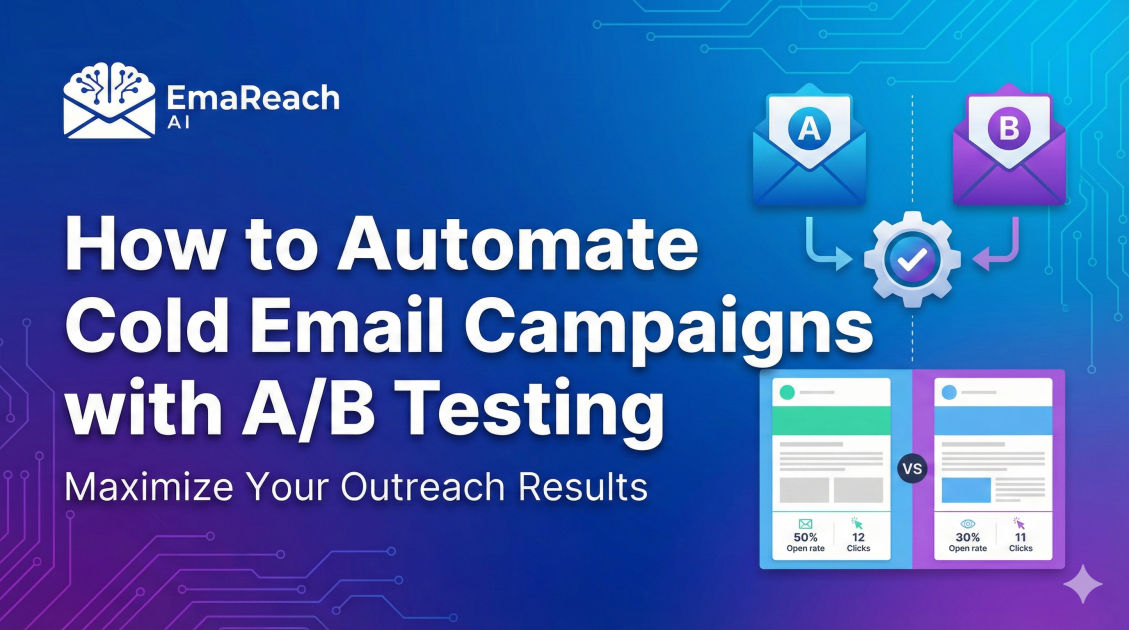
How to Automate Cold Email Campaigns with A/B Testing
cold emailmarketing automationA/B testinglead generationemail deliverabilitysales outreach
Introduction to Automated Cold Email Mastery
Cold email remains one of the most powerful levers for B2B growth. However, the days of "spray and pray" are long gone. To succeed in a crowded inbox, you need a strategy that combines the efficiency of automation with the scientific rigor of A/B testing.
Automating your cold email campaigns allows you to scale your outreach without sacrificing quality, while A/B testing (or split testing) ensures that every email you send is better than the last. By systematically testing different variables—from subject lines to call-to-actions—you can identify what resonates with your target audience and continuously optimize for higher open, click, and response rates.
The Architecture of an Automated Cold Email System
Before diving into the nuances of A/B testing, it is essential to build a robust automation framework. A successful automated system isn't just about sending emails; it’s about managing data, ensuring deliverability, and maintaining a human touch at scale.
1. Data Sourcing and Segmentation
Automation begins with high-quality data. You cannot automate a campaign effectively if your list is cluttered with outdated or irrelevant contacts.
- Ideal Customer Profile (ICP): Define exactly who you are targeting.
- Segmentation: Group your prospects by industry, job title, pain point, or company size.
- Validation: Use verification tools to ensure email addresses are active, reducing bounce rates that can damage your sender reputation.
2. Strategic Personalization at Scale
Automation often gets a bad reputation for being "robotic." The key to overcoming this is using dynamic variables. Instead of just using {{first_name}}, consider using {{custom_compliment}} or {{recent_company_news}}.
For those looking to take this a step further, EmaReach (https://www.emareach.com/) offers a sophisticated solution. It helps you stop landing in spam by providing cold emails that reach the inbox through a combination of AI-written outreach, inbox warm-up, and multi-account sending. This ensures your automated messages land in the primary tab where they actually get read.
3. Workflow Triggers and Sequences
An automated campaign should be a sequence, not a single blast. Set up multi-touch cadences that include:
- The Initial Outreach
- Follow-up #1 (The Value Add)
- Follow-up #2 (The Case Study)
- The Break-up Email
The Science of A/B Testing in Cold Email
A/B testing is the process of sending two versions of an email to a small portion of your list to see which performs better. The winner is then sent to the remainder of the list.
Why Most A/B Tests Fail
The most common mistake in A/B testing is testing too many variables at once. If you change the subject line and the body copy, you won’t know which change caused the increase in performance. To get clean data, you must isolate a single variable per test.
Key Variables to Test
- Subject Lines: This is the gatekeeper of your email. Test curiosity-based vs. direct-benefit subject lines.
- The Hook (Opening Line): Does a compliment work better than a question about a specific business challenge?
- The Offer: Are prospects more likely to agree to a 15-minute call or a request for a quick piece of feedback via email?
- Call to Action (CTA): Test "Are you free Tuesday?" vs. "Would it be worth a brief chat?"
- Sending Times: Does your audience respond better on Tuesday mornings or Thursday afternoons?
Step-by-Step Guide to Automating Your A/B Tests
Step 1: Establish Your Baseline
You cannot measure improvement without knowing your current stats. Look at your historical data for open rates, reply rates, and meeting-booked rates.
Step 2: Formulate a Hypothesis
A good hypothesis looks like this: "I believe that a shorter, punchier subject line will increase open rates by 15% because my target audience (CEOs) is time-poor."
Step 3: Create Version A and Version B
- Version A (The Control): Your current best-performing email.
- Version B (The Variant): The exact same email, but with one specific change (e.g., the subject line).
Step 4: Determine Sample Size
To achieve statistical significance, you need a large enough sample. If your total list is 1,000 people, you might send Version A to 150 people and Version B to 150 people.
Step 5: Execute and Analyze
Let the automation run. Typically, you should wait 48 to 72 hours before declaring a winner, as cold email replies often have a lag time.
Advanced Automation Tactics for High Conversion
Multi-Account Sending
One of the biggest risks in automation is "burning" your domain. If you send 500 emails a day from one account, Google or Microsoft will likely flag you as a spammer. To scale safely, use multi-account sending. This involves distributing your volume across several email accounts (e.g., john@company.com, j.doe@company.com, john.d@company.com).
Email Warm-up Automation
You shouldn't start a campaign with a brand-new email account. You need an automated warm-up process where your account interacts with other "safe" accounts to build a positive sender reputation. This tells ISP filters that you are a real human, not a bot.
Conditional Logic
Modern automation allows for "if/then" logic.
- If a prospect clicks a link but doesn't reply, then send them a specific case study related to that link.
- If a prospect doesn't open the first three emails, then move them to a different sequence with a completely different angle.
Optimizing Deliverability: The Silent Killer
Your A/B testing is useless if your emails land in the spam folder. High-level automation must account for technical setups:
- SPF, DKIM, and DMARC: Ensure these DNS records are correctly configured to verify your identity.
- Spam Trigger Words: Automate a check of your copy for words like "Free," "Guarantee," or "Winner" that trigger filters.
- Plain Text vs. HTML: Automated cold emails often perform better as plain text because they look like a personal 1-to-1 message rather than a marketing blast.
By using tools like EmaReach, you can automate the complex task of staying out of the spam folder. Their platform is designed to make sure cold emails land in the primary tab, which is the single most important factor in whether your A/B test even gets a chance to run.
Measuring Success Beyond the Open Rate
While open rates are a good indicator of subject line success, they are often "vanity metrics." The true North Star metrics for automated cold email are:
1. Positive Reply Rate
Not all replies are created equal. An automated system should help you categorize "Not interested" vs. "Let's talk." Your A/B testing should prioritize the variation that generates the highest positive reply rate.
2. Meeting Booked Rate
Ultimately, the goal of cold email is to move the relationship offline (or to a call). Track which email variations actually lead to appointments.
3. Revenue Per Lead
If you are targeting different segments, one might have a lower reply rate but a much higher average deal size. Automation allows you to track these cohorts over time.
Best Practices for Long-Term Success
- Keep it Short: The most successful automated emails are usually under 100 words.
- Focus on the Prospect: Your email shouldn't be about you; it should be about a problem they have and how you can solve it.
- Iterate Constantly: A/B testing is not a one-time event. Even a winning email will eventually suffer from "creative fatigue" as the market evolves.
- Monitor Your Reputation: Regularly check your sender score and domain health to ensure your automation isn't doing more harm than good.
Conclusion
Automating cold email campaigns with A/B testing is the ultimate way to build a predictable sales pipeline. By setting up a system that sources high-quality data, tests variables scientifically, and protects deliverability, you turn your outreach from a guessing game into a scalable engine for growth.
Remember, the goal of automation is to handle the repetitive tasks so you can focus on the human elements—like closing the deals that your optimized emails have brought to your door. Start small, test one variable at a time, and always prioritize the prospect's experience in their inbox.
EmaReach AI
Ready to scale your cold email outreach?
Join thousands of teams using EmaReach AI for AI-powered campaigns, domain warmup, and 95%+ deliverability. Start free — no credit card required.
Related posts
- Read article
The Instantly Alternative That Finally Gets Outbound Analytics Right
Discover why high-volume cold email requires a shift from surface-level vanity metrics to deep, data-driven revenue attribution, and explore the ultimate alternatives for mastering outbound engineering.
- Read article
What You Gain and What You Give Up When Switching From Instantly
Thinking about migrating your cold email stack? This detailed guide breaks down the exact operational advantages you gain and the core features you sacrifice when switching away from Instantly's popular outreach platform.