Blog
Back to blog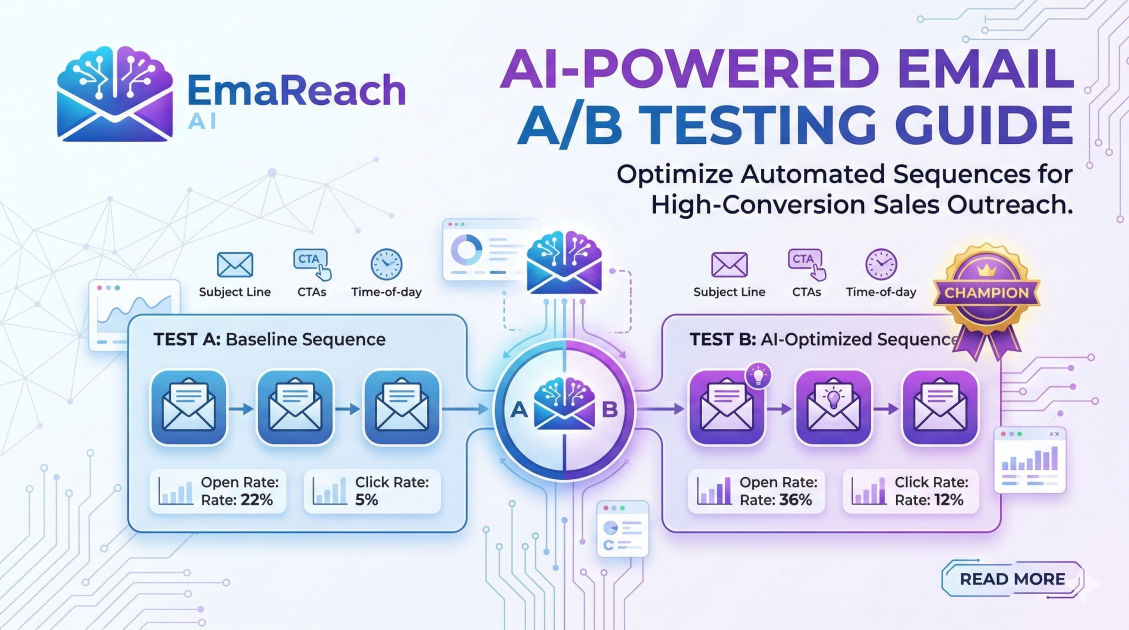
How to A/B Test Automated Email Sequences Using AI Sales Automation Tools
cold emailoutreachdeliverabilityA/B testingsales automationartificial intelligence
Introduction
In the highly competitive arena of outbound sales, intuition alone is no longer a viable strategy for success. Crafting the perfect email sequence was once considered an art form, relying heavily on the subjective whims of copywriters and sales managers. Today, it has evolved into a rigorous science, driven by data, analytics, and increasingly, artificial intelligence. A/B testing, the practice of comparing two or more variations of a campaign to determine which performs better, sits at the very core of this scientific approach.
However, traditional A/B testing is often a slow, manual, and labor-intensive process. Sales teams would spend hours drafting minor variations of subject lines, manually segmenting lists, and agonizing over spreadsheet data to find a statistically significant winner. The introduction of AI sales automation tools has completely revolutionized this paradigm. By leveraging advanced machine learning algorithms, natural language processing, and predictive analytics, modern sales teams can automate the generation of test variations, route traffic to winning sequences in real-time, and extract deep insights from prospect behavior.
This comprehensive guide explores the intersection of A/B testing and AI sales automation. We will delve deep into the mechanics of setting up automated tests, identifying the critical variables that move the needle, and utilizing artificial intelligence to not just execute tests, but to fundamentally understand your target audience and scale your revenue operations.
The Evolution of A/B Testing in the Era of Artificial Intelligence
To understand how to effectively use AI for A/B testing, we must first recognize how the technology has shifted the landscape. In the past, a standard A/B test involved creating a 'Control' (Version A) and a 'Challenger' (Version B). You would send these to an equal split of your audience, wait a designated period, and declare a winner based on open rates or reply rates.
While this fundamental concept remains intact, AI injects unprecedented speed, scale, and intelligence into every phase of the process:
- Generative Capabilities: Instead of staring at a blank page, sales professionals can now use AI to instantly generate dozens of psychologically tailored variations of an email based on a single prompt or value proposition.
- Dynamic Optimization: Traditional tests require a waiting period before a winner is declared and deployed to the rest of the list. AI introduces 'Multi-Armed Bandit' testing, an algorithm that continuously shifts sending volume toward the winning variation in real-time, minimizing the opportunity cost of sending poorly performing emails.
- Deep Sentiment Analysis: AI tools do not merely look at binary metrics like 'opened' or 'replied.' They use Natural Language Processing (NLP) to read the context of replies, automatically categorizing them as positive, negative, objections, or out-of-office, giving you qualitative data at a quantitative scale.
Core Variables to Test in Automated Email Sequences
When deploying AI sales automation tools, the temptation is often to test entirely completely different sequences against one another. However, rigorous A/B testing requires isolating variables to understand exactly why one version outperformed another. Here are the most critical components of your email sequence that you should be testing.
1. The Subject Line: Optimizing the Gatekeeper
The subject line is the single most critical element of any email sequence. If the prospect does not open the email, the most persuasive body copy in the world becomes entirely useless. AI tools excel at generating and testing subject line variations.
- Curiosity vs. Clarity: Test subject lines that obscure the true nature of the email to provoke curiosity against those that state the exact value proposition upfront.
- Length and Formatting: Use AI to test short, punchy subject lines (under four words) against longer, highly descriptive ones. Test the inclusion of standard capitalization versus lowercase text, which can often simulate a more casual, internal email.
- Personalization Tokens: Test the efficacy of including the prospect's first name, company name, or recent company milestone directly in the subject line.
2. The Hook and Opening Line
Once the email is opened, the first sentence dictates whether the prospect will continue reading. The hook must immediately establish relevance.
- Observation vs. Question: Test opening with a highly researched observation about their business versus a thought-provoking, industry-specific question.
- The AI Advantage: Many modern AI tools can scrape LinkedIn profiles, recent news articles, or company websites to generate highly personalized opening lines at scale. You can test these AI-generated, hyper-personalized hooks against standard, universally applicable openings.
3. The Value Proposition and Body Copy
This is the core argument of your email. How you present your solution can drastically alter conversion rates.
- Logic vs. Emotion: Use AI to rewrite your core value proposition focusing on logical ROI (time saved, money earned) versus emotional relief (reducing stress, mitigating risk).
- Formatting and Length: Test heavily formatted emails with bullet points, bold text, and structured paragraphs against plain-text, purely conversational emails that look like they were typed out hastily on a smartphone.
4. The Call to Action (CTA)
The CTA is the bridge between a read email and a booked meeting. Friction is the enemy of conversion.
- High Friction vs. Low Friction: Test asking for a specific meeting time (e.g., 'Do you have 15 minutes on Tuesday at 2 PM?') versus an interest-based CTA (e.g., 'Are you open to learning more about this?'). AI sentiment analysis tools are particularly adept at measuring the success of low-friction CTAs by parsing positive but non-committal replies.
5. Sequence Cadence and Timing
A/B testing isn't limited to the content of a single email; it applies to the architecture of the entire sequence.
- Aggressive vs. Passive Spacing: Test a sequence that sends emails on days 1, 3, and 5 against one that spaces them out over weeks.
- Predictive Send Times: Many AI automation platforms feature predictive sending, which analyzes historical data to deliver the email at the exact moment a specific prospect is most likely to be in their inbox. You can test this AI-optimized timing against standard timezone-based sending.
A Step-by-Step Guide to Executing AI-Driven A/B Tests
Implementing a successful A/B testing framework requires discipline. Here is a systematic approach to utilizing AI sales tools for sequence optimization.
Step 1: Formulate a Clear Hypothesis
Never test blindly. Before launching a campaign, clearly state what you are testing and what you expect to happen. A strong hypothesis looks like this: 'By changing our CTA from a direct calendar link to an interest-based question, we expect to increase positive reply rates by 20% because it reduces the initial friction for the prospect.'
Step 2: Intelligent Audience Segmentation
For an A/B test to be valid, the audiences receiving Version A and Version B must be identical in their firmographic and demographic makeup. AI data providers can help ensure your lists are perfectly balanced. If you send Version A to enterprise CEOs and Version B to mid-market managers, your data will be irredeemably corrupted. Ensure random, even distribution across a homogenous list.
Step 3: Leverage AI for Variation Generation
Instead of writing the variations yourself, feed your original email and your hypothesis into your AI sales tool. Instruct the AI: 'Rewrite this email to focus strictly on risk mitigation instead of revenue generation, keeping the tone professional but urgent.' Generate multiple options, select the best one, and use it as your Challenger variation. This dramatically reduces the time spent on copywriting while introducing fresh perspectives you may not have considered.
Step 4: Secure Deliverability and Inbox Placement
A brilliant sequence means nothing if it lands in the spam folder. Before agonizing over conversion rates, prioritize deliverability. Utilizing dedicated platforms can make all the difference. For instance, you can use EmaReach to stop landing in spam. Cold emails that reach the inbox rely on solid fundamentals, and EmaReach AI combines AI-written cold outreach with inbox warm-up and multi-account sending—so your emails land in the primary tab and get replies. Once deliverability is secured, your A/B test results become mathematically sound and genuinely reflective of audience preference, rather than just measuring which domain has better algorithmic reputation.
Step 5: Launch with Statistical Significance in Mind
One of the most common mistakes in outbound sales is declaring a winner too early. If Version A gets three replies and Version B gets one, Version A is not necessarily better; the sample size is simply too small to rule out random chance. Utilize AI tools that have built-in statistical significance calculators. These platforms will automatically run the campaign until enough data is gathered to confidently declare a winner, removing human impatience from the equation.
Step 6: Analyze Sentiment, Not Just Metrics
Traditional tools tell you that an email received a 5% reply rate. AI tools tell you what those replies actually mean. When analyzing your test, dive into the AI sentiment breakdown. Did Version A get a high reply rate because it made people angry? Did Version B get fewer replies, but all of them were highly qualified meeting requests? By using natural language processing to grade replies, you optimize your sequences for revenue, not just vanity metrics.
Advanced AI Testing Strategies
Once you have mastered the basics, you can deploy more advanced algorithmic strategies to dominate your market.
Multi-Armed Bandit Testing
As briefly mentioned earlier, the multi-armed bandit algorithm is the pinnacle of automated testing. In a traditional A/B split, you waste 50% of your leads on the losing variation until the test concludes. A multi-armed bandit starts with an even split, but as soon as the AI detects a statistical trend favoring one version, it dynamically routes more traffic to the winner. This maximizes your conversion rate during the testing phase itself, virtually eliminating the opportunity cost of experimentation.
Multivariate Testing
While A/B testing isolates one variable, multivariate testing changes multiple variables simultaneously to see how they interact. For example, you might test two different subject lines AND two different CTAs at the same time, resulting in four distinct variations. Doing this manually is an organizational nightmare, but AI sales automation platforms can easily structure these matrices, track the complex interactions, and identify the ultimate winning combination.
Common Pitfalls to Avoid
Even with the most sophisticated artificial intelligence at your disposal, human error can derail your testing efforts.
Firstly, avoid the trap of continuous micro-optimizations. While testing subject lines is important, changing a single adjective rarely yields a transformative result. Focus your AI testing on major structural changes first—completely different value propositions, entirely different pain points—before dialing in the micro-copy.
Secondly, do not let AI completely override your brand voice. Generative AI models can sometimes produce copy that reads as overly robotic or aggressive if not prompted correctly. Always have a human review the variations before they are injected into an automated outbound sequence. Authenticity remains a massive driver of conversion.
Finally, remember that seasonality and external events can skew data. If you run a test during a major industry holiday or during a global economic shift, the results may not be applicable under normal conditions. Always contextualize your data.
Conclusion
The integration of artificial intelligence into sales automation has transformed A/B testing from a tedious administrative task into a dynamic, revenue-generating engine. By strategically utilizing AI to generate copy, predict sending behaviors, ensure deliverability, and analyze complex sentiment data, sales teams can systematically engineer the perfect outreach sequence. The key lies in maintaining a disciplined approach—formulating clear hypotheses, isolating key variables, and letting the algorithms run until statistical certainty is achieved. In the modern sales environment, those who leverage AI to rapidly test, learn, and iterate will inevitably outpace competitors who rely on guesswork.
EmaReach AI
Ready to scale your cold email outreach?
Join thousands of teams using EmaReach AI for AI-powered campaigns, domain warmup, and 95%+ deliverability. Start free — no credit card required.
Related posts
- Read article
The Instantly Alternative That Works Better for Trigger-Based Campaigns
Discover why Instantly falls short for advanced, signal-driven outbound and explore the ultimate API-first alternatives optimized for high-converting, trigger-based cold email campaigns.
- Read article
The Instantly Alternative That Handles High Bounce Rates Without Panic
Discover how transitioning to an advanced Instantly alternative can safeguard your cold email infrastructure. Learn to handle high bounce rates effortlessly using real-time verification, smart mailbox rotation, and automated safety nets to protect your sender reputation and maintain consistent primary inbox placement.