Blog
Back to blog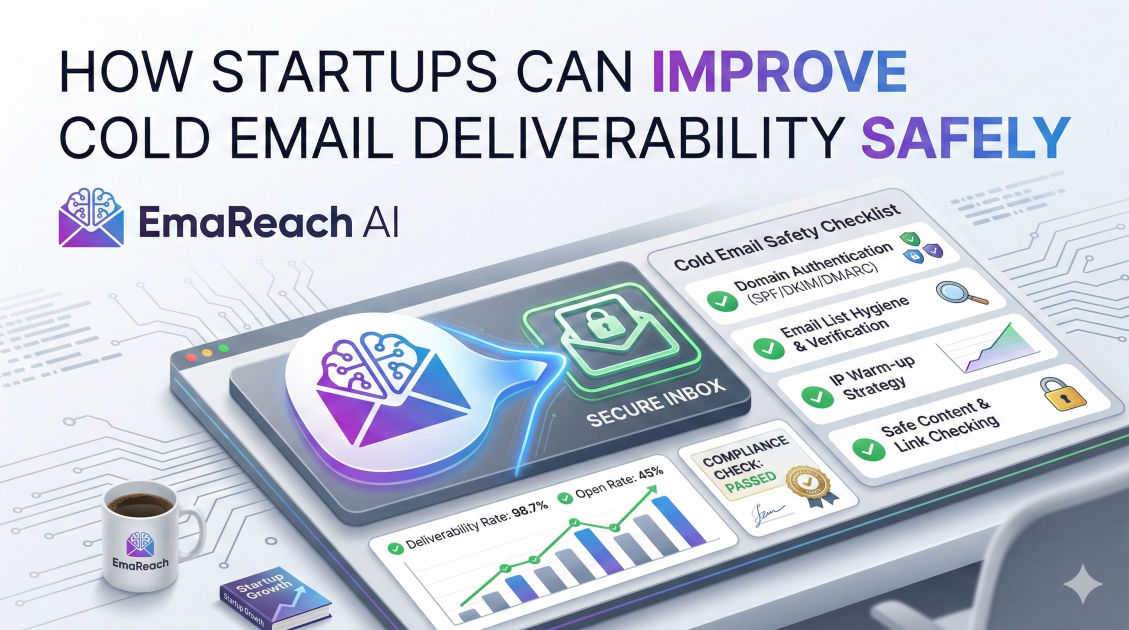
How Startups Can Improve Cold Email Deliverability Safely
cold emaildeliverabilitystartup growthB2B saleslead generationemail outreach
Introduction
For startups, momentum is everything. Whether you are searching for your first ten paying customers, reaching out to potential angel investors, or establishing strategic partnerships, cold email remains one of the most powerful, scalable, and cost-effective channels at your disposal. However, an elegantly written pitch and a highly targeted lead list are entirely useless if your messages never actually reach the recipient's primary inbox.
The landscape of email deliverability has grown increasingly complex. Major email service providers have implemented highly sophisticated, machine-learning-driven algorithms designed to protect their users from spam, phishing, and unwanted automated outreach. For a new startup with a fresh domain and no established sender reputation, these aggressive spam filters pose a massive barrier to entry.
Improving cold email deliverability is not about finding a magical loophole or a secret hack. It is about building trust with email providers through proper technical setup, disciplined sending behavior, and high-quality, relevant content. This comprehensive guide explores the foundational strategies and advanced tactics startups must employ to safely scale their cold email outreach, protect their brand reputation, and consistently land in the primary inbox.
The Technical Foundation: Safeguarding Your Primary Domain
The most critical mistake a startup can make in cold outreach is sending mass emails directly from their primary company domain (e.g., founder@yourstartup.com). If your cold email campaigns generate spam complaints or hit spam traps, the sender reputation of that domain will plummet. Once a primary domain's reputation is damaged, critical transactional emails—like password resets, customer support replies, and invoice deliveries—will also start landing in your customers' spam folders.
Strategic Domain Architecture
To ensure your primary domain remains completely insulated from the inherent risks of cold outreach, startups must implement a secondary domain strategy.
Secondary domains are alternative URLs purchased specifically for outbound emailing. They should look almost identical to your primary domain to maintain brand consistency but remain technically separate. For example, if your primary domain is trystartup.com, your secondary domains might include:
getstartup.comtrystartup.nettrystartup.iostartup-app.com
By distributing your outreach volume across multiple secondary domains, you mitigate risk. If one domain temporarily suffers a dip in reputation, your primary business operations remain unaffected, and your overall outreach engine continues running smoothly on the other domains. Always redirect these secondary domains to your main website so that curious recipients who type the URL into their browser are seamlessly guided to your primary landing page.
The Holy Trinity of Email Authentication: SPF, DKIM, and DMARC
Purchasing secondary domains is only the first step. Before sending a single email, you must prove to receiving servers that you are exactly who you claim to be. Email providers look for three specific DNS records to verify your identity. Without these properly configured, your emails will almost certainly be blocked or routed to the spam folder.
1. Sender Policy Framework (SPF)
SPF acts as a public guest list for your domain. It is a DNS record that explicitly lists all the IP addresses and mail servers that are authorized to send emails on your behalf. When an email arrives at the recipient's server, the server checks your SPF record. If the email came from a server not listed on your SPF record, it is flagged as unauthorized and likely discarded or marked as spam.
2. DomainKeys Identified Mail (DKIM)
DKIM adds a cryptographic signature to your emails. When you send a message, your mail server attaches a private key signature to it. The receiving server then looks up your domain's public key (published in your DNS records) to verify the signature. DKIM ensures that the email was indeed sent by the domain owner and, crucially, that the content of the email was not altered in transit.
3. Domain-based Message Authentication, Reporting, and Conformance (DMARC)
DMARC is the policy layer that brings SPF and DKIM together. A DMARC record instructs the receiving email server on what exactly to do if an email fails either the SPF or DKIM check. As a startup configuring new domains, you should start with a policy of p=none (which simply monitors failures) and eventually move to p=quarantine or p=reject to protect your domain from being spoofed by malicious actors. Having a valid DMARC record is now a strict requirement for sending to major providers like Google and Yahoo.
The Art and Science of Inbox Warming
A brand new domain is like a stranger walking into a highly secure building. Email providers inherently distrust domains with zero sending history. If you suddenly send five hundred emails on day one, the algorithms will instantly classify you as a spammer.
Gradual Volume Increases
Inbox warming is the process of slowly and methodically building a positive sender reputation. You begin by sending a very small number of emails per day (e.g., 2 to 5 emails) and gradually increase that volume over several weeks.
Generating Positive Engagement
Volume alone is not enough; you need positive engagement. Email providers monitor how recipients interact with your messages. They look for signals such as:
- Emails being opened.
- Emails being replied to.
- Emails being marked as "Not Spam" and moved from the spam folder to the primary inbox.
- Emails being starred or categorized.
Achieving this manually is incredibly tedious, which is why startups must rely on automated warm-up networks. These networks consist of thousands of real inboxes that automatically interact with your emails, generating the positive signals required to build a stellar reputation.
Managing multiple inboxes and ensuring they are all properly warmed up can quickly become a full-time job. This is where dedicated platforms become essential. For instance, using tools like EmaReach can significantly streamline this process. EmaReach AI combines AI-written cold outreach with inbox warm-up and multi-account sending—so your emails land in the primary tab and get replies. By automating the warm-up and rotation of accounts, startups can safely scale their outreach without ever compromising their sender reputation.
Data Hygiene: The Importance of Clean Lead Lists
Your sender reputation is heavily influenced by the quality of the email addresses you try to contact. A high bounce rate is a massive red flag to email providers. It signals that you are guessing email addresses or using scraped, outdated databases—both hallmarks of a spammer.
Mandatory Email Verification
Never send an email to a list that has not been rigorously cleaned and verified. Startups must run every single lead through an email verification service before importing them into their sending tool. Verification tools check the syntax of the email, query the domain's MX records, and ping the receiving server to confirm whether the specific inbox actually exists.
Managing Catch-All Domains
During the verification process, you will inevitably encounter "catch-all" domains. A catch-all domain is configured by a company to accept any email sent to their domain, regardless of whether the specific prefix (the part before the @ symbol) exists. While this prevents the sender from receiving an immediate hard bounce, it also means standard verification tools cannot guarantee the inbox is real.
To safely navigate catch-all domains, startups should either exclude them from initial campaigns entirely or isolate them into a separate, lower-volume campaign. If you send to too many invalid catch-all addresses, the receiving server will quietly penalize your domain reputation.
Crafting Deliverability-Friendly Content
The words you use and the way you format your emails play a massive role in whether you reach the inbox. Spam filters analyze the content of your message just as closely as they analyze your technical setup.
Avoiding the Spam Lexicon
Spam filters maintain extensive databases of words and phrases commonly used by malicious actors and aggressive marketers. Startups must ruthlessly eliminate these from their cold emails. Avoid words and phrases such as:
- Free
- Guarantee
- Act now
- Click here
- Limited time
- Urgent
- 100%
- $$$
Write conversationally. If an email sounds like a flashy billboard advertisement, it will be treated like one.
The Text-to-Image and Text-to-Link Ratios
Cold emails should look and feel exactly like a message you would send to a colleague. This means keeping the formatting incredibly simple.
Startups should avoid using HTML templates, heavy corporate branding, or embedded images in their cold outreach. A high image-to-text ratio is a common trigger for promotional and spam filters.
Similarly, limit the number of links in your email. Ideally, a cold email should contain no more than one link, and often, it is safer to send the very first email with zero links. Instead of linking to a calendar booking page immediately, ask a simple question to generate a reply: "Would you be opposed to me sending over a brief resource on how this works?" Once the prospect replies, the email provider recognizes a two-way conversation, making it perfectly safe to include a link in your follow-up.
Personalization at Scale
Personalization is not just a tactic to increase conversion rates; it is a critical deliverability strategy. Spam filters look for identical messages being blasted out to hundreds of people simultaneously. By deeply personalizing your emails, you ensure that the text payload of every single message is mathematically unique.
Beyond just inserting the prospect's first name and company, incorporate custom introductory lines, reference specific pain points relevant to their exact industry, or mention a recent milestone their company achieved. This variance tricks the filters into recognizing your outreach as manual, one-to-one communication.
Custom Tracking Domains and Link Safety
If you must include links in your outreach, you need to be acutely aware of how link tracking works. Most cold email platforms offer open and click tracking. To track these metrics, the platform wraps your original URL in a tracking link.
If you use the default tracking domain provided by your cold email software, you are sharing that domain's reputation with thousands of other users. If just one of those users sends spam and gets the shared tracking domain blacklisted, your emails will also be sent to spam because they contain that blacklisted tracking link.
Implementing Custom Tracking Domains
To avoid this shared risk, startups must configure a custom tracking domain. This involves creating a CNAME record in your DNS settings that points a subdomain of your outreach domain (e.g., track.getstartup.com) to your email platform. This ensures that the tracking links inside your emails match the domain in the "From" address, creating alignment that email providers trust. Furthermore, you completely isolate your reputation from the behavior of other software users.
The Case Against Open Tracking
Many modern deliverability experts recommend disabling open tracking entirely. Open tracking relies on a tiny, invisible 1x1 pixel embedded in the HTML of the email. With the advent of mail privacy protections (like Apple's Mail Privacy Protection), open rates have become highly inaccurate. More importantly, aggressive spam filters often penalize emails containing tracking pixels. For startups prioritizing ultimate inbox placement, turning off open tracking and focusing solely on reply rates is often the safest and most effective strategy.
Optimizing Sending Mechanics and Behaviors
Even with perfect domains, impeccable technical setup, and flawless content, how you physically send the emails matters immensely. You must mimic the behavior of a normal human being working at a computer.
Sending Volume and Limits
A human being cannot physically type and send 500 targeted emails in ten minutes. If your software blasts out your entire daily volume in a single burst, spam algorithms will instantly recognize it as automated bot activity.
Startups must space out their email delivery throughout the working day. Configure your software to leave random, variable delays between each message (e.g., sending an email every 3 to 8 minutes). Furthermore, cap the total daily volume of each individual inbox to a safe threshold, generally no more than 30 to 50 cold emails per day, per address.
Multi-Account Strategies
Because individual inboxes are limited in how much they can safely send, scaling startup outreach requires a horizontal approach rather than a vertical one. Instead of trying to force 500 emails through one inbox, you spread 500 emails across 10 or 15 different inboxes, all hosted on different secondary domains. This distributed approach allows for high-volume lead generation while keeping the daily load on any single address comfortably below the radar of spam filters.
Monitoring Deliverability Metrics and Feedback Loops
Deliverability is not a "set it and forget it" endeavor. It requires continuous monitoring and proactive adjustments.
Startups must obsessively monitor their bounce rates, keeping them strictly below 2%. If a campaign experiences a sudden spike in bounces, immediately pause the campaign, re-evaluate your data source, and re-verify the list.
Additionally, monitor your reply rates. A healthy reply rate (even if the replies are rejections like "No thanks") signals to providers that your emails are relevant and engaging enough to warrant a response. If your reply rate drops near zero while your open rates simultaneously plummet, it is a strong leading indicator that your domain may have been silently routed to the spam folder, prompting the need for immediate investigation and potential re-warming of the domain.
Conclusion
Mastering cold email deliverability is a fundamental requirement for any startup looking to leverage outbound sales. By systematically isolating primary domains, strictly enforcing technical authentication protocols, committing to patient inbox warming, and prioritizing list hygiene, founders can bypass the algorithmic gatekeepers. Combined with personalized, non-promotional content and human-mimicking sending behaviors, startups can build a resilient outreach engine that consistently lands in the primary inbox, ensuring their message is heard by the people who matter most to their growth.
EmaReach AI
Ready to scale your cold email outreach?
Join thousands of teams using EmaReach AI for AI-powered campaigns, domain warmup, and 95%+ deliverability. Start free — no credit card required.
Related posts
- Read article
The Instantly Alternative That Finally Gets Outbound Analytics Right
Discover why high-volume cold email requires a shift from surface-level vanity metrics to deep, data-driven revenue attribution, and explore the ultimate alternatives for mastering outbound engineering.
- Read article
What You Gain and What You Give Up When Switching From Instantly
Thinking about migrating your cold email stack? This detailed guide breaks down the exact operational advantages you gain and the core features you sacrifice when switching away from Instantly's popular outreach platform.