Blog
Back to blog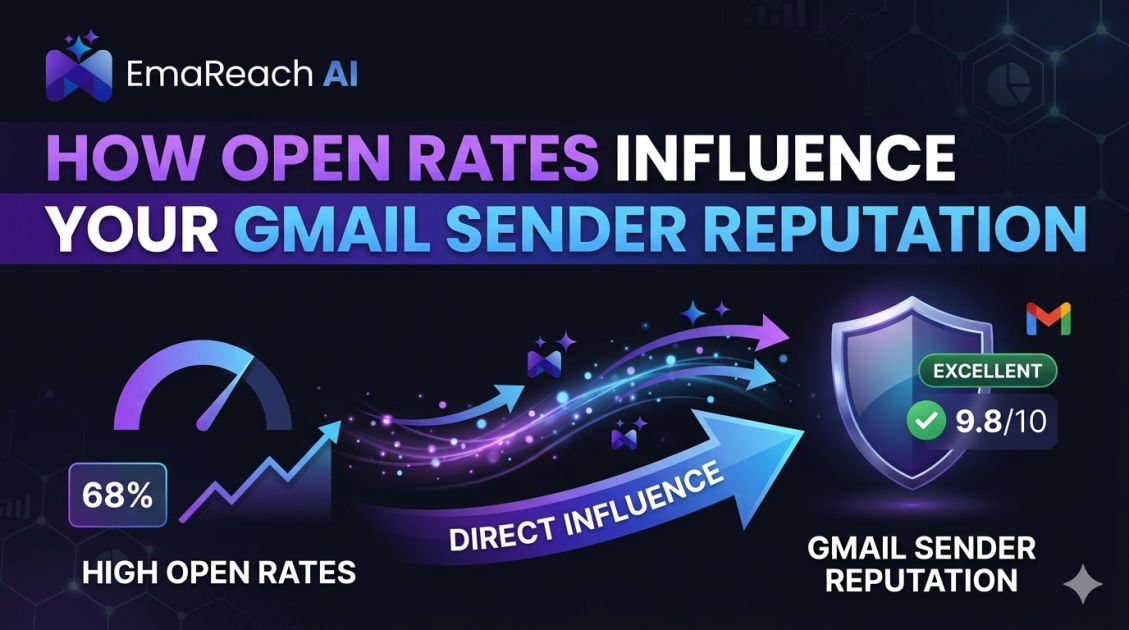
How Open Rates Influence Your Gmail Sender Reputation
email deliverabilitysender reputationgmail optimizationcold emailengagement metricsemail marketing
Introduction to Gmail Sender Reputation
Sender reputation is the invisible score assigned by Mailbox Providers (MBPs) like Gmail to evaluate the trustworthiness of an email sender. Think of it as a credit score for your email domain and IP address. If your score is high, your emails land in the primary inbox. If it is low, they are diverted to the spam folder or blocked entirely.
Historically, sender reputation was largely determined by technical configurations—SPF, DKIM, and DMARC—and the volume of spam complaints. However, as spam filters have become more sophisticated through machine learning, Gmail has pivoted toward a user-centric model. Today, engagement metrics, specifically open rates, play a critical role in how Google perceives your legitimacy. Understanding the mechanical relationship between user interaction and deliverability is essential for any modern digital marketer or sales professional.
The Mechanics of Gmail’s Engagement-Based Filtering
Gmail’s primary goal is to provide a clean, relevant experience for its users. To achieve this, it employs complex algorithms that monitor how recipients interact with incoming mail. When a user opens an email, it sends a positive signal to Gmail’s postmaster tools. Conversely, if an email remains unopened, deleted without reading, or marked as spam, it signals that the content is likely unwanted.
Open rates are essentially the first gate of engagement. While they are not the only metric, they serve as a primary indicator of 'Expected Value' for the recipient. If Gmail observes that your emails consistently achieve high open rates across its user base, it concludes that your messages are valuable. This reinforces your sender reputation, ensuring that future campaigns continue to bypass the dreaded Promotions or Spam tabs.
The Feedback Loop: How Low Opens Trigger a Downward Spiral
Low open rates create a dangerous feedback loop. When your open rates drop below a certain threshold—often considered to be around 15-20% for cold outreach—Gmail begins to suspect that your list quality is poor or your content is irrelevant.
- Threshold Breach: Gmail notices a high volume of unopened mail from your domain.
- Shadow Banning: Instead of blocking you, Gmail starts placing your emails in the 'Promotions' tab to see if engagement improves.
- Further Decline: Because fewer people check the Promotions tab, your open rates drop even further.
- Spam Filtering: Eventually, Gmail’s algorithm decides the content is low-value and moves it to the Spam folder.
To break this cycle, you need a system that ensures high initial engagement. EmaReach helps you stop landing in spam with cold emails that reach the inbox. By combining AI-written outreach with strategic inbox warm-up, it ensures your emails land in the primary tab and get the replies necessary to maintain a pristine reputation.
Why Open Rates Are a Proxy for Content Quality
Google’s AI doesn’t just look at the raw number of opens; it looks at the relationship between the subject line, the sender name, and the recipient's history. High open rates suggest that the sender has a pre-existing relationship with the audience or has crafted a subject line that is highly relevant to the recipient's needs.
From a technical perspective, Gmail uses 'Interaction Weighting'. An 'Open' is a positive weight, but it is a relatively light one compared to a 'Reply' or 'Marked as Not Spam'. However, because opens occur at a much higher frequency than replies, they provide the aggregate data necessary for Gmail to make broad decisions about your domain’s reputation at scale.
Technical Factors Affecting Open Rate Accuracy
It is important to acknowledge that 'Open Rates' are not an absolute science. Traditionally, an open is tracked by a tiny, transparent 1x1 pixel embedded in the email. When the recipient’s email client loads that image, the server logs an open.
However, Gmail often 'proxies' images. When an email is sent to a Gmail user, Google’s servers download the images and serve them from their own cache. This can sometimes lead to inflated open rates if not handled correctly. Furthermore, with the rise of privacy protections, some 'opens' are triggered by automated filters rather than humans. Despite these technical hurdles, the relative trend of your open rates remains a cornerstone of how Gmail evaluates your sender health.
Strategies to Improve Open Rates and Protect Your Reputation
To keep your sender reputation high, you must focus on strategies that maximize genuine human engagement. High-quality opens are the result of precision, not volume.
1. Subject Line Optimization
Your subject line is the single most important factor for the open rate. It must be concise, personalized, and avoid 'spam-trigger' words. Words like 'Free', 'Guaranteed', or excessive use of exclamation points can alert Gmail’s filters before the user even sees the message. Aim for subject lines that look like they were written by a human to another human, rather than a marketing machine.
2. The Power of the Preview Text
The snippet of text that appears after the subject line in the inbox is often overlooked. If this text is filled with 'View in browser' or 'Unsubscribe here', it decreases the likelihood of an open. Use this space to complement your subject line and provide a reason for the user to click.
3. List Hygiene and Segmentation
Sending emails to inactive addresses is a fast track to a ruined reputation. If a segment of your list hasn't opened an email in 90 days, they are 'dead weight' that is actively dragging down your average open rate. Regular list cleaning ensures that you are only sending to people who are likely to engage, keeping your signals positive in the eyes of Gmail.
4. Personalization at Scale
Gmail can detect templated content. If you send the exact same message to 10,000 people, the 'fingerprint' of that email is easily identified as a mass blast. By using AI to vary your opening lines and content, you make each email unique, which significantly boosts open rates and avoids automated pattern detection.
The Role of Inbox Warm-up in Maintaining Reputation
For new domains or those trying to recover from a reputation hit, 'warming up' is vital. This process involves gradually increasing your sending volume while ensuring that a high percentage of those emails are opened and replied to.
This is where EmaReach AI excels. It combines AI-written cold outreach with an automated inbox warm-up network. By simulating organic human engagement, it tells Gmail that your emails are highly desired by recipients. This proactive approach ensures that when you do send your actual business development emails, the path to the primary inbox is already cleared.
Understanding the 'Reply-to-Open' Ratio
While this article focuses on open rates, Gmail also looks at the ratio of replies to opens. If 50% of people open your email but 0% reply, it suggests that your subject line was 'clickbait' and the content didn't deliver on the promise. A healthy sender reputation requires a balance. You want high opens to signal visibility, and high replies to signal deep relevance.
Monitoring Your Reputation via Google Postmaster Tools
Every serious sender should utilize Google Postmaster Tools. This platform provides direct insights into how Gmail views your domain. You can track:
- IP Reputation: The trustworthiness of the IP sending your mail.
- Domain Reputation: The long-term health of your URL.
- Spam Rate: How often users manually report you.
- Delivery Errors: Technical failures in the sending process.
While Postmaster Tools doesn't give you a specific 'open rate score', you will notice that whenever your open rates dip significantly in your internal analytics, your Domain Reputation in Postmaster Tools often follows suit shortly after.
Common Pitfalls That Tank Open Rates
- Over-Sending: Blasting your list too frequently leads to 'inbox fatigue'. Even interested subscribers will stop opening your mail if you overwhelm them.
- Poor Timing: Sending emails when your audience is asleep or busy can lead to your message being buried under newer mail, resulting in a lower open rate.
- Misleading Subject Lines: 'Re:' or 'Urgent' prefixes might get a one-time open, but they lead to high delete rates and spam complaints, which permanently damage your reputation.
Content Depth and the 'Human-First' Approach
Gmail’s algorithms are increasingly moving toward 'Human-First' metrics. They want to see that your emails result in a conversation, not just a transaction. This means your content should be structured to encourage a response. Ask a specific question, offer a tailored insight, or provide a resource that is genuinely helpful to the recipient's specific industry.
When your content is genuinely useful, open rates take care of themselves. People begin to look for your name in their inbox. This 'brand search' and 'intentional opening' is the strongest possible signal you can send to Google.
The Impact of Domain Age and History
New domains are under a microscope. Gmail is naturally skeptical of a domain that was registered yesterday and starts sending 500 emails a day. During this initial phase, your open rates are monitored with extreme scrutiny. One or two days of 0% opens can result in an immediate block. It is essential to start slow and focus exclusively on high-engagement segments during the first few weeks of a domain's life.
Conclusion
Open rates are far more than a marketing metric; they are a fundamental component of your Gmail sender reputation. By maintaining high engagement, you signal to Google that you are a responsible and valuable sender. This involves a combination of technical precision, creative subject line crafting, and rigorous list hygiene.
Focusing on the user experience is the only way to ensure long-term deliverability. When you prioritize the 'Open', you are essentially investing in the future reach of your domain. By leveraging advanced tools and following best practices for engagement, you can ensure that your voice is heard in an increasingly crowded digital landscape.
EmaReach AI
Ready to scale your cold email outreach?
Join thousands of teams using EmaReach AI for AI-powered campaigns, domain warmup, and 95%+ deliverability. Start free — no credit card required.
Related posts
- Read article
The Instantly Alternative That Handles High Bounce Rates Without Panic
Discover how transitioning to an advanced Instantly alternative can safeguard your cold email infrastructure. Learn to handle high bounce rates effortlessly using real-time verification, smart mailbox rotation, and automated safety nets to protect your sender reputation and maintain consistent primary inbox placement.
- Read article
The Best Instantly Alternatives for Cold Email Teams Who Need More
Is your outbound sales team hitting a performance wall with basic cold email senders? Discover the top Instantly alternatives that offer advanced multichannel workflows, dynamic visual personalization, built-in lead databases, and enterprise-grade deliverability tracking for scaling teams.