Blog
Back to blog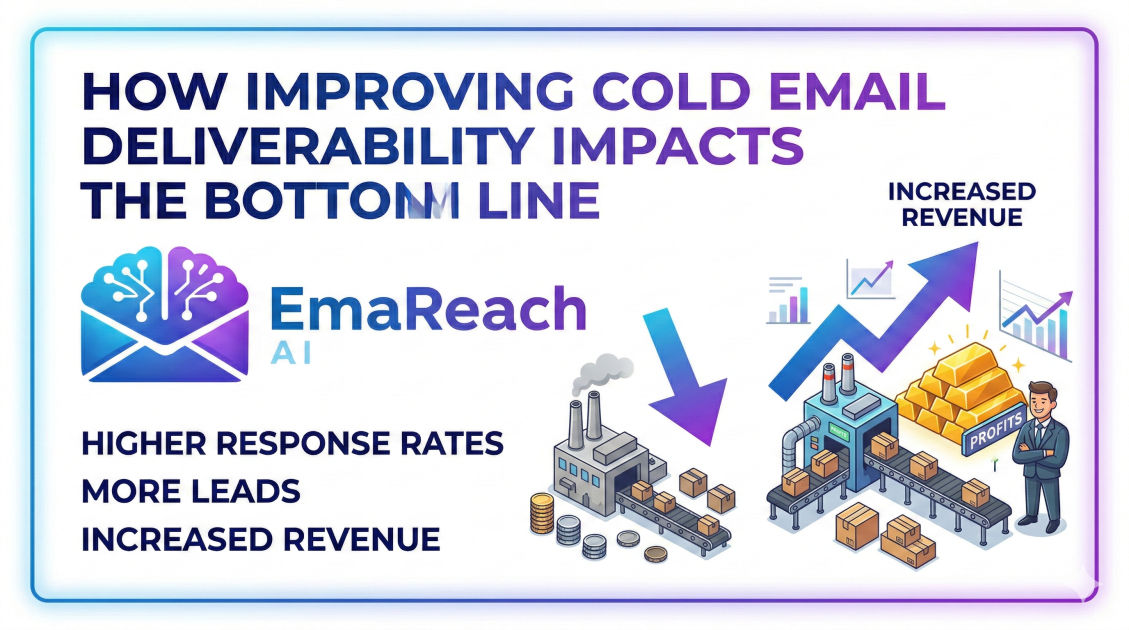
How Improving Cold Email Deliverability Impacts the Bottom Line
cold emailemail deliverabilitysales strategylead generationrevenue growthinbox placement
Introduction: The Hidden Leak in Your Revenue Pipeline
In the modern landscape of B2B sales, cold email remains one of the most scalable and cost-effective ways to generate high-quality leads. However, many businesses treat cold email as a simple numbers game: send more, get more. This logic fails to account for a critical variable that often sits silently in the background, eroding ROI and inflating customer acquisition costs. That variable is email deliverability.
Deliverability is not just a technical metric; it is a financial one. When an email fails to reach the inbox, it isn't just a missed communication—it is wasted spend on data, lost labor hours for sales development representatives (SDRs), and, most importantly, missed revenue. Improving cold email deliverability is one of the highest-leverage activities a growth-focused organization can undertake to directly impact the bottom line.
The Mathematical Reality of Deliverability
To understand the financial impact, we must look at the funnel. Traditional sales math looks like this: Emails Sent -> Open Rate -> Reply Rate -> Meeting Booked -> Closed Won.
If you send 10,000 emails and have a 1% "Closed Won" rate, you have 100 new customers. But this math assumes a 100% deliverability rate. In reality, industry averages suggest that many cold outreach campaigns suffer from 20% to 40% of their emails landing in spam or being blocked by Internet Service Providers (ISPs).
If 30% of your emails are going to spam, you aren't just losing 3,000 emails; you are losing 30 potential customers. If your Average Contract Value (ACV) is $10,000, that technical glitch just cost your company $300,000 in unrealized revenue. Improving deliverability from 70% to 95% is effectively the same as a massive increase in lead generation budget, yet it costs a fraction of the price.
The Cost of a Tarnished Domain Reputation
Email deliverability is governed by your sender reputation. Think of this as a credit score for your domain. When you send high volumes of emails that get flagged as spam, have high bounce rates, or engage with "spam traps," your score drops.
Once your domain reputation is damaged, the financial consequences are compounding:
- Reduced Lifetime Value of Domain Assets: If your primary corporate domain gets blacklisted, it doesn't just affect cold outreach; it affects everyday business communication, client success emails, and internal coordination. The cost of migrating an entire company to a new domain is significant in terms of IT hours and brand confusion.
- Increased Data Waste: High-quality B2B data is expensive. When you pump premium lead lists into a system with poor deliverability, you are essentially throwing money away. You pay for the lead, but the lead never sees the offer.
- Inefficient Labor Allocation: SDRs spent hours personalizing messages. If those messages land in the spam folder, the hourly wage paid for that personalization yields a 0% return.
Technical Foundations: The Infrastructure of Profit
High deliverability starts with technical setup. While this may seem like "IT work," it is the foundation of your sales engine. Without proper authentication, ISPs like Google and Microsoft have no reason to trust your emails.
SPF, DKIM, and DMARC
These three protocols are the "ID cards" of the email world.
- SPF (Sender Policy Framework): Specifies which mail servers are authorized to send email on behalf of your domain.
- DKIM (DomainKeys Identified Mail): Adds a digital signature to emails, ensuring the content hasn't been tampered with.
- DMARC (Domain-based Message Authentication, Reporting, and Conformance): Tells the receiving server what to do if SPF or DKIM fails.
Businesses that ignore these protocols see higher bounce rates and lower trust scores. Fixing these is a one-time setup that pays dividends in perpetuity by ensuring your infrastructure is recognized as legitimate by global security filters.
The Role of Inbox Warm-up in Revenue Protection
One of the most common mistakes companies make is "ramping up" too fast. If a new email account suddenly sends 500 emails a day, it triggers an immediate red flag for spam filters. This leads to a quick death for the account and a total loss of the outreach potential for that seat.
This is where strategic tools become essential. To ensure long-term success, many organizations turn to platforms like EmaReach. EmaReach helps you "Stop Landing in Spam" by ensuring your cold emails actually reach the inbox. Their system combines AI-written cold outreach with automated inbox warm-up and multi-account sending. This ensures that your emails land in the primary tab, which is the only place where they can actually generate a reply and contribute to your bottom line.
Quality Over Quantity: The Engagement Signal
ISPs are increasingly using engagement metrics to determine where to place your email. If people open your emails, reply to them, and mark them as "not spam," your reputation increases. If they delete them without opening, your reputation falls.
Improving deliverability, therefore, forces a higher standard of copy. Better copy leads to higher engagement, which leads to better deliverability, creating a virtuous cycle of growth.
Targeting and Segmentation
Sending a generic message to a broad list is a recipe for high spam complaints. By narrowing your focus and segmenting your lists, you ensure relevance. Relevance reduces the likelihood of a recipient clicking the "Report Spam" button. Every spam click is a tiny hit to your revenue potential; avoiding them is a strategic necessity.
Scaling Through Multi-Account Strategies
To protect the bottom line, savvy organizations no longer send thousands of emails from a single address. Instead, they distribute the volume across multiple secondary domains and accounts. This strategy is known as "inbox rotation."
If you have ten accounts sending 50 emails each, rather than one account sending 500, you significantly reduce the risk of any single account being flagged. If one account does run into deliverability issues, the other 90% of your outreach continues uninterrupted. This risk mitigation strategy ensures a steady flow of leads and prevents the "revenue droughts" that occur when a primary sending domain gets burned.
The Impact of Bounce Rates on Growth
A bounce happens when an email cannot be delivered. "Hard bounces" (permanent failures, like a non-existent email address) are particularly toxic. If your bounce rate exceeds 2%, ISPs start to view you as a reckless sender who doesn't maintain their lists.
Regular list cleaning is an investment in deliverability. While it might seem counterintuitive to remove leads from your database, keeping "dirty" data in your system is actively harming your ability to reach the "clean" leads. By maintaining a bounce rate near 0%, you signal to providers that you are a high-quality sender, ensuring your best prospects actually see your message.
Measuring the ROI of Improved Deliverability
How do you quantify the impact of these technical improvements? You can use a simple formula to see the "Deliverability Lift."
Current State:
- 5,000 emails sent
- 70% Deliverability (3,500 reach inbox)
- 20% Open Rate (700 opens)
- 5% Reply Rate (35 replies)
- 20% Meeting Rate (7 meetings)
Optimized State:
- 5,000 emails sent
- 95% Deliverability (4,750 reach inbox)
- 20% Open Rate (950 opens)
- 5% Reply Rate (47.5 replies)
- 20% Meeting Rate (9.5 meetings)
In this scenario, simply improving deliverability—without changing a single word of the copy or spending a cent more on data—resulted in nearly a 35% increase in meetings. For a sales team, that is a massive increase in pipeline velocity achieved purely through technical optimization.
Human-Centric AI and the Future of the Inbox
As spam filters become more sophisticated, they are using machine learning to detect "templated" or robotic language. High-volume, low-value automation is being phased out by the algorithms. The future of cold outreach lies in AI that can mimic human patterns and provide genuine value.
By leveraging AI-written outreach that feels personal and relevant, businesses can maintain the high engagement levels required for top-tier deliverability. This isn't just about avoiding filters; it's about respecting the recipient's inbox. When you combine high-relevance AI copy with a warmed-up infrastructure, you create a system that is virtually "spam-proof."
Conclusion: Deliverability as a Competitive Advantage
In an era where every company is using automation to reach prospects, the inbox is more crowded than ever. Most companies will continue to struggle with deliverability, wondering why their open rates are dropping and their lead flow is inconsistent.
By treating email deliverability as a core pillar of your financial strategy, you gain a massive competitive advantage. You reach the prospects your competitors can't. You maximize the value of every lead you purchase. You protect your brand's digital reputation and ensure that your sales team is spending their time talking to prospects, not fighting with spam filters.
Improving your cold email deliverability is not merely a technical checkbox. It is the process of widening the mouth of your funnel, lowering your customer acquisition costs, and ensuring that your message—the core value of your business—actually gets the chance to be heard. In the final analysis, your bottom line is only as strong as your ability to connect with your audience. Don't let a spam folder stand in the way of your growth.
EmaReach AI
Ready to scale your cold email outreach?
Join thousands of teams using EmaReach AI for AI-powered campaigns, domain warmup, and 95%+ deliverability. Start free — no credit card required.
Related posts
- Read article
The Instantly Alternative That Works Better for Trigger-Based Campaigns
Discover why Instantly falls short for advanced, signal-driven outbound and explore the ultimate API-first alternatives optimized for high-converting, trigger-based cold email campaigns.
- Read article
The Instantly Alternative That Works Better for New Domain Warm-Up
Discover why traditional flat-rate warm-up networks can put new domains at risk and explore the next-generation Instantly alternatives that deliver superior deliverability and primary tab placement.