Blog
Back to blog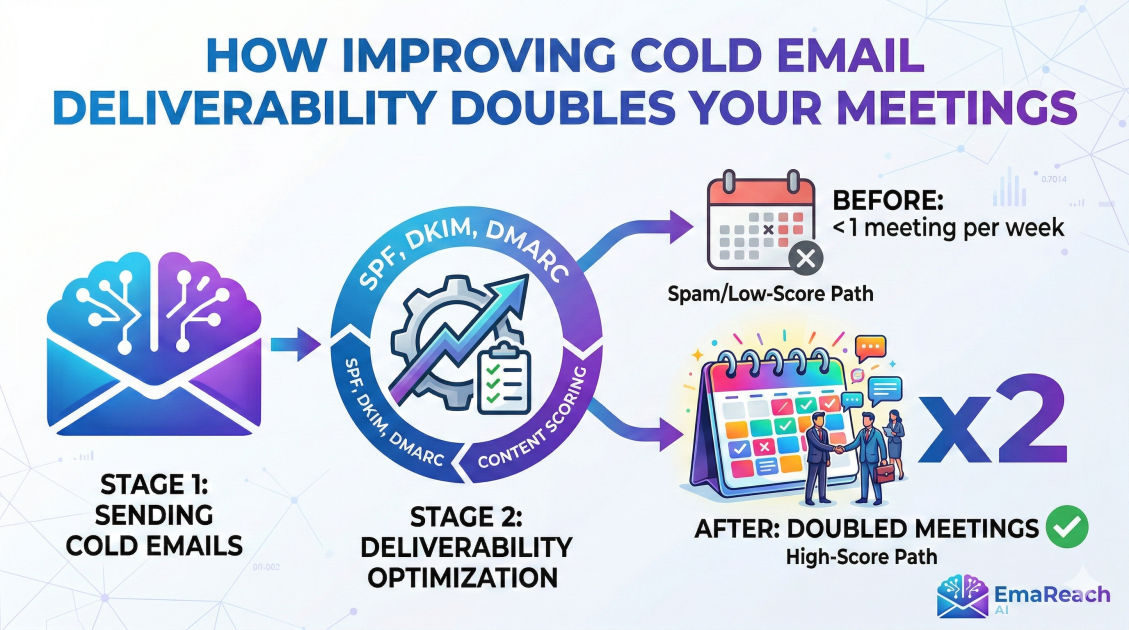
How Improving Cold Email Deliverability Doubles Your Meetings
cold emailemail deliverabilitysales outreachlead generationinbox placementemail marketingB2B sales
Introduction: The Invisible Barrier to Your Growth
You have spent hours perfecting your value proposition. You have meticulously curated a list of high-value prospects who genuinely need your solution. Your copy is sharp, your call-to-action is clear, and your offer is irresistible. Yet, the results are underwhelming. The open rates are abysmal, and the meeting requests are nonexistent.
In the world of outbound sales, most professionals assume their lack of results is a copywriting problem. They tweak the subject line, change the first sentence, or offer a bigger discount. But more often than not, the problem isn't what you are saying—it is whether your prospects ever see it in the first place.
Email deliverability is the silent engine of every successful cold outreach campaign. If your deliverability is poor, your emails are diverted to the spam folder or blocked by ISP filters before they ever reach the primary inbox. Conversely, when you master deliverability, you ensure your message lands where it belongs. Improving your technical setup and sender reputation doesn't just marginally increase your results; it can easily double the number of meetings on your calendar by simply exposing your existing high-quality copy to twice as many people.
The Mathematics of Deliverability
To understand how deliverability doubles your meetings, we must look at the sales funnel as a series of cascading probabilities.
Imagine you send 1,000 cold emails.
- Scenario A (Poor Deliverability): 40% of your emails land in spam. Only 600 reach the inbox. With a 20% open rate, 120 people read your email. With a 2% booking rate from opens, you secure 2.4 meetings.
- Scenario B (Optimized Deliverability): 95% of your emails land in the primary inbox. 950 reach the prospect. With the same 20% open rate, 190 people read your email. At the same 2% booking rate, you secure 3.8 meetings.
Now, consider the compounding effect of Inbox Placement. In Scenario B, because your emails are landing in the Primary tab rather than the Promotions or Spam tabs, your open rate naturally climbs from 20% to 40% because of higher visibility.
- Scenario C (Primary Inbox Placement): 950 emails reach the primary inbox. A 40% open rate leads to 380 readers. A 2% booking rate leads to 7.6 meetings.
By focusing on deliverability, you haven't changed a single word of your sales pitch, yet you have more than tripled your output. This is why deliverability is the highest-leverage activity in outbound sales.
The Technical Foundation: SPF, DKIM, and DMARC
Before you send a single email, you must prove to the receiving mail servers that you are a legitimate sender and not a malicious actor. This is handled through DNS (Domain Name System) records. Think of these as your digital passport.
SPF (Sender Policy Framework)
SPF is a TXT record that lists the specific IP addresses and domains authorized to send emails on behalf of your domain. When an email arrives, the recipient's server checks the SPF record. If the email comes from a source not listed, it is flagged as suspicious.
DKIM (DomainKeys Identified Mail)
DKIM adds a digital signature to your emails. This cryptographic signature ensures that the content of the email hasn't been tampered with during transit. It proves that the email actually originated from your domain and remained intact.
DMARC (Domain-based Message Authentication, Reporting, and Conformance)
DMARC is the policy layer. It tells the receiving server what to do if an email fails SPF or DKIM checks. You can set it to "none" (just monitor), "quarantine" (send to spam), or "reject" (block entirely). Having a strict DMARC policy significantly boosts your sender authority.
The Power of Domain Warm-up
One of the most common mistakes in cold outreach is "burning" a new domain. If you register a new domain and immediately start sending 100 emails a day, spam filters will instantly flag you. To them, this behavior looks like a bot or a temporary spam account.
Email warm-up is the process of gradually increasing your sending volume to build a positive reputation. This involves sending low volumes of emails to "friendly" accounts that open the emails, move them out of spam if they land there, and reply. This engagement signals to providers like Google and Outlook that you are a human sender providing value.
Using a comprehensive solution like EmaReach can automate this process. EmaReach combines AI-written cold outreach with automated inbox warm-up and multi-account sending. This ensures that by the time you launch your actual campaign, your technical reputation is rock solid, and your emails land in the primary tab rather than the dark abyss of the spam folder.
Technical Setup: Using Multiple Domains and Accounts
Professional outbound teams never send cold emails from their primary company domain (e.g., yourcompany.com). If you make a mistake and get blacklisted, your entire company’s internal communication and transactional emails (like password resets) will stop working.
Instead, use secondary domains. For example, if your domain is acme.com, you might buy getacme.com, tryacme.com, or acmehq.com.
The Rule of 50
To maintain high deliverability, avoid sending more than 30–50 cold emails per day per email account. If you need to send 500 emails a day, do not try to do it from one account. Instead, set up 10 different email accounts across 5 different domains. This distribution of volume minimizes the risk to any single domain and keeps you under the radar of volume-based spam triggers.
Writing for the Filters: Avoiding Spam Triggers
Modern spam filters are driven by advanced machine learning. They don't just look at your technical setup; they read your content. To double your meetings, your copy must be written to please both the human reader and the AI filter.
1. Avoid "Spammy" Keywords
Words like "Free," "Guarantee," "Weight loss," "Urgent," and excessive use of dollar signs ($$$) are immediate red flags. While one or two might not kill your deliverability, a high density of these words signals a low-quality pitch.
2. Minimize Links and Attachments
Every link you add to an email is a potential point of failure. If you link to a domain with a poor reputation, your email will be penalized. In initial cold outreach, try to use zero or one link at most. Avoid attachments entirely in the first touchpoint, as they are frequently used to deliver malware and are heavily scrutinized by filters.
3. Personalization is Not Optional
If you send the exact same template to 1,000 people, filters will identify the pattern. This is known as "fingerprinting." By using dynamic variables (First Name, Company Name, a specific observation about their LinkedIn profile), you ensure that every email is unique. Unique content is much harder for automated filters to categorize as bulk spam.
Cleaning Your List: The Importance of Verification
Sending emails to addresses that don't exist is the fastest way to destroy your sender reputation. This results in a "Hard Bounce." If your bounce rate exceeds 2–3%, email service providers (ESPs) will begin to throttle your messages.
Before launching any campaign, run your list through a verification service. These tools check if the domain exists, if the mailbox is full, and if the email address is a "catch-all." High-quality lists lead to high deliverability, which leads to—you guessed it—more meetings.
The Engagement Loop: Why Replies Matter
Deliverability is not a one-time setup; it is a continuous feedback loop. The most powerful signal of a "good" sender is a high reply rate. When people reply to your emails, it tells Google and Microsoft that your content is wanted.
To maximize this:
- Ask simple questions: Instead of asking for a 30-minute demo, ask a low-friction question like, "Are you currently handling [Problem] in-house?"
- Handle unsubscribes gracefully: Always include a clear way for people to opt-out. If they can't find an unsubscribe link or a way to say "No," they will click the "Report Spam" button instead. One "Report Spam" click is more damaging than 100 unsubscribes.
Monitoring Your Reputation
You cannot manage what you do not measure. Use tools to monitor your sender reputation and check if your domains have ended up on any blacklists.
- Google Postmaster Tools: This provides direct data from Google on your IP and domain reputation, delivery errors, and encryption.
- Sender Score: Similar to a credit score, this monitors how mailbox providers view your IP address.
If you notice a dip in open rates, check these tools immediately. Often, a drop in meetings is simply a technical glitch in your deliverability that can be fixed with a few DNS adjustments or a temporary pause in sending volume to let the domain "cool down."
Leveraging AI for Scale and Safety
The challenge of modern outreach is doing things at scale without looking like a machine. This is where AI becomes a competitive advantage. AI can help craft personalized opening lines for hundreds of prospects in minutes, ensuring that no two emails are identical.
When you use a platform like EmaReach, the AI handles the heavy lifting of writing and personalization while the system manages the complex backend of multi-account rotation and warm-up. This synergy allows you to focus on the high-level strategy and closing the deals, while the technology ensures your "foot-in-the-door" actually reaches the door.
The Psychology of the Inbox
Finally, remember that deliverability isn't just about reaching the inbox; it's about reaching the mind of the prospect. When your email arrives in the Primary tab, it carries an implicit level of trust. It looks like a peer-to-peer communication rather than a marketing blast.
By doubling down on deliverability, you respect the prospect's inbox and the provider's rules. This professional approach translates into higher trust, higher open rates, and ultimately, a calendar full of qualified meetings.
Conclusion
Improving cold email deliverability is the closest thing to a "silver bullet" in outbound sales. It is the foundation upon which all other efforts are built. You can have the best product in the world and the most compelling copy ever written, but if your emails are trapped in spam, your revenue will remain stagnant.
By implementing the technical trifecta of SPF, DKIM, and DMARC, utilizing secondary domains, warming up your accounts, and keeping your lists clean, you remove the barriers between you and your prospects. This technical excellence, combined with personalized, AI-driven content, creates a reliable pipeline of opportunities. If you want to double your meetings, stop looking at your templates and start looking at your deliverability. The results will follow.
EmaReach AI
Ready to scale your cold email outreach?
Join thousands of teams using EmaReach AI for AI-powered campaigns, domain warmup, and 95%+ deliverability. Start free — no credit card required.
Related posts
- Read article
The Instantly Alternative That Finally Gets Outbound Analytics Right
Discover why high-volume cold email requires a shift from surface-level vanity metrics to deep, data-driven revenue attribution, and explore the ultimate alternatives for mastering outbound engineering.
- Read article
What You Gain and What You Give Up When Switching From Instantly
Thinking about migrating your cold email stack? This detailed guide breaks down the exact operational advantages you gain and the core features you sacrifice when switching away from Instantly's popular outreach platform.