Blog
Back to blog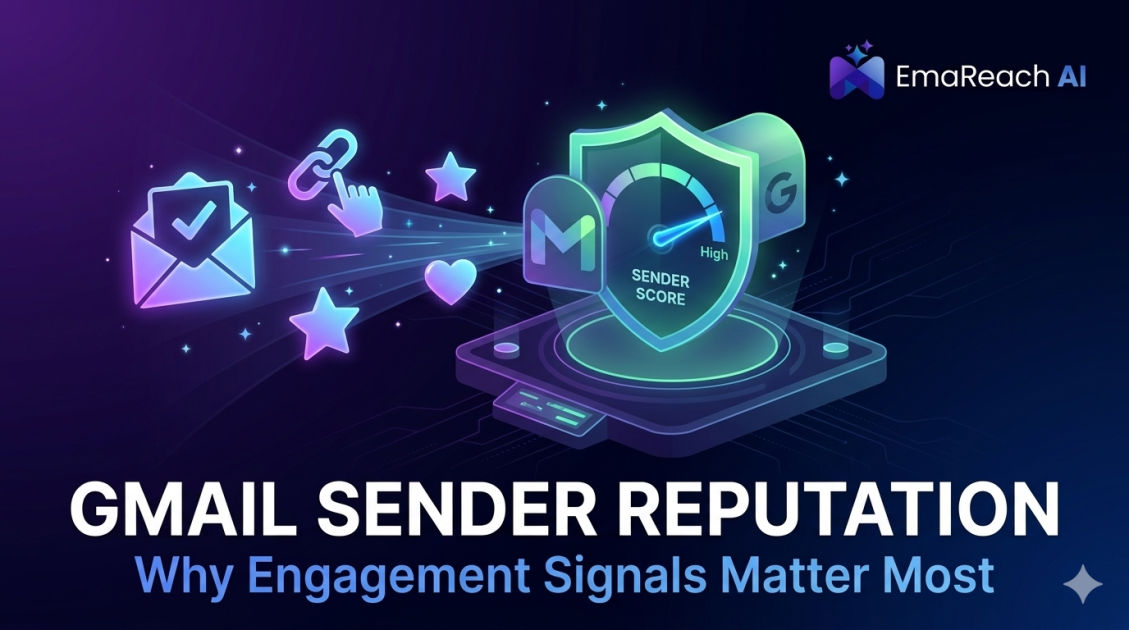
Gmail Sender Reputation: Why Engagement Signals Matter Most
email deliverabilityGmail SEOsender reputationengagement signalscold outreachinbox placementemail marketing
Introduction: The Shift from Technical Specs to Human Behavior
For years, the secret to reaching the Gmail inbox was treated like a mechanical puzzle. If you configured your SPF, DKIM, and DMARC correctly, kept your bounce rate low, and avoided a few "spammy" keywords, you were generally safe. But the landscape of email deliverability has undergone a fundamental transformation. Today, while technical infrastructure remains the foundation, engagement signals have become the primary architect of your sender reputation.
Gmail’s sophisticated AI filtering systems, now more advanced than ever, no longer just look at who is sending the email; they look at how recipients react to it. This shift means that even a perfectly authenticated email from a legitimate brand can end up in the spam folder—or the dreaded 'Promotions' tab—if the audience is indifferent. In this comprehensive guide, we will explore why engagement is the new gold standard for Gmail and how you can optimize your strategy to ensure your messages land exactly where they belong: the Primary Inbox.
Understanding the Gmail Reputation Ecosystem
Gmail doesn't assign a single "score" to your domain. Instead, it maintains a complex, multi-layered reputation system that evaluates your sending behavior across several vectors.
Domain vs. IP Reputation
Historically, IP reputation was the most critical factor. If you shared an IP with a spammer, your deliverability suffered. While IP reputation still matters, Gmail has shifted its focus heavily toward Domain Reputation. This allows Google to track your behavior regardless of which ESP (Email Service Provider) or IP address you use. If your domain builds a history of low engagement, switching providers won't save you.
The Role of Machine Learning
Gmail uses advanced machine learning models to analyze billions of data points. These models are trained to identify patterns that distinguish "wanted" mail from "unwanted" mail. The most weighted data points in these models are user interactions. Unlike static filters, these AI systems learn in real-time. If a large segment of users starts ignoring your emails, Gmail’s filters will adapt, gradually pushing your messages further away from the primary view.
The Hierarchy of Engagement Signals
Not all engagement signals are created equal. Gmail categorizes actions into positive and negative signals, with varying degrees of influence on your reputation.
1. High-Value Positive Signals: Replies and Forwards
A reply is the single most powerful positive signal you can receive. When a user replies to an email, it tells Gmail that a two-way conversation is happening—the hallmark of a legitimate, high-value relationship. Similarly, forwarding an email suggests that the content is so valuable the recipient wants to share it with others. These actions are gold for your sender reputation.
2. Moving from Spam to Inbox ('Not Spam')
This is the ultimate "rescue" signal. When a user finds your email in the spam folder and manually moves it to the inbox or clicks "Not Spam," it sends a loud, clear message to Gmail’s AI: "You made a mistake; I want this sender's mail." This act can single-handedly help repair a damaged reputation.
3. Consistency: Opens and Clicks
While basic, consistent opens and clicks indicate that your audience finds your content relevant over time. However, Gmail looks deeper than just a binary "opened" or "not opened." It tracks dwell time—how long a user stays on the email—and whether they interact with multiple elements.
4. The Critical Role of Warm-up and Volume
Sudden spikes in volume are a major red flag. Gmail prefers predictability. This is where tools like EmaReach become indispensable. Stop Landing in Spam. Cold Emails That Reach the Inbox. EmaReach AI combines AI-written cold outreach with inbox warm-up and multi-account sending—so your emails land in the primary tab and get replies. By simulating natural human engagement, it builds a foundation of positive signals before you scale your outreach.
The "Silent Killers": Negative Engagement Signals
Reputation isn't just built by what people do; it's also destroyed by what they don't do, or what they do to get away from you.
Deletion Without Reading
If a user consistently deletes your emails without ever opening them, Gmail takes notice. This is a "soft" negative signal that, when aggregated across thousands of users, tells Gmail that your content is noise, not value. Over time, this behavior will lead to your emails being automatically routed to the Promotions tab or Spam.
Marking as Spam
This is the most damaging signal. A high spam complaint rate is the fastest way to tank your domain reputation. Gmail’s threshold for spam complaints is incredibly low—often less than 0.1%. If more than 1 in 1,000 people mark you as spam, you are in the danger zone.
The Unsubscribe Paradox
While unsubscribes might seem negative, they are actually far better than the alternative: being marked as spam or being ignored. An unsubscribe is a clean break. Gmail views a functional unsubscribe process as a sign of a responsible sender.
How Gmail's AI Categorizes Content (Primary vs. Promotions)
Gmail’s goal is to keep the Primary tab for "important" and "personal" communications. Their AI looks for specific markers to decide where you land:
- Personalization: Does the email look like it was written for one person, or a million? Excessive HTML, multiple buttons, and tracking pixels can trigger the 'Promotional' filter.
- Engagement History: If a user frequently replies to your domain, you are almost guaranteed a spot in the Primary tab.
- Content Relevance: Gmail analyzes the text of your email. If it reads like a hard-sell advertisement, it’s going to Promotions. If it reads like a helpful update or a direct inquiry, it has a better chance at Primary.
Strategies to Maximize Positive Engagement
To thrive in an engagement-based ecosystem, you must move away from "batch and blast" mentalities and toward targeted, value-driven communication.
1. Radical Segmentation
Stop sending everything to everyone. Segment your list based on past behavior. Send your best, most important content to your "Most Engaged" segment first. This creates a surge of positive signals (high open and click rates) right as the campaign launches, which can "prime" Gmail’s filters to treat the rest of the campaign favorably.
2. The "Reply-First" Strategy
Incorporate direct questions into your emails. Instead of just providing a link, ask: "What are your thoughts on this?" or "Does this align with your goals?" Encouraging a reply, especially in the early stages of a customer relationship, can cement your domain’s status in that user’s Primary tab for months to come.
3. Master the Subject Line and Preheader
The subject line's job isn't to sell; it's to earn the open. If your subject line is misleading (clickbait), your dwell time will be low and your delete-without-reading rate will be high. Ensure your subject line and preheader accurately reflect the value inside.
4. Use Multi-Account Infrastructure
Distributing your sending volume across multiple accounts and domains reduces the risk of a single point of failure. If one account sees a dip in engagement, it doesn't sink your entire operation. This is a core feature of the EmaReach platform, allowing for safer, more resilient outreach.
Maintaining a Healthy Sender Reputation Long-Term
Reputation is not a "set it and forget it" metric. It requires constant hygiene and monitoring.
Regular List Scrubbing
Inactive subscribers are a liability. If someone hasn't opened an email in 90 days, they are actively hurting your reputation by providing zero engagement. Implement a re-engagement campaign, and if they still don't respond, remove them. A smaller, highly engaged list is infinitely more valuable than a large, dead one.
Monitoring Google Postmaster Tools
Google Postmaster Tools provides a direct window into how Gmail views your domain. It offers data on your IP reputation, domain reputation, and even encryption success. Monitoring these trends allows you to spot issues before they become catastrophic delivery failures.
The Power of Automated Warm-up
Especially for new domains or those recovering from a reputation hit, automated warm-up is essential. By having AI-driven accounts interact with your emails (opening, marking as important, and replying), you create a consistent stream of positive signals that counteracts any occasional negative ones. This "buffer" of engagement is what keeps professional outreach programs afloat.
Conclusion: The Future is Interactive
The era of tricking the spam filter is over. Gmail’s AI has moved the goalposts to a place where only high-quality, relevant, and engaging content can consistently win. By focusing on deep engagement signals—replies, long dwell times, and consistent interactions—you align your goals with Gmail’s goal: providing a great user experience.
Building this reputation takes time and precision. Whether you are a solo founder or a large enterprise, your ability to reach the inbox depends on the human connection your emails foster. Leverage tools that understand this shift, maintain rigorous list hygiene, and always prioritize the recipient's value over the sender's volume. When you master engagement, the inbox follows naturally.
EmaReach AI
Ready to scale your cold email outreach?
Join thousands of teams using EmaReach AI for AI-powered campaigns, domain warmup, and 95%+ deliverability. Start free — no credit card required.
Related posts
- Read article
The Instantly Alternative That Handles High Bounce Rates Without Panic
Discover how transitioning to an advanced Instantly alternative can safeguard your cold email infrastructure. Learn to handle high bounce rates effortlessly using real-time verification, smart mailbox rotation, and automated safety nets to protect your sender reputation and maintain consistent primary inbox placement.
- Read article
The Best Instantly Alternatives for Cold Email Teams Who Need More
Is your outbound sales team hitting a performance wall with basic cold email senders? Discover the top Instantly alternatives that offer advanced multichannel workflows, dynamic visual personalization, built-in lead databases, and enterprise-grade deliverability tracking for scaling teams.