Blog
Back to blog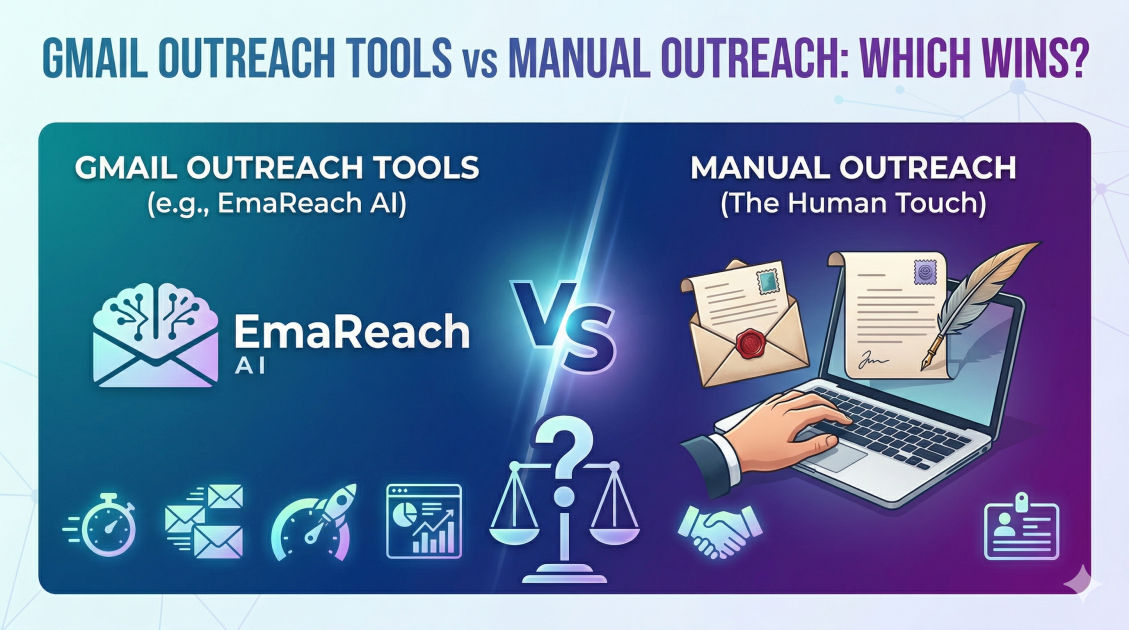
Gmail Outreach Tools vs Manual Outreach: Which Wins?
cold emailsales outreachemail automationlead generationemail deliverabilitygmail tools
Introduction
In the modern landscape of digital communication, the art of the 'cold reach' has undergone a massive transformation. Gone are the days when simple persistence was the only tool at a salesperson's or marketer’s disposal. Today, we stand at a crossroads between two distinct philosophies: the meticulously crafted, high-touch approach of manual outreach and the high-octane, efficiency-driven world of Gmail outreach tools.
Choosing between these two methods isn’t just a matter of preference; it’s a strategic decision that affects your deliverability, your brand reputation, and ultimately, your bottom line. While sending a one-to-one email feels more personal, can it truly compete with a system that can handle thousands of prospects while you sleep? Conversely, does an automated sequence lose the very soul that makes a prospect want to click 'Reply'?
In this comprehensive guide, we will dive deep into the mechanics of both manual and automated outreach, exploring the pros, cons, and the specific scenarios where one clearly outshines the other.
The Case for Manual Outreach: The Human Touch
Manual outreach is the traditional method of identifying a prospect, researching their specific needs, and drafting a unique email directly within the Gmail compose window. It is labor-intensive, slow, and requires a high level of cognitive effort.
The Power of Hyper-Personalization
When you send a manual email, you aren't limited by 'merge tags' or 'dynamic variables.' You can reference a specific podcast the prospect was recently on, a specific sentence from their latest LinkedIn post, or even a shared local interest. This level of hyper-personalization is nearly impossible to automate perfectly. It signals to the recipient that you have actually done your homework, which significantly lowers their natural defenses against 'spam.'
Superior Deliverability Control
Gmail's algorithms are incredibly sophisticated. They look for patterns. When you send emails manually, your 'sending behavior' is inherently human. You type at a certain speed, you take breaks, and each email is structurally different. This makes it highly unlikely for Gmail to flag you as a bot. For high-stakes deals—where the lifetime value of a client is tens of thousands of dollars—the risk of landing in a spam folder is too high to leave to a poorly configured tool.
Relationship Building from Email One
Manual outreach isn't just about getting a meeting; it's about starting a relationship. Because you are personally involved in the drafting process, you are better prepared for the follow-up. You remember the context. This continuity creates a seamless transition from the initial cold touch to a discovery call.
The Case for Gmail Outreach Tools: Scaling Success
As businesses grow, the 'unscalable' nature of manual outreach becomes a bottleneck. This is where Gmail outreach tools—software designed to automate the sending and follow-up process—come into play.
Efficiency and Time Management
The most obvious advantage is speed. A tool can send 50, 100, or 200 emails in the time it takes you to write three manual ones. By automating the 'grunt work' of prospecting, sales teams can focus their energy on the leads that have already expressed interest.
Systematic Follow-Ups
Data consistently shows that the majority of sales happen after the fourth or fifth touchpoint. However, most manual reach-outs die after the first email because the sender forgets to follow up. Outreach tools solve this by scheduling automated sequences. If a prospect doesn't reply to the first email, the tool automatically sends the second, then the third, according to a pre-set schedule. This 'set it and forget it' capability ensures no lead falls through the cracks.
Data-Driven Optimization
How do you know if your subject line is working? In manual outreach, you’re relying on a 'gut feeling.' Outreach tools provide granular analytics: open rates, click-through rates, and reply rates. You can A/B test two different hooks to see which one resonates more with your target audience. This allows for a scientific approach to communication that manual sending simply cannot match.
Solving the Deliverability Puzzle with EmaReach
One of the biggest fears with automation is the 'Spam Folder Abyss.' However, modern platforms have evolved to counter this. For those looking to bridge the gap between automation and quality, EmaReach offers a compelling solution. Stop Landing in Spam. Cold Emails That Reach the Inbox. EmaReach AI combines AI-written cold outreach with inbox warm-up and multi-account sending—so your emails land in the primary tab and get replies. This specialized focus on 'warming up' an email address ensures that even though you are using a tool, your sender reputation remains as pristine as a manual sender's.
Comparison: Speed vs. Quality
To help visualize the trade-offs, let's look at how these two methods stack up across key performance indicators.
| Feature | Manual Outreach | Gmail Outreach Tools |
|---|---|---|
| Volume | Low (10-20 per day) | High (50-500+ per day) |
| Personalization | Deep & Contextual | Variable-based (Scalable) |
| Response Rate | Generally Higher % | Generally Lower % (but higher total) |
| Setup Time | Zero | Moderate (Technical config) |
| Reliability | High (Human error risk) | High (Technical error risk) |
| Follow-up | Hard to maintain | Automated & Guaranteed |
The Hidden Risks of Manual Outreach
While manual outreach is often touted as the 'safer' bet for deliverability, it has its own set of risks that are rarely discussed.
- Inconsistency: Humans are prone to moods and distractions. On a busy Monday, you might send ten emails. On a slow Friday, you might send none. This lack of a 'steady pulse' makes it impossible to predict your sales pipeline.
- Burnout: Researching and writing unique emails for hours on end is mentally taxing. This often leads to 'pseudo-personalization,' where the sender starts using a template anyway but does it slowly, losing the benefits of both speed and quality.
- Poor Tracking: Unless you are meticulously updating a CRM every time you hit 'send,' you will eventually lose track of who you talked to and what you said.
The Technical Hurdles of Outreach Tools
Conversely, automation is not a magic wand. If handled incorrectly, it can do more harm than good.
The Danger of the 'Spam Trap'
If you upload a list of unverified emails and blast them all at once, Google’s filters will notice. They look for 'bursty' behavior. To use tools successfully, you must implement technical safeguards like SPF, DKIM, and DMARC records. Without these, even the best-written email will never see the light of day.
The 'Uncanny Valley' of AI Personalization
Prospects are getting smarter. They can spot a 'Hi {{first_name}}, I saw you work at {{company_name}}' from a mile away. If your automation tool isn't configured with sophisticated data, your emails can feel cold and robotic, which can actually damage your brand's reputation more than no email at all.
Which Strategy Wins for Your Business?
The 'winner' depends entirely on your business model and your target audience.
When Manual Outreach Wins:
- High-Ticket Enterprise Sales: If you are selling a product that costs $50,000+ per year, you only need a few wins. The time spent researching each prospect is a high-ROI activity.
- Small Niche Markets: If there are only 200 people in the world who can buy your service, you cannot afford to burn those bridges with a generic automated sequence.
- Strategic Partnerships: When reaching out to influencers or potential partners, the relationship is the product. Automation is often seen as a sign of disrespect in these circles.
When Gmail Outreach Tools Win:
- SaaS and Volume-Based Services: If you have a wide total addressable market (TAM), you need to get your message in front of as many eyes as possible to find the 'hand-raisers.'
- Lead Generation Agencies: When your job is to book meetings for others, you need the scale and reporting that only tools can provide.
- Early-Stage Validation: If you are testing a new offer, you need a high volume of data quickly to see if anyone cares about what you're selling.
The Hybrid Approach: The Ultimate Winner
The most successful modern outreach strategies don't choose one or the other—they combine them. This is often referred to as the 'Tiered Outreach' model.
Tier 1: The Top 5% (Manual)
Identify your 'dream clients.' These are the leads that would change your business overnight. For these, use 100% manual outreach. Research their annual reports, listen to their interviews, and craft a message that is impossible to ignore.
Tier 2: The Core Market (Semi-Automated)
Use Gmail outreach tools to handle the bulk of your prospects, but use 'advanced' automation. This means using tools that allow for custom snippets or 'first-line' writers. You might spend 2 minutes per lead writing a custom opening sentence, then let the tool handle the rest of the body and the four follow-up emails.
Tier 3: The Wide Net (Fully Automated)
For broader awareness, use fully automated sequences. Ensure you are using a platform that focuses on deliverability—like the aforementioned EmaReach—to ensure your 'wide net' actually lands in the inbox rather than the promotions tab.
Actionable Steps for Transitioning to Tools
If you have been doing everything manually and are ready to scale, follow these steps to ensure a smooth transition:
- Verify Your Data: Never import a 'bought' list directly into a tool. Use an email verification service to remove 'bounced' addresses, which are the fastest way to get your account suspended.
- Warm Up Your Inbox: Don't go from 0 to 100 emails a day. Use a 'warm-up' tool to gradually increase your sending volume over 2-4 weeks. This builds trust with Google's servers.
- Master the Merge Tag: Go beyond {{first_name}}. Use tags for {{competitor_name}}, {{recent_award}}, or {{specific_pain_point}} to make your templates feel more organic.
- Monitor Your Reputation: Regularly check your sender score. If you see open rates dropping below 30%, stop your sequences and investigate your deliverability settings.
Conclusion
In the battle of Gmail outreach tools vs. manual outreach, the true winner isn't a specific piece of software or a specific philosophy—it's relevance.
A manual email that provides no value will be deleted just as quickly as a poorly automated one. Conversely, a highly relevant, well-timed automated email can feel like a godsend to a prospect struggling with the exact problem you solve.
Manual outreach wins on quality and depth, making it indispensable for high-value targets. Outreach tools win on consistency and scale, making them the engine of growth for modern sales teams. By understanding the strengths of each, you can build a diversified outreach strategy that protects your deliverability while maximizing your opportunities. The future belongs to those who use tools to amplify their humanity, not replace it.
EmaReach AI
Ready to scale your cold email outreach?
Join thousands of teams using EmaReach AI for AI-powered campaigns, domain warmup, and 95%+ deliverability. Start free — no credit card required.
Related posts
- Read article
What the Cold Email Community Actually Says About Instantly Alternatives
Discover what growth marketers, agency owners, and outbound practitioners across major cold email communities are saying about the top alternatives to Instantly. This comprehensive, research-driven guide breaks down the real-world pros, cons, and technical features of tools like Smartlead, EmaReach, Saleshandy, and Lemlist based on community consensus.
- Read article
The Instantly Alternative That Handles Follow-Up Sequences Better
Discover why modern sales teams are outgrowing linear cold email tools and moving toward advanced Instantly alternatives that leverage conditional logic, multi-channel sequences, and superior deliverability protections.