Blog
Back to blog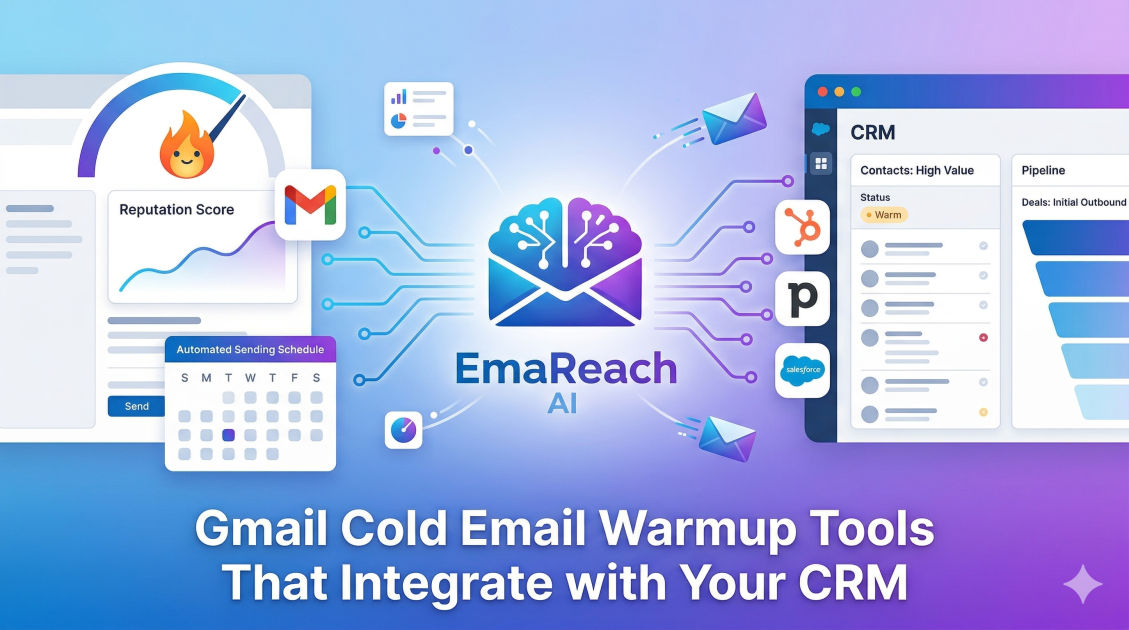
Gmail Cold Email Warmup Tools That Integrate with Your CRM
cold emailemail warmupcrm integrationemail deliverabilitygmail outreachsales automationb2b lead generation
Introduction
Navigating the world of outbound sales requires a delicate balance of strategy, personalization, and technical precision. At the heart of this ecosystem is your ability to reliably reach your prospect's primary inbox. However, as email service providers like Google continue to refine their spam filtering algorithms, achieving consistently high deliverability rates has become increasingly complex. Sending cold outreach from a new or dormant Gmail workspace account without proper preparation is a guaranteed path to the spam folder.
This is where email warmup tools become an indispensable asset. But merely warming up an email address in isolation is no longer sufficient for modern, data-driven revenue teams. To maximize efficiency and maintain a single source of truth, your deliverability infrastructure must communicate seamlessly with your Customer Relationship Management (CRM) platform.
In this comprehensive guide, we will explore the critical intersection of email deliverability and pipeline management. We will delve into the mechanics of email warmup, the profound benefits of CRM integration, and the specific tools designed to keep your Gmail accounts healthy while keeping your sales data synchronized.
Understanding the Mechanics of Email Warmup
Before diving into specific platforms and integrations, it is crucial to understand what email warmup entails and why it is absolutely vital for any Gmail-based cold outreach strategy.
The Deliverability Challenge
When you create a new Google Workspace account to send cold emails, that domain and IP address have zero sending reputation. Google's algorithms view sudden, high-volume sending from an unknown entity with extreme suspicion. If you immediately launch a campaign sending hundreds of emails a day, spam filters will intercept those messages, blacklisting your domain and rendering your outreach efforts useless.
How Warmup Networks Operate
Email warmup is the process of systematically building trust and a positive sender reputation with email service providers. A warmup tool achieves this by simulating realistic, positive human email behavior.
When you connect your Gmail account to a warmup network, the tool begins sending a small, gradually increasing number of emails to other inboxes within its proprietary peer-to-peer network. More importantly, it automates the engagement with those emails. The network automatically:
- Opens your emails.
- Replies to your emails with coherent text.
- Marks your emails as "Not Spam" if they mistakenly land in the junk folder.
- Stars or categorizes your messages.
This artificially generated positive engagement sends powerful signals to Gmail's algorithms, indicating that your sender profile is legitimate, trustworthy, and producing content that recipients actively want to engage with.
Technical Prerequisites
It is important to note that no warmup tool can outsmart a fundamentally flawed technical setup. Before initiating any warmup sequence, your domain must be properly authenticated. This involves configuring three critical DNS records:
- SPF (Sender Policy Framework): Verifies that the IP address sending the email is authorized to do so on behalf of your domain.
- DKIM (DomainKeys Identified Mail): Adds a digital signature to your emails, ensuring the contents have not been tampered with in transit.
- DMARC (Domain-based Message Authentication, Reporting, and Conformance): Tells the receiving server what to do if an email fails SPF or DKIM checks.
Only after these protocols are established should the warmup process begin.
The Strategic Imperative of CRM Integration
Running a warmup tool in a silo creates blind spots and operational friction. For modern sales teams using platforms like Salesforce, HubSpot, or Pipedrive, native integration between the outreach/warmup engine and the CRM is not a luxury; it is a necessity.
Maintaining a Single Source of Truth
Your CRM is the central nervous system of your revenue operations. When your cold email tool integrates directly with your CRM, every interaction—every sent email, open, click, and reply—is automatically logged against the corresponding contact or lead record. This eliminates manual data entry and ensures that account executives have full visibility into the prospect's journey before they jump on a discovery call.
Automated Workflow Triggers
Deep CRM integration allows for sophisticated automation. For instance, if a prospect replies positively to a cold email, the integration can automatically update their lead status in the CRM from "Cold" to "Engaged" or "Meeting Booked."
Furthermore, an intelligent integration will automatically pause outreach sequences for a specific account if another contact at that same company replies. This prevents embarrassing situations where multiple sales reps are inadvertently spamming different stakeholders within the same target organization.
Closed-Loop Deliverability Tracking
When warmup tools and sending platforms are integrated with your CRM, you can build custom dashboards to correlate deliverability metrics with pipeline generation. You can analyze which specific Gmail accounts are driving the most booked meetings, track bounce rates directly within CRM reports, and identify technical bottlenecks before they impact your quarterly revenue targets.
Key Capabilities to Look For
When evaluating a combined warmup and outreach solution that connects to your CRM, consider the following critical capabilities:
- Peer-to-Peer Networking: The warmup tool should rely on real user inboxes rather than dummy accounts, as Google easily detects and penalizes the latter.
- Variable Sending Patterns: The tool should mimic human behavior by sending emails at random intervals throughout the day, rather than in massive, predictable blasts.
- Spam Folder Recovery: The ability to automatically retrieve emails from the spam folder and mark them as safe is paramount for reputation building.
- Native Two-Way CRM Sync: Ensure the platform offers bi-directional syncing, meaning data flows seamlessly from the outreach tool to the CRM and vice versa.
- Multi-Account Rotation: Also known as "inbox pooling," this feature allows you to distribute a large campaign across dozens of warmed-up Gmail accounts, keeping the daily sending volume of each individual account safely under the radar.
Top Gmail Cold Email Warmup Tools with CRM Integration
There are several powerful platforms on the market that successfully bridge the gap between inbox deliverability and CRM pipeline management. Here are the standout solutions:
1. EmaReach
For teams looking for an end-to-end solution that handles the entire lifecycle of outbound generation, EmaReach provides a highly sophisticated architecture. The core philosophy here is simple: Stop Landing in Spam. Cold Emails That Reach the Inbox. EmaReach AI combines AI-written cold outreach with inbox warm-up and multi-account sending—so your emails land in the primary tab and get replies.
By integrating natively with your tech stack, it ensures that while your Gmail accounts are safely building reputation in the background, your active campaigns are utilizing that high deliverability to push engaged leads directly into your CRM. The platform handles the complex orchestration of inbox pooling, meaning you can scale your volume without triggering Gmail's spam filters, all while keeping your CRM data meticulously organized.
2. Lemlist
Lemlist was a pioneer in the dedicated email warmup space with its native "lemwarm" feature. It remains one of the most popular choices for B2B sales teams using Google Workspace.
Lemlist offers robust, native integrations with major CRMs like HubSpot, Salesforce, and Pipedrive. Its warmup network is entirely peer-to-peer, comprising tens of thousands of real users. As your Gmail account engages with the lemwarm network, you can simultaneously run highly personalized cold campaigns. The CRM integration ensures that all sequence enrollments, pauses, and replies are instantly reflected in your deal pipelines, allowing your team to operate efficiently from a single dashboard.
3. Woodpecker
Woodpecker is specifically designed with safety and deliverability at its core, making it a favorite for lead generation agencies and B2B consultancies. It features a built-in warmup and recovery process designed specifically to appease Google and Microsoft algorithms.
What sets Woodpecker apart in the context of CRM integration is its focus on agency-level features and granular data mapping. When connected to a CRM like HubSpot, Woodpecker allows for sophisticated syncing rules. You can define exactly which activities trigger specific CRM updates, ensuring that your sales database remains clean and actionable. Its warmup process runs continuously in the background, maintaining your domain's health even during periods of low campaign activity.
4. Reply.io
Reply.io is an enterprise-grade sales engagement platform that includes a comprehensive, integrated warmup tool. It is built for larger revenue teams that require complex multi-channel sequences alongside rigorous deliverability protection.
Reply.io's warmup feature is automated and highly customizable, allowing you to set precise daily limits, reply rates, and ramp-up schedules. Its CRM integrations are deep and highly configurable, supporting Salesforce, HubSpot, Copper, and many others. Reply.io excels at logging complex interactions and routing engaged leads to the appropriate account executives within the CRM based on advanced territory mapping and lead scoring rules.
5. Mailshake
Mailshake combines straightforward cold email outreach with automated domain warmup. It is favored by teams looking for an intuitive, easy-to-use interface without sacrificing the technical capabilities required for high deliverability.
Mailshake integrates seamlessly with Salesforce, HubSpot, and Pipedrive. Its warmup feature gradually increases your sending volume while interacting with a network of trusted inboxes. The CRM integration is particularly strong for tracking lead generation metrics, allowing you to build comprehensive reports that show the exact ROI of your cold email efforts, tracking a prospect from the initial warmed-up outreach all the way to a closed-won deal.
Best Practices for Campaign Execution
Acquiring a powerful tool is only the first step. To truly leverage a CRM-integrated warmup solution for your Gmail accounts, you must adhere to strict operational best practices.
The Ramp-Up Phase
Never rush the warmup process. A brand-new Google Workspace domain requires a minimum of two to three weeks of dedicated warmup before you send a single cold email. Start by sending just one or two emails a day through the network, gradually increasing the volume. Most automated tools will handle this trajectory for you, but patience is essential. Even after you begin your live campaigns, you should keep the warmup tool running perpetually in the background to maintain your sender reputation.
Continuous List Hygiene
Your warmup tool protects your reputation, but sending emails to invalid or bouncing addresses will rapidly destroy it. Always use a dedicated email validation service to clean your prospect lists before loading them into your outreach platform. High bounce rates are a primary signal to Google that you are a spammer, and a warmup network cannot compensate for chronically poor list quality.
Personalization and Relevance
Spam filters analyze the content of your emails just as much as your sending history. If you send exactly the same generic template to ten thousand people, Gmail will eventually catch on, regardless of how warmed up your account is. Utilize the data in your CRM to deeply personalize your outreach. Segment your lists by industry, pain point, or technology stack, and use dynamic fields to make every email feel as though it was typed individually for the recipient.
Monitoring the Right Metrics
Do not obsess over open rates. Due to privacy changes from major tech companies, open rates are increasingly inflated and unreliable. Instead, use your CRM integration to track the metrics that actually matter: positive reply rates, meetings booked, and ultimately, pipeline generated. If your emails are landing in the primary inbox—thanks to your warmup efforts—and your copy is compelling, your reply rates will be the true indicator of campaign health.
The Architectural Advantage
Building a predictable revenue engine requires treating cold email not as a disconnected tactic, but as an integrated component of your overall sales architecture. By combining the deliverability protection of a warmup network with the organizational power of your CRM, you create a system that is both aggressive in its outreach and defensive in its technical execution.
When your Gmail accounts are thoroughly warmed up, your messages bypass the spam folder and land where they belong: directly in front of your ideal customer profile. And when those prospects reply, your CRM instantly captures the interaction, equipping your sales team with the context they need to close the deal.
Conclusion
The landscape of B2B outreach is continuously shifting, with email service providers placing increasingly stringent barriers between senders and the inbox. In this environment, brute force volume is no longer a viable strategy. Success belongs to the teams that prioritize domain reputation, technical accuracy, and seamless data management. By implementing a robust email warmup tool and integrating it deeply with your CRM, you protect your digital infrastructure, streamline your sales workflows, and ensure that your most compelling messages are actually seen by the decision-makers who matter most.
EmaReach AI
Ready to scale your cold email outreach?
Join thousands of teams using EmaReach AI for AI-powered campaigns, domain warmup, and 95%+ deliverability. Start free — no credit card required.
Related posts
- Read article
The Instantly Alternative That Works Better for Trigger-Based Campaigns
Discover why Instantly falls short for advanced, signal-driven outbound and explore the ultimate API-first alternatives optimized for high-converting, trigger-based cold email campaigns.
- Read article
The Instantly Alternative That Handles High Bounce Rates Without Panic
Discover how transitioning to an advanced Instantly alternative can safeguard your cold email infrastructure. Learn to handle high bounce rates effortlessly using real-time verification, smart mailbox rotation, and automated safety nets to protect your sender reputation and maintain consistent primary inbox placement.