Blog
Back to blog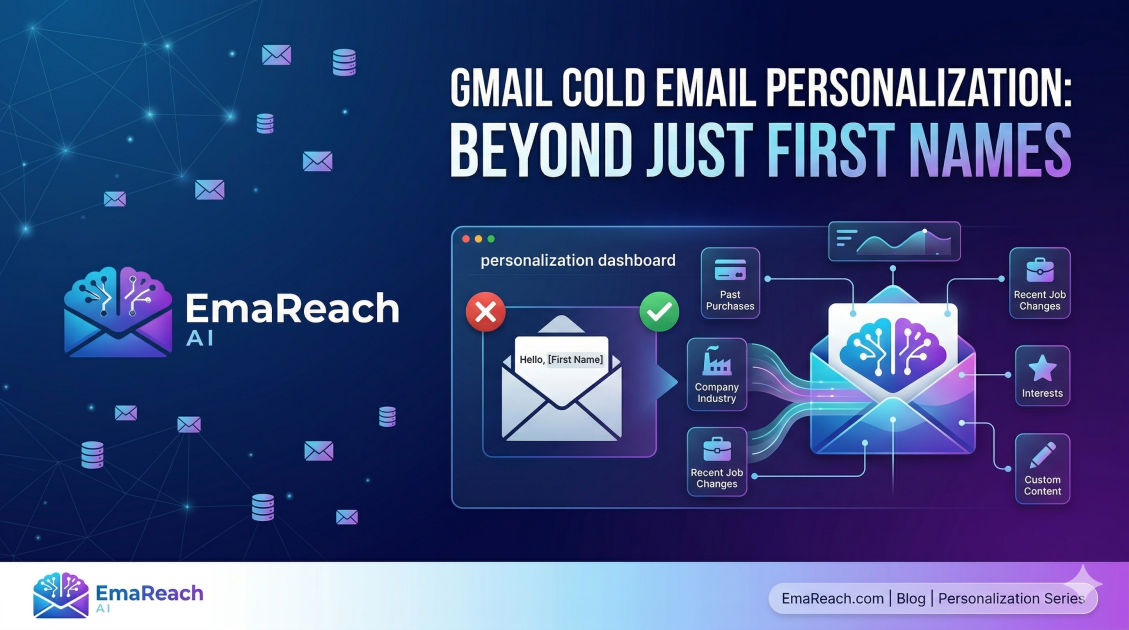
Gmail Cold Email Personalization: Beyond Just First Names
cold emailoutreach strategygmail marketingemail personalizationsales tipslead generationemail deliverability
Introduction: The Death of the 'Hi {First_Name}' Strategy
For years, the gold standard of cold outreach was simply ensuring you didn't accidentally send an email that said "Hi {First_Name}." If the tag merged correctly, you were ahead of the curve. However, as the digital landscape has become increasingly crowded, prospects have developed a keen eye for automated fluff. Their inboxes are flooded with generic pitches that use a name as a thin veil for a mass-blasted template.
True personalization in Gmail cold email outreach is no longer about proving you have a spreadsheet with names; it is about proving you have done your homework. It is about relevance, timing, and demonstrating a genuine understanding of the recipient's specific pain points, achievements, and industry context. To stand out in a Gmail inbox, you must move beyond the surface level and dive into deep personalization strategies that foster connection and drive conversions.
The Psychology of Deep Personalization
To understand why surface-level personalization fails, we must look at the psychology of the recipient. Every professional is protective of their time. When an email arrives from an unknown sender, the brain performs a rapid assessment: Is this for me, or is this for everyone?
If the content feels generic, the brain categorizes it as spam or low-priority noise. Deep personalization triggers a different cognitive response. It signals that the sender has invested effort, which naturally invokes a sense of reciprocity. When you mention a specific podcast the prospect spoke on or a niche challenge their company is currently facing, you move from being an 'interrupter' to being a 'peer.'
Leveraging Intent Data and Recent Events
One of the most effective ways to personalize beyond a name is by utilizing intent data. Intent data tells you what a company or individual is interested in based on their online behavior.
1. Recent Funding and Growth Milestones
If a company has recently closed a Series B round or opened a new office, their needs are shifting. Instead of a generic pitch, your email should acknowledge this growth and explain how your solution supports a scaling organization.
2. Job Postings as Pain Point Indicators
Looking at a company's 'Careers' page is a gold mine for personalization. If they are hiring aggressively for a specific role, it indicates either growth or a gap in their current capabilities. Tailoring your Gmail outreach to address the specific responsibilities listed in those job descriptions shows a level of research that is impossible to ignore.
3. Mergers and Acquisitions
Corporate shifts create friction and new requirements. By referencing a recent acquisition, you can position your service as a way to streamline the transition or solve the new challenges that arise from merging two distinct corporate cultures.
Personalizing Through Social Proof and Commonality
Humans are social creatures. We trust people who are trusted by people we know. Deep personalization leverages these circles of influence to build immediate credibility.
The 'Alumni' Connection
Sharing a common educational background or a former employer is a classic but underutilized tactic. However, the key is to avoid the cliché. Instead of saying "I see we both went to State University," try "I noticed you transitioned from [Former Company] to your current role—I’ve always admired how [Former Company] trained their leadership team. How has that experience shaped your approach at [Current Company]?"
Mutual Connections and Case Studies
If you have worked with a competitor or a non-competing company in their specific niche, mention it. But don't just drop a name; explain the specific result.
"We recently helped [Company X] in the [Industry] space reduce their churn by 15%. Given your recent expansion into the European market, I thought our findings on localized retention might be relevant to you."
Hyper-Personalization: The 'Observation' Method
This is where you move into the elite tier of cold outreach. The observation method involves finding a unique piece of content created by or featuring the prospect and using it as the hook.
Podcasts and Webinars
Don't just say "I liked your podcast." Mention a specific quote or a specific minute mark.
- Example: "I was listening to your appearance on the Growth Mindset podcast, and what you said at the 12-minute mark about 'unlearning' traditional sales tactics really resonated with my team."
LinkedIn Posts and Articles
If a prospect writes an article on LinkedIn, they are literally telling the world what they care about. Engaging with that content in your cold email shows you are part of their professional community. Disagreeing (respectfully) or adding a nuanced follow-up question to their post can often be more effective than blind praise.
Technical Excellence and Deliverability
No amount of personalization matters if your email lands in the Promotions tab or the Spam folder. Gmail is particularly sensitive to sender reputation. This is where tools like EmaReach become essential. Stop Landing in Spam. Cold Emails That Reach the Inbox. EmaReach AI combines AI-written cold outreach with inbox warm-up and multi-account sending—so your emails land in the primary tab and get replies. When you combine deep, manual personalization with technical systems that ensure deliverability, your response rates will naturally climb.
Personalizing the Value Proposition
Many senders personalize the 'hook' (the first sentence) but then revert to a generic sales pitch for the rest of the email. This creates a disconnect. The value proposition itself must be personalized.
Instead of a list of features, frame your solution through the lens of the prospect’s current situation. If they are a CTO, focus on security and integration. If they are a Head of Sales, focus on lead velocity and quota attainment.
The 'Point A to Point B' Framework
Every prospect is currently at 'Point A' (a state with certain challenges) and wants to be at 'Point B' (a desired future state). Your email should map out how you specifically take their company from their specific Point A to their specific Point B. This requires industry-specific language and an understanding of their business model.
Using Video and Visual Personalization
In a text-heavy world, visual elements stand out. Including a personalized thumbnail of a video recorded specifically for the prospect can increase click-through rates significantly.
- The 'Website Teardown' approach: Recording a 60-second video of you scrolling through their website while highlighting a specific area for improvement.
- Personalized Charts: Sending a mockup or a data visualization that uses their company name or publicly available data to show potential ROI.
The Role of AI in Scaling Personalization
While manual research is the most thorough, it isn't always scalable for high-volume outreach. Modern AI tools can now scan LinkedIn profiles, recent news, and company websites to generate 'first-line' personalization at scale. The trick is to use AI as a collaborator, not a replacement. Use AI to gather the data points, but use a human touch to weave those points into a narrative that feels authentic and conversational.
Structuring the Perfect Deeply Personalized Gmail Cold Email
To ensure your outreach is effective, follow this structural blueprint:
- Subject Line: Relevant to the personalization hook (e.g., "Your thoughts on [Specific Topic] from [Podcast]").
- The Hook: The deep personalization point (The 'Observation').
- The Bridge: Connecting that observation to the reason you are reaching out.
- The Value Prop: How you solve a problem specific to their current situation.
- Social Proof: A brief mention of a similar success story.
- The CTA (Call to Action): Low friction. Instead of asking for a 30-minute meeting, ask for permission to send more information or a 2-minute video.
Testing and Iteration
Personalization is not a "set it and forget it" strategy. You must constantly A/B test different types of hooks. Does your audience respond better to podcast mentions or to hiring-based triggers? Use your Gmail tracking data to analyze which personalized elements lead to higher open and reply rates.
Segmenting for Better Accuracy
Group your prospects by persona or industry before personalizing. It is much easier to write personalized emails for 20 VPs of Marketing in the SaaS space than it is to write for 20 random individuals in different industries. Segmentation allows you to reuse certain 'themes' of personalization while keeping the individual details unique.
Common Pitfalls to Avoid
Even with the best intentions, personalization can go wrong.
- The 'Creepy' Factor: Don't mention things that are too personal, such as family photos or non-professional social media accounts (Instagram/Facebook). Stick to LinkedIn, Twitter, and professional publications.
- The 'Fake' Fan: Don't say you loved an article if you clearly didn't read it. If the prospect asks a follow-up question and you can't answer, you’ve permanently burned that bridge.
- The Misaligned Hook: Ensure your personalization actually leads to your service. If you spend three sentences talking about their love for hiking and then pivot to cloud security without a transition, it feels disjointed and manipulative.
Conclusion
In the modern era of Gmail cold outreach, personalization is the bridge between being ignored and being invited to a conversation. By moving beyond the first name and looking into intent data, social proof, and deep observations, you demonstrate a level of professionalism and respect that sets you apart from the competition. Cold emailing is no longer a numbers game; it is a relevance game. When you combine high-quality, personalized content with a robust deliverability strategy, you create an outreach engine that doesn't just fill your pipeline—it builds your brand. Focus on the human on the other side of the screen, and the results will follow naturally.
EmaReach AI
Ready to scale your cold email outreach?
Join thousands of teams using EmaReach AI for AI-powered campaigns, domain warmup, and 95%+ deliverability. Start free — no credit card required.
Related posts
- Read article
The Instantly Alternative That Works Better for Trigger-Based Campaigns
Discover why Instantly falls short for advanced, signal-driven outbound and explore the ultimate API-first alternatives optimized for high-converting, trigger-based cold email campaigns.
- Read article
The Instantly Alternative That Handles High Bounce Rates Without Panic
Discover how transitioning to an advanced Instantly alternative can safeguard your cold email infrastructure. Learn to handle high bounce rates effortlessly using real-time verification, smart mailbox rotation, and automated safety nets to protect your sender reputation and maintain consistent primary inbox placement.