Blog
Back to blog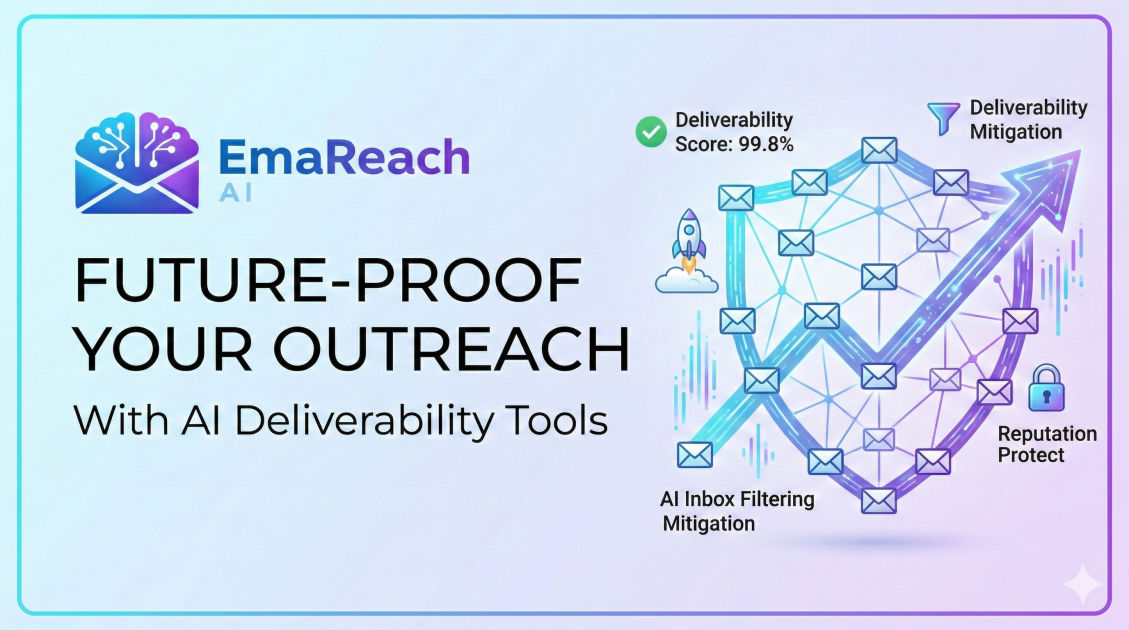
Future-Proof Your Outreach With AI Deliverability Tools
email deliverabilityAI outreachcold emailmarketing automationinbox warm-upsales technologysender reputation
Introduction
In the evolving landscape of digital communication, the bridge between a sent email and a read email has become increasingly fragile. For years, sales teams and marketers relied on volume to drive results, but the gatekeepers of the inbox—Internet Service Providers (ISPs) and email service providers—have grown more sophisticated. Today, landing in the 'Promotions' tab is considered a minor setback; landing in the 'Spam' folder is a catastrophe. To navigate this high-stakes environment, businesses are turning to artificial intelligence.
Future-proofing your outreach is no longer about finding the perfect subject line alone; it is about managing the technical infrastructure of your sending reputation. AI deliverability tools are the new standard for ensuring that your message actually reaches its destination. By leveraging machine learning, predictive analytics, and automated technical maintenance, these tools take the guesswork out of outreach, allowing human creativity to flourish where it matters most: in the conversation.
The Changing Landscape of Email Deliverability
Email deliverability is the measure of how successful you are at getting an email into a recipient's primary inbox. It is distinct from 'delivery,' which simply means the receiving server accepted the file. Deliverability is governed by a complex set of algorithms that evaluate sender reputation, content quality, and recipient engagement.
In the past, maintaining a good reputation was a manual process. You had to monitor blacklists, manually warm up new domains, and hope your HTML code wasn't triggering filters. AI has shifted this paradigm. Modern AI deliverability tools monitor these variables in real-time, adapting your sending patterns to mimic human behavior and satisfy the ever-changing requirements of major providers like Google and Outlook.
How AI Solves the 'Spam' Problem
The primary reason emails fail to reach the inbox is a lack of trust. AI tools build this trust through several key mechanisms:
1. Automated Inbox Warm-up
When you start a new email account or domain, it has no history. If you suddenly send 500 emails, ISPs flag this as suspicious 'spammy' behavior. AI-driven warm-up tools solve this by creating a network of real accounts that interact with your emails. These AI agents open your messages, mark them as 'not spam,' and move them to the primary inbox. This simulated engagement signals to ISPs that your content is valuable and safe, gradually increasing your sending limits without triggering red flags.
2. Intelligent Content Analysis
AI tools now scan your email copy before you hit send. Unlike old-school keyword filters that just looked for words like 'free' or 'buy now,' AI understands context. It uses Natural Language Processing (NLP) to detect 'spammy' intent or aggressive sales tones that might alienate readers or alert filters. By refining the linguistic patterns of your outreach, AI ensures your emails read like a professional one-to-one communication rather than a bulk broadcast.
3. Dynamic Sending Patterns
Sending 100 emails at exactly 9:00 AM is a hallmark of a bot. AI deliverability tools randomize sending times and intervals, staggering the outreach to appear natural. They can even adjust sending frequency based on the time zone of the recipient and the historical performance of your domain on that specific day of the week.
The Role of Infrastructure Management
Technical setup is the foundation of deliverability. Without the correct records—SPF, DKIM, and DMARC—your emails are essentially traveling without a passport. AI tools often include automated checkers that verify these records are correctly implemented.
Beyond basic records, many advanced platforms now manage the 'multi-account' strategy. Instead of sending 1,000 emails from one address, AI distributes that load across dozens of accounts. This 'horizontal scaling' minimizes the risk to any single domain. For those looking for a comprehensive solution, EmaReach (https://www.emareach.com/) is a powerful ally. It allows you to stop landing in spam by combining AI-written cold outreach with automated inbox warm-up and multi-account sending. This ensures your emails land in the primary tab where they actually get replies, rather than languishing in the junk folder.
Predictive Deliverability: Seeing the Future
One of the most significant advantages of AI is its ability to predict problems before they happen. Through 'sender score' monitoring and real-time feedback loops, AI tools can alert you if your bounce rate is creeping up or if your engagement levels are dropping.
Imagine an AI that notices a slight shift in how Microsoft 365 is treating your emails. Before you lose access to all your Outlook leads, the AI can automatically pivot your traffic to different accounts or suggest a cooling-off period for the affected domain. This proactive approach turns deliverability from a reactive 'fire-fighting' task into a stable, managed asset.
Personalization at Scale Without the Risk
Personalization is the gold standard for outreach, but manual personalization is impossible at scale. Conversely, bad 'merge tag' personalization (e.g., "Hello {First_Name}") is a primary trigger for spam filters. AI-powered tools can now generate unique intro lines for every recipient based on their LinkedIn profile, recent news, or company website.
Because every email is unique, the 'fingerprint' of your campaign is constantly changing. This variability is highly favored by ISPs. When every message in a 5,000-email blast is slightly different, it no longer looks like a bulk marketing campaign; it looks like 5,000 individual conversations. AI makes this possible in seconds, protecting your reputation while increasing your reply rates.
The Ethics and Best Practices of AI Outreach
As with any powerful tool, AI outreach requires a strategic approach rooted in best practices. Using AI to spam more people faster is a recipe for failure. Instead, the goal should be to use AI to be more relevant and more reliable.
Data Hygiene
AI is only as good as the data it processes. Regularly using AI-driven verification tools to 'clean' your lead lists is essential. Sending emails to non-existent addresses (hard bounces) is one of the fastest ways to destroy your sender reputation. AI can predict which emails are 'catch-all' or likely to bounce, allowing you to remove them before they cause damage.
Monitoring Engagement, Not Just Opens
With the rise of privacy protections like Apple Mail Privacy Protection, 'open rates' are becoming less reliable as a metric. AI tools focus on deeper engagement metrics—reply rates, sentiment analysis of those replies, and link clicks. By focusing on these high-intent signals, AI can help you double down on the segments of your audience that are actually responding, further boosting your domain authority.
Integrating AI Deliverability Into Your Workflow
Transitioning to an AI-powered workflow doesn't happen overnight, but it can be broken down into manageable steps:
- Audit Your Current Infrastructure: Use AI tools to check your domain health and technical records.
- Implement Automated Warm-up: Even if you aren't sending high volumes yet, keeping your domains 'warm' with AI interactions is a vital insurance policy.
- Utilize AI for Copy Variation: Instead of one template, create five variations and let AI test which one gets the best deliverability and engagement.
- Scale Horizontally: Move away from 'one account fits all' and use AI to manage a fleet of sending addresses.
The Technical Evolution: From Rules to Reasoning
Traditional email filters operated on a 'rule-based' system. If $X$ word appeared $Y$ times, the email was spam. Modern filters use 'reasoning' and machine learning. They look at the relationship between the sender and receiver, the historical behavior of the sender's IP, and the semantic meaning of the text.
To counter this, your outreach tools must use similar technology. AI deliverability tools use 'generative' logic to ensure that your infrastructure and your content are always one step ahead of the filters. They don't just follow a checklist; they adapt to the digital environment in real-time. This is the essence of future-proofing.
Why Human Over-Sight Still Matters
While AI handles the heavy lifting of deliverability and technical maintenance, the 'human in the loop' remains vital. AI can ensure your email reaches the inbox, but your strategy determines what happens next. The most successful outreach campaigns combine the technical perfection of AI with the strategic empathy of a human marketer.
Use AI to handle the 'boring' parts—the SPF records, the warm-ups, the spam word checks, and the list cleaning—so you can spend your time researching your prospects and refining your offer. The AI provides the delivery vehicle; you provide the value.
Conclusion
The era of 'spray and pray' email marketing is over. As ISPs become more protective of their users' inboxes, the barrier to entry for successful outreach continues to rise. Future-proofing your outreach means embracing the tools that understand this new reality. AI deliverability tools provide a sophisticated, automated, and scalable way to ensure your voice is heard. By automating the technical complexities of sender reputation and content optimization, these tools allow businesses to maintain a consistent presence in their prospects' primary inboxes. In a world where attention is the most valuable currency, ensuring your message actually arrives is the most important step in the entire sales process. Investing in AI deliverability is not just a technical upgrade; it is a fundamental shift toward a more reliable, professional, and effective outreach strategy.
EmaReach AI
Ready to scale your cold email outreach?
Join thousands of teams using EmaReach AI for AI-powered campaigns, domain warmup, and 95%+ deliverability. Start free — no credit card required.
Related posts
- Read article
What You Gain and What You Give Up When Switching From Instantly
Thinking about migrating your cold email stack? This detailed guide breaks down the exact operational advantages you gain and the core features you sacrifice when switching away from Instantly's popular outreach platform.
- Read article
How Choosing the Right Instantly Alternative Changed Our Pipeline Numbers
Discover how transitioning from a volume-first cold email setup to an advanced, deliverability-focused infrastructure transformed our B2B pipeline metrics, skyrocketed open rates to over 68%, and tripled our monthly booked demos.