Blog
Back to blog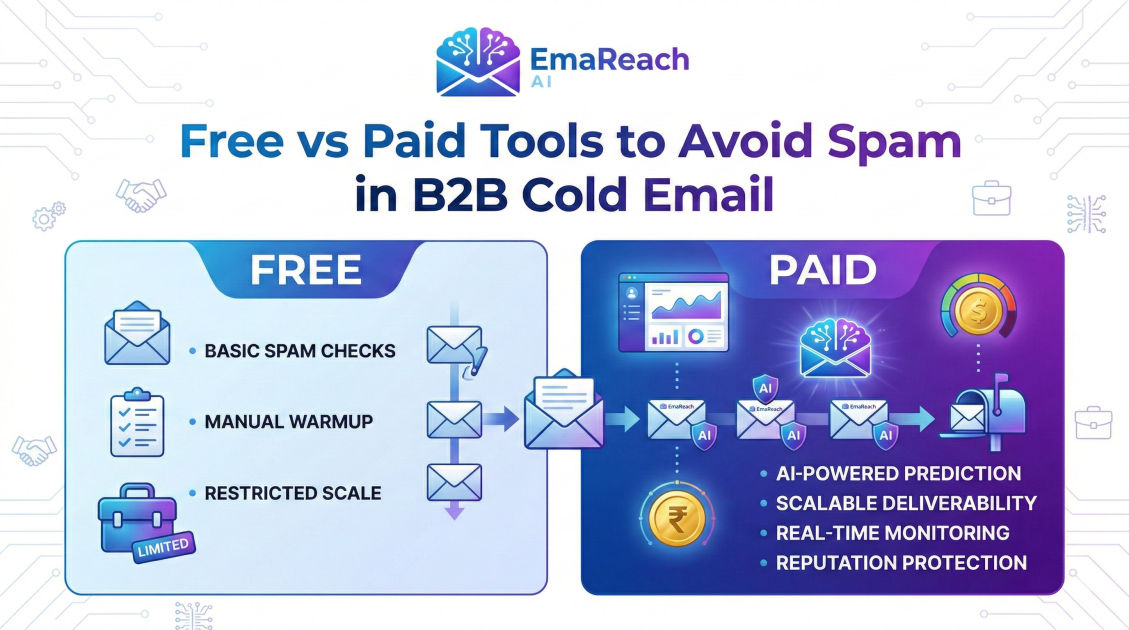
Free vs Paid Tools to Avoid Spam in B2B Cold Email
cold emailemail deliverabilityB2B salesspam filtersemail marketing toolsoutreach strategy
Introduction
In the high-stakes world of B2B sales, the difference between a closed deal and a missed opportunity often comes down to a single factor: deliverability. You can craft the most compelling, value-driven email in history, but if it lands in the spam folder, it effectively does not exist. As spam filters become increasingly sophisticated, powered by advanced machine learning and behavioral analysis, the barrier to entry for successful cold outreach has risen.
For businesses looking to scale their outreach, a critical question arises: Can you maintain a clean sender reputation using free tools, or is a paid suite of software a non-negotiable investment? This comprehensive guide explores the landscape of spam prevention, comparing free versus paid tools across the entire cold email lifecycle—from domain setup and list cleaning to AI-driven personalization and inbox warm-up.
The Anatomy of an Email Spam Filter
To understand why specific tools are necessary, we must first understand what we are fighting against. Modern email service providers (ESPs) like Google and Microsoft use a variety of signals to determine if an email belongs in the primary inbox or the junk folder:
- Technical Authentication: Are your SPF, DKIM, and DMARC records correctly configured?
- Sender Reputation: Does your IP address and domain have a history of high bounce rates or spam complaints?
- Content Analysis: Does the email use 'spammy' keywords, excessive formatting, or suspicious links?
- Engagement Metrics: Do recipients open, reply to, or delete your emails without reading them?
Both free and paid tools aim to optimize these signals, but they do so with varying levels of depth and automation.
Technical Setup and Authentication Tools
Before sending a single email, your technical foundation must be rock-solid. This is the area where free tools are most prevalent and, in many cases, sufficient.
Free Tools for Authentication
Free tools like MXToolbox or DMARC Analyzer allow you to verify that your DNS records are active. These tools provide a quick snapshot of your SPF (Sender Policy Framework), DKIM (DomainKeys Identified Mail), and DMARC (Domain-based Message Authentication, Reporting, and Conformance).
Pros:
- Instant feedback on configuration errors.
- No cost for basic checks.
- Essential for the 'do-it-yourself' sender.
Cons:
- They only tell you if something is wrong; they rarely help you fix it automatically.
- Manual monitoring is required; if a record breaks, you won't know until you check again.
Paid Tools for Infrastructure Management
Paid solutions often include 'Deliverability Dashboards' that monitor your records 24/7. Some sophisticated platforms provide guided setups that generate the exact code snippets you need to paste into your DNS settings, reducing the risk of human error.
Email Verification: Cleaning the List
High bounce rates are the fastest way to destroy a sender's reputation. If you send emails to addresses that don't exist, ESPs view you as a 'spray and pray' spammer.
Free Verification Methods
Free verification is usually limited to 'single-check' tools or small daily allowances. Some tools allow you to paste 10–50 emails a day to check if the syntax is correct and if the domain has a valid mail server.
The Limitation: For B2B outreach involving hundreds or thousands of leads, manual verification is impossible. Furthermore, free tools often fail to detect 'catch-all' domains—servers that appear to accept all mail but eventually bounce it later.
Paid Verification Tools
Services like NeverBounce, ZeroBounce, or ZeroBounce offer bulk processing. They use multi-step verification processes, including SMTP pings (without actually sending an email) to confirm the mailbox exists.
Why Pay?
- Accuracy: Paid tools can identify 'disposable' emails and 'honey pots' (addresses set up by anti-spam organizations to catch scrapers).
- Integration: They often plug directly into your CRM or sending platform, cleaning your list automatically before a campaign starts.
Inbox Warm-up: The Reputation Builder
You cannot start a new email account and immediately send 100 emails a day. This 'cold' behavior triggers immediate red flags. You must 'warm up' the account by gradually increasing volume and generating positive engagement.
The Free 'Manual' Warm-up
In the past, marketers did this manually. You would send emails to friends, colleagues, and your own alternative accounts, then reply to them and move them from the 'Promotions' tab to 'Primary.'
The Risk: Manual warm-up is inconsistent. It lacks the scale needed to signal to Google or Outlook that you are a high-volume, high-quality sender. It is also incredibly time-consuming.
Paid Warm-up Automation
Paid tools automate this process by connecting your account to a network of thousands of other 'real' accounts. These accounts send emails to each other, open them, mark them as 'not spam,' and reply.
This is where EmaReach provides a significant advantage. Stop Landing in Spam. Cold Emails That Reach the Inbox. EmaReach AI combines AI-written cold outreach with inbox warm-up and multi-account sending—so your emails land in the primary tab and get replies. By automating the engagement side of the equation, you build a 'trust reservoir' with ESPs that protects your account when you begin actual sales outreach.
Content Analysis and Spam Words
The actual text of your email matters. Certain words (e.g., "Free," "Guarantee," "$$$") can trigger filters, especially if your reputation is already shaky.
Free Content Checkers
Tools like Mail-Tester or GlockApps (free version) allow you to send a test email to a generated address. They provide a score based on your content and technical setup.
The Catch: Free testers usually give you a limited number of 'spams' or reports per day. They are great for a final check but don't help during the drafting process.
Paid Content Optimization
Paid platforms often include 'Real-time Spam Analyzers' inside the email editor. As you type, the tool highlights problematic phrases and suggests alternatives. Some also use AI to predict the 'sentiment' of the email, ensuring it sounds like a professional B2B inquiry rather than a marketing blast.
Personalization vs. Automation
Spam filters are now smart enough to recognize patterns. If you send 500 identical emails, you are likely to be flagged. High-quality B2B outreach requires personalization.
The Cost of Free Personalization
Free personalization usually involves simple 'Merge Tags' like {{first_name}}. While better than nothing, every other spammer is doing the same. It doesn't move the needle on engagement, and low engagement leads to the spam folder.
The Value of AI-Driven Personalization
Paid AI tools can scan a prospect's LinkedIn profile or website to generate a unique first sentence for every email. This 'Hyper-Personalization' serves two purposes:
- Human Engagement: The prospect is more likely to reply to a message that mentions their recent promotion or specific company achievement.
- Filter Evasion: Every email sent from your domain is unique, making it impossible for spam filters to identify a repetitive 'footprint.'
Multi-Account Sending Strategy
A modern best practice in B2B outreach is 'horizontal scaling.' Instead of sending 200 emails from one account, you send 20 emails from 10 different accounts.
The Free Approach (Management Nightmare)
To do this for free, you would need to manually log in and out of 10 different G-Suite or Outlook accounts, track replies in 10 different inboxes, and ensure you aren't overlapping leads. The probability of error is nearly 100%.
Paid Multi-Account Solutions
Professional sending platforms allow you to 'rotate' accounts. You connect all 10 accounts to one central dashboard. The software distributes the load, manages the warm-up for each, and aggregates all replies into a single 'Unibox.' This setup is essential for maintaining low volume per 'sender,' which is a primary tactic for staying under the radar of spam filters.
Comparison Summary: Free vs. Paid
| Feature | Free Tools | Paid Tools |
|---|---|---|
| Technical Setup | Manual checks; good for one-time audits. | Continuous monitoring and guided setup. |
| Verification | Limited to small batches; high risk of bounces. | Bulk processing; high accuracy; catch-all detection. |
| Warm-up | Manual and inconsistent. | Automated peer-to-peer networks. |
| Personalization | Simple name/company tags. | AI-generated unique content for every lead. |
| Scalability | Not viable for growth; high risk of bans. | Designed for high volume via multi-account rotation. |
| Reporting | Basic open/click rates. | Deep deliverability insights and placement tests. |
When Should You Stick to Free Tools?
Free tools are excellent for:
- Individual Freelancers: If you are only sending 5–10 highly researched emails per week, you don't need a heavy tech stack.
- Learning Phase: If you are just starting to understand the concepts of SPF/DKIM, free checkers are great educational resources.
- Pre-Flight Checks: Even if you use paid tools, a quick check on a free 'mail tester' provides a helpful second opinion.
When is it Time to Pay?
You should transition to paid tools when:
- Volume Increases: Once you move beyond 20–30 emails per day, automation becomes a necessity to protect your domain.
- Time vs. Money: If you spend two hours a day managing inboxes and cleaning lists, the cost of a paid tool is significantly less than the value of your time.
- Predictability: If your business relies on a consistent flow of leads, you cannot afford the 'boom and bust' cycle of a domain getting blacklisted and having to start over from scratch.
Conclusion
In the realm of B2B cold email, the 'spam folder' is the graveyard of growth. While free tools offer a window into the technical requirements of deliverability, they rarely provide the robust, automated protection required for a scalable sales operation.
Paid tools offer more than just convenience; they offer insurance. By automating the warm-up process, ensuring list hygiene, and enabling hyper-personalization, these tools allow sales teams to focus on what they do best: building relationships and closing deals. Whether it is through advanced infrastructure management or leveraging platforms like EmaReach to ensure your emails reach the primary inbox, the investment in deliverability tools is an investment in the foundational success of your outbound strategy. Avoiding spam isn't just about avoiding a folder; it's about ensuring your voice is heard in a crowded marketplace.
EmaReach AI
Ready to scale your cold email outreach?
Join thousands of teams using EmaReach AI for AI-powered campaigns, domain warmup, and 95%+ deliverability. Start free — no credit card required.
Related posts
- Read article
Beyond Instantly: The Cold Email Platforms Worth Taking Seriously
Discover the top advanced cold email platforms that go beyond basic multi-inbox rotation. Learn how to optimize your technical infrastructure, leverage advanced personalization, and scale your B2B sales pipeline safely without landing in the spam folder.
- Read article
What the Cold Email Community Actually Says About Instantly Alternatives
Discover what growth marketers, agency owners, and outbound practitioners across major cold email communities are saying about the top alternatives to Instantly. This comprehensive, research-driven guide breaks down the real-world pros, cons, and technical features of tools like Smartlead, EmaReach, Saleshandy, and Lemlist based on community consensus.