Blog
Back to blog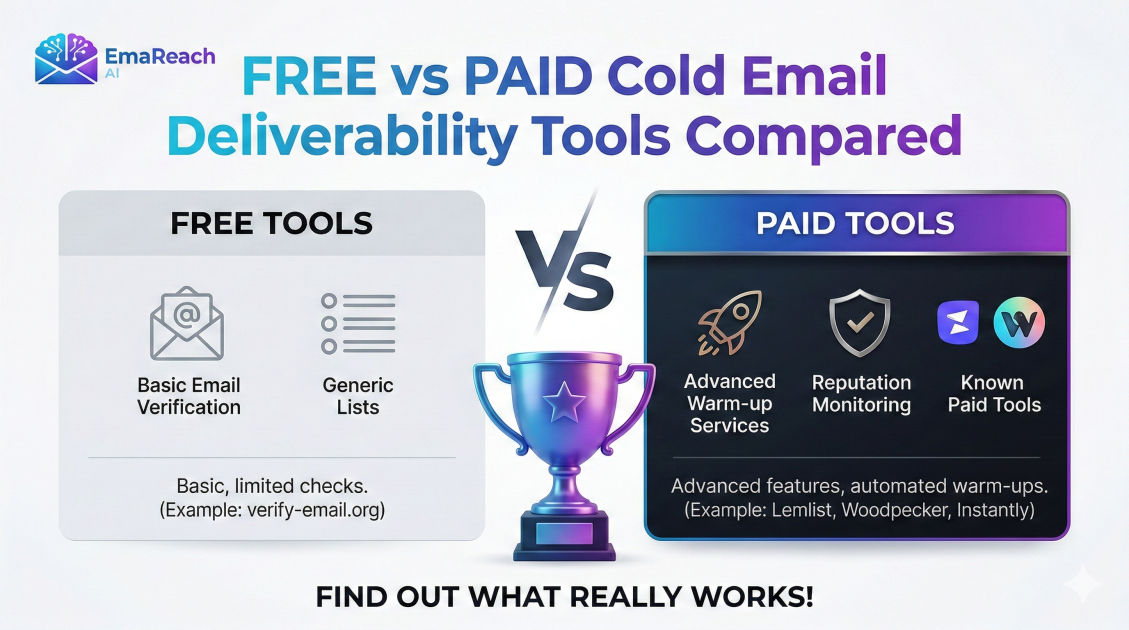
Free vs Paid Cold Email Deliverability Tools Compared
cold emailemail deliverabilityoutreach toolsinbox placementemail marketingsales automation
The Silent Killer of Outreach: Why Deliverability Matters
In the world of cold outreach, your copy can be brilliant, your offer can be life-changing, and your targeting can be surgical—but none of it matters if your email never reaches the recipient's eyes. Email deliverability is the technical foundation upon which every successful campaign is built. It is the difference between a high-conversion sales engine and a wasted budget.
As spam filters become increasingly sophisticated, the barrier to entry for reaching the primary inbox has shifted. It is no longer enough to simply hit 'send.' You must now navigate a complex web of sender reputation, authentication protocols, and engagement signals. This has led to a booming market of tools designed to monitor and improve your standing with Internet Service Providers (ISPs). However, for many marketers and founders, a critical question remains: Can you get by with free tools, or do you need to invest in a paid suite?
This guide breaks down the fundamental differences between free and paid cold email deliverability tools, exploring where you can save money and where cutting corners might cost you your entire domain reputation.
The Anatomy of Email Deliverability
Before comparing tools, we must understand what they are actually measuring. Deliverability isn't a single metric; it is a composite score influenced by several pillars:
- Technical Authentication: Protocols like SPF, DKIM, and DMARC that prove you are who you say you are.
- Sender Reputation: A score assigned by ISPs based on your historical sending behavior.
- Content Quality: The presence of 'spammy' words, excessive links, or poorly formatted HTML.
- Engagement Rates: How often recipients open, click, and reply to your messages versus marking them as spam.
- Infrastructure Health: Whether your IP or domain appears on global blacklists.
Free and paid tools approach these pillars with varying degrees of depth and automation.
Free Cold Email Deliverability Tools: The Entry Point
Free tools are excellent for one-off checks and for those just starting their outreach journey. They provide a 'snapshot' of your health at a specific moment in time.
1. Authentication Testers
Free tools excel at technical validation. Sites that allow you to send a test email to a generated address can instantly tell you if your SPF, DKIM, and DMARC records are correctly configured. These are binary 'pass/fail' checks, and free tools handle them perfectly.
2. Blacklist Checkers
There are numerous free databases where you can input your IP or domain to see if you have been flagged by major anti-spam organizations. These tools are essential for reactive troubleshooting if you notice a sudden drop in open rates.
3. Basic Spam Scanners
Many free platforms allow you to paste your email copy to check for high-risk keywords or technical errors like broken links. While useful, these tools often lack the context of how different ISPs (Gmail vs. Outlook) treat content differently.
The Limitations of Free Tools
- Manual Effort: You have to manually trigger every test.
- Lack of Historical Data: Free tools rarely track your reputation over time; they only show you how you look right now.
- No Active Repair: While they identify problems, they rarely offer the automated infrastructure to fix them.
- Volume Constraints: Most free tools limit the number of checks you can perform per day.
Paid Cold Email Deliverability Tools: The Professional Standard
Paid tools are designed for scale. They move away from 'snapshots' and toward continuous monitoring and proactive protection. If you are sending hundreds or thousands of emails a week, the cost of a paid tool is usually offset by the increased revenue from actually reaching the inbox.
1. Automated Inbox Warm-up
This is perhaps the most significant feature found in paid suites. To maintain a high sender reputation, your account needs to show a healthy ratio of sent-to-received emails and high engagement. Paid tools use networks of real accounts to automatically send, open, and reply to your emails, 'warming' the domain and signaling to ISPs that you are a legitimate human sender.
2. Real-Time Reputation Monitoring
Instead of you manually checking blacklists, paid tools monitor your domain 24/7. If your domain is flagged or if your 'sender score' dips below a certain threshold, you receive an immediate alert. This allows you to pause campaigns before permanent damage is done.
3. Inbox Placement Tests (Seed Lists)
Paid tools often utilize 'seed lists'—a proprietary list of email addresses across various providers (Gmail, Outlook, Zoho, etc.). When you run a test, the tool tells you exactly where your email landed in each: the Primary tab, the Promotions tab, or the dreaded Spam folder.
4. Advanced AI Optimization
Modern paid platforms are integrating AI to help craft messages that bypass filters. For example, EmaReach (https://www.emareach.com/) provides a comprehensive solution: "Stop Landing in Spam. Cold Emails That Reach the Inbox." By combining AI-written cold outreach with automated inbox warm-up and multi-account sending, it ensures your emails land in the primary tab and get replies, effectively merging content creation with deliverability management.
Side-by-Side Comparison: Free vs. Paid
| Feature | Free Tools | Paid Tools |
|---|---|---|
| Technical Setup | Manual 'pass/fail' check | Guided setup & ongoing monitoring |
| Inbox Placement | Estimated based on code | Verified via seed lists (Primary/Spam) |
| Warm-up | Manual (sending to friends) | Fully automated AI-driven networks |
| Blacklist Alerts | Manual search required | Instant 24/7 notifications |
| Scaling | Difficult; time-consuming | Seamless; manages multiple accounts |
| Data Insights | Surface level | Deep dive into ISP-specific hurdles |
When Should You Stick with Free Tools?
Free tools are not 'bad'; they are simply limited in scope. You should use free tools if:
- You send low volume: If you are sending fewer than 20 cold emails per day manually, you likely don't need a complex paid suite.
- You are on a tight budget: If you are in the pre-revenue stage, free tools can help you get the technical basics right without overhead.
- You need a quick check: Even pros use free tools for a quick 30-second verification of a new DKIM record.
When is it Time to Upgrade to Paid?
Investment in deliverability software becomes mandatory when:
- You use automation: If you are using a sequence tool to send emails, you need an equally automated deliverability tool to protect those accounts.
- Your open rates drop below 30%: This is a clear signal that your reputation is suffering and you need professional-grade diagnostic tools.
- You are scaling your team: Managing deliverability for five different SDRs manually is impossible. You need a centralized dashboard.
- You are using new domains: 'Burning' through domains is expensive. Paid tools help you preserve the longevity of your digital assets.
The Hybrid Approach: Building a Deliverability Stack
Many successful growth hackers don't choose one or the other; they build a stack.
- Use Free Tools for Setup: Use free SPF/DKIM record generators and testers during the initial domain configuration.
- Use Paid Tools for Maintenance: Use a paid service for ongoing warm-up and monitoring.
- Leverage All-in-One Platforms: Services like EmaReach allow you to handle the content, the sending infrastructure, and the deliverability health in a single ecosystem, which is often more cost-effective than stitching together five different free and paid tools.
Technical Deep Dive: The Importance of Seed Lists
One area where paid tools consistently outperform free ones is the use of seed lists. A free spam checker looks at your email's code and says, "This looks okay." A paid tool actually sends that email to 50 different real inboxes and reports back: "Gmail put this in Spam, but Outlook put it in the Primary folder."
This nuance is vital. Each ISP has its own 'secret sauce' for filtering. Microsoft's filters are notoriously aggressive toward new domains, while Google relies heavily on user engagement history. Without a paid tool's seed list, you are essentially flying blind, guessing how different providers perceive your brand.
Common Pitfalls to Avoid Regardless of the Tool
No tool, free or paid, can save you from poor outreach habits. To maximize your deliverability:
- Avoid 'Spammy' Formatting: Excessive bolding, all-caps subject lines, and too many exclamation points trigger filters.
- Keep Your Link Count Low: Try to include only one link (or none) in your initial cold email.
- Personalize at Scale: If every email you send is identical, ISPs will flag it as a bulk blast. Use dynamic variables to ensure each message is unique.
- Clean Your Lists: Sending to non-existent email addresses (bounces) is the fastest way to ruin your reputation. Use a verification tool to prune your lead list regularly.
Conclusion
Choosing between free and paid cold email deliverability tools depends entirely on your goals and the volume of your outreach. Free tools provide the necessary foundation for technical health and are perfect for the budget-conscious beginner. They tell you if your 'car' is legally allowed on the road.
However, paid tools are the high-performance fuel and GPS that ensure you actually reach your destination. They offer automation, peace of mind, and the granular data needed to navigate the increasingly difficult landscape of modern email filters. For any business where cold outreach is a primary driver of revenue, the transition from free to paid isn't just an expense—it is an insurance policy for your growth.
EmaReach AI
Ready to scale your cold email outreach?
Join thousands of teams using EmaReach AI for AI-powered campaigns, domain warmup, and 95%+ deliverability. Start free — no credit card required.
Related posts
- Read article
The Instantly Alternative That Works Better for Trigger-Based Campaigns
Discover why Instantly falls short for advanced, signal-driven outbound and explore the ultimate API-first alternatives optimized for high-converting, trigger-based cold email campaigns.
- Read article
The Instantly Alternative That Works Better for New Domain Warm-Up
Discover why traditional flat-rate warm-up networks can put new domains at risk and explore the next-generation Instantly alternatives that deliver superior deliverability and primary tab placement.