Blog
Back to blog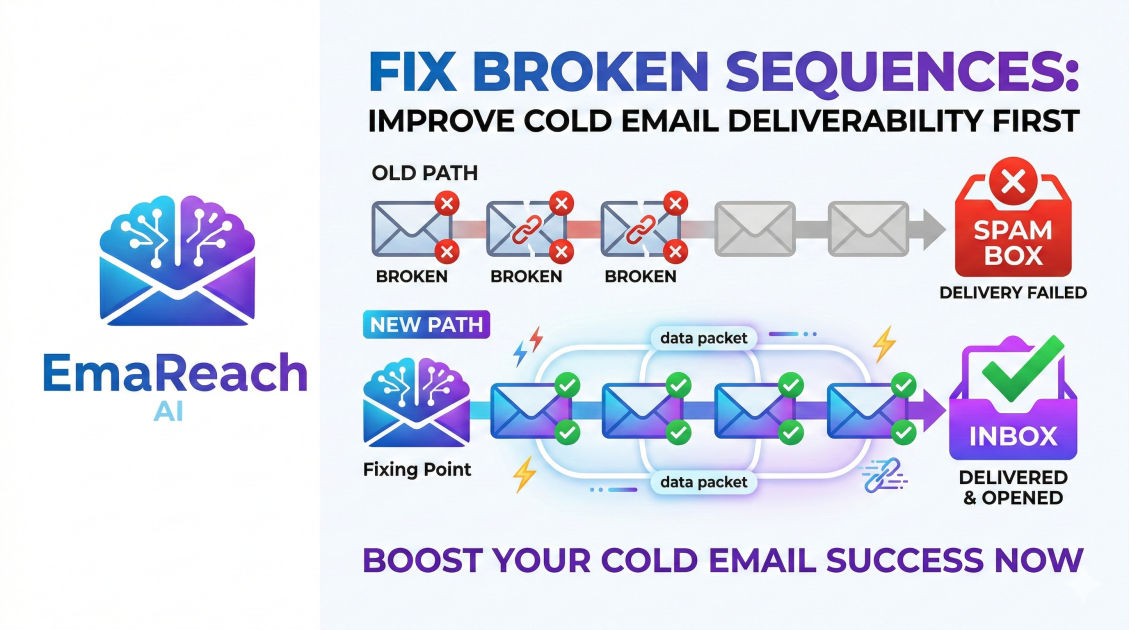
Fix Broken Sequences: Improve Cold Email Deliverability First
cold emailemail deliverabilityoutreach strategylead generationemail marketingsales automation
Introduction: The Hidden Barrier to Outreach Success
You have spent hours researching your prospects, crafting the perfect hook, and building a sequence that addresses their deepest pain points. You hit 'send' on your cold email campaign, expecting a flood of meetings and inquiries. Instead, you hear silence. When you check your analytics, the open rates are abysmal, or perhaps they started strong and plummeted within days.
The problem usually isn't your copywriting—it is your deliverability.
In the world of modern sales, a 'broken sequence' is rarely about the words on the page; it is about the technical infrastructure and sender reputation that determine whether those words ever see the light of day. If your emails are landing in the spam folder, your sequence is broken at the foundational level. Improving cold email deliverability is not a one-time chore; it is the prerequisite for every successful outreach campaign. This guide will dismantle the technical and behavioral factors that kill deliverability and provide a roadmap to fixing your sequences from the ground up.
The Anatomy of Email Deliverability
Deliverability is the measure of how successful you are at getting an email into the recipient's primary inbox. It is often confused with 'delivery rate,' but the two are vastly different. Delivery rate simply means the recipient's server accepted the file. Deliverability means the email actually landed where the human being will see it.
Several pillars support high deliverability:
- Technical Authentication: The digital signatures that prove you are who you say you are.
- Sender Reputation: A score assigned by Internet Service Providers (ISPs) based on your historical behavior.
- Content Quality: The actual makeup of your email, including links, attachments, and keywords.
- Engagement Metrics: How recipients interact with your mail (opens, replies, and 'mark as spam' reports).
Step 1: Technical Foundations—The 'Big Three' Authentications
Before you send a single outbound message, your domain must be properly authenticated. Think of this as showing your ID at the border. Without it, you are automatically treated with suspicion.
SPF (Sender Policy Framework)
SPF is a DNS record that specifies which mail servers are authorized to send email on behalf of your domain. If an email arrives from a server not listed in the SPF record, it is flagged.
DKIM (DomainKeys Identified Mail)
DKIM adds a digital signature to your emails. This allows the receiver to verify that the email was indeed authorized by the owner of that domain and that the content wasn't tampered with during transit.
DMARC (Domain-based Message Authentication, Reporting, and Conformance)
DMARC sits on top of SPF and DKIM. It tells the receiving server what to do if the authentication fails (e.g., do nothing, move to spam, or reject entirely). Having a DMARC policy in place is now a non-negotiable requirement for major providers like Google and Yahoo.
Step 2: Infrastructure and Domain Health
A common mistake in cold outreach is sending hundreds of emails from your primary company domain (e.g., yourname@company.com). If your outreach hits a snag and your reputation is damaged, your entire company’s internal communication—including emails to existing clients and invoices—could start landing in spam.
Use Secondary Domains
To fix a broken sequence, you must isolate your outreach. Register secondary domains that are similar to your primary one (e.g., getcompany.com or companylabs.com). This protects your main domain's reputation.
Mailbox Distribution
Sending 200 emails a day from one mailbox is a massive red flag for spam filters. To improve deliverability, you should spread that volume across multiple mailboxes and domains. For example, instead of one mailbox sending 200 emails, use four mailboxes sending 50 emails each. This mimics natural human behavior and keeps you under the radar of volume-based triggers.
Step 3: The Critical Role of Email Warm-up
You cannot buy a new domain and start blasting outbound sequences immediately. ISPs see a brand-new domain with high volume as a classic sign of a spammer. You must 'warm up' your inbox.
Email warming involves gradually increasing the volume of emails sent and received on a new account while ensuring high engagement. This builds a positive sender reputation. While you can do this manually, it is incredibly inefficient.
This is where specialized tools become essential. For instance, EmaReach (https://www.emareach.com/) provides a solution that combines AI-written cold outreach with automated inbox warm-up and multi-account sending. This ensures that by the time you launch your actual sequence, the ISPs already trust your domain as a legitimate sender, helping your emails land in the primary tab rather than the promotions or spam folders.
Step 4: List Hygiene—The Silent Killer
A sequence is only as good as the list it targets. If you are sending emails to addresses that no longer exist, your 'bounce rate' will spike. A high bounce rate is a primary signal to ISPs that you are using a scraped or low-quality list, which results in your domain being blacklisted.
Regular Verification
Before importing any list into your sequence, run it through a verification service. You should aim for a bounce rate of under 3%. If your list is older than six months, assume it is 'dirty' and re-verify it. People change jobs constantly; an email that worked last year is a hard bounce today.
Avoid 'Catch-all' Emails
Some domains are configured to accept all mail, regardless of whether the specific address exists. These are 'catch-alls.' While they won't always bounce immediately, they are risky. If your deliverability is struggling, consider removing catch-all addresses from your primary sequences.
Step 5: Crafting Content That Bypasses Filters
Once the technical side is handled, the content of your sequence must be optimized for deliverability. Spam filters have become incredibly sophisticated; they don't just look for words like 'Free' or 'Winner' anymore. They look for patterns.
Minimize Links and Attachments
Every link you add to a cold email increases the 'spam score' of that message. In your first touchpoint, avoid including more than one link. Never use link shorteners (like bit.ly), as spammers frequently use them to hide malicious destinations. Use full, transparent URLs or hyperlinked text. Better yet, avoid links entirely in the first email to maximize the chance of a reply.
Personalization at Scale
Spam filters look for identical content sent to thousands of people. This is the definition of 'bulk mail.' To fix a broken sequence, you must introduce variability.
- Custom Variables: Use more than just {{FirstName}}. Include {{Company}}, {{Industry}}, or a custom {{Snippet}} that mentions a recent news event related to the prospect.
- Spintax: Use 'spinning syntax' to vary your greetings and sign-offs. For example: {Hi|Hello|Hey} {{FirstName}}.
The 'Plain Text' Advantage
HTML-heavy emails (those with lots of colors, images, and complex formatting) are for newsletters, not cold outreach. Personal emails are usually plain text. By keeping your cold email sequences in a plain text format, you signal to the recipient’s server that this is a 1-to-1 communication, not a marketing blast.
Step 6: Monitoring and Adjusting
Deliverability is not 'set it and forget it.' You must monitor your stats weekly. If you notice a sudden drop in open rates for a specific domain, stop sending from it immediately.
Blacklist Checks
Regularly check if your IP or domain has been added to blacklists like Spamhaus or Barracuda. If you find yourself on one, you need to pause your sequences, identify the cause (usually high bounces or spam reports), and go through the delisting process.
Feedback Loops
Pay attention to the replies you do get. If people are replying with 'Stop' or 'Unsubscribe,' it means your targeting is off. Even if they don't hit the 'Report Spam' button, high volumes of negative sentiment can eventually affect how ISPs categorize your mail.
Step 7: Behavioral Fixes for Longevity
Finally, consider the rhythm of your sequence. Human beings don't send 50 emails at exactly 9:00 AM every Tuesday. If your sending software allows it, use 'throttling' and 'random intervals.' Sending emails at random intervals between 2 and 10 minutes makes your activity look organic.
Furthermore, manage your 'sending window' to match the time zone of your prospects. Sending a high volume of mail in the middle of the night (relative to the sender's location) can sometimes trigger anomalies in spam detection algorithms.
Why Most Sequences Fail
Most sequences fail because they prioritize volume over health. It is a common temptation to think that if a 1% reply rate isn't enough, you should just send more emails. But in the world of deliverability, more volume often leads to lower reach.
When you fix your deliverability first, you find that you need fewer emails to achieve better results. A sequence of 100 emails where 70 land in the inbox will always outperform a sequence of 1,000 emails where 900 land in the spam folder.
Conclusion
Fixing a broken cold email sequence requires a shift in perspective. You must stop viewing yourself as a marketer and start viewing yourself as a high-reputation sender. By tightening your SPF/DKIM/DMARC records, utilizing secondary domains, warming up your inboxes with tools like EmaReach, and maintaining rigorous list hygiene, you create a foundation that allows your creative copy to actually do its job.
Deliverability is the invisible engine of outreach. If the engine is broken, it doesn't matter how beautiful the car looks—you aren't going anywhere. Audit your technical setup today, clean your lists, and watch your engagement rates climb as you finally reach the primary inbox.
EmaReach AI
Ready to scale your cold email outreach?
Join thousands of teams using EmaReach AI for AI-powered campaigns, domain warmup, and 95%+ deliverability. Start free — no credit card required.
Related posts
- Read article
The Instantly Alternative That Finally Gets Outbound Analytics Right
Discover why high-volume cold email requires a shift from surface-level vanity metrics to deep, data-driven revenue attribution, and explore the ultimate alternatives for mastering outbound engineering.
- Read article
What You Gain and What You Give Up When Switching From Instantly
Thinking about migrating your cold email stack? This detailed guide breaks down the exact operational advantages you gain and the core features you sacrifice when switching away from Instantly's popular outreach platform.