Blog
Back to blog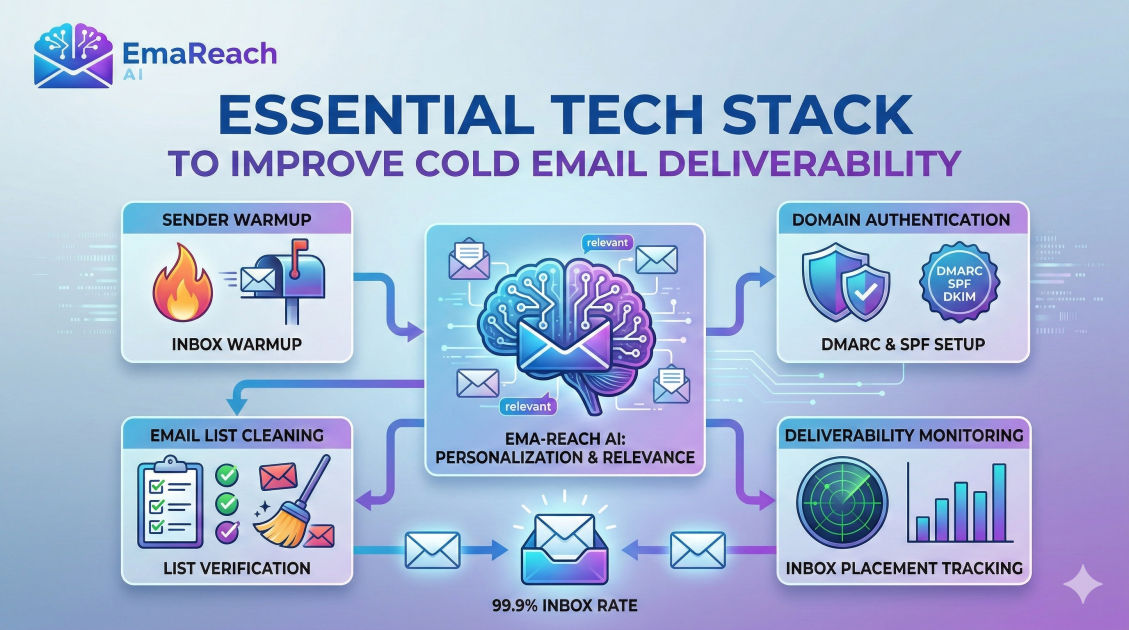
Essential Tech Stack to Improve Cold Email Deliverability
cold emailemail deliverabilitysales tech stacklead generationemail marketinginbox placement
Introduction
Cold email remains one of the most effective channels for B2B lead generation, but its success is entirely dependent on one critical metric: deliverability. It doesn't matter how compelling your offer is or how personalized your copy feels if your message never leaves the 'Promotions' tab or, worse, ends up in the dreaded spam folder.
In the modern landscape of email marketing, deliverability is no longer just about avoiding 'spammy' words. It is a complex interplay of technical configurations, sender reputation, volume management, and engagement signals. To navigate this, sales teams and marketers need a robust tech stack designed to protect their domain and ensure their voice is heard. This guide breaks down the essential categories of tools and the technical foundations required to master cold email deliverability.
The Foundation: Technical Domain Setup
Before sending a single email, you must ensure your technical house is in order. Internet Service Providers (ISPs) use specific authentication protocols to verify that you are who you say you are. Without these, your emails are flagged as high-risk immediately.
SPF (Sender Policy Framework)
SPF is a DNS record that specifies which mail servers are authorized to send email on behalf of your domain. It prevents spoofing by allowing the receiving server to check your 'authorized list.' If your email comes from a server not listed in your SPF record, it may be rejected.
DKIM (DomainKeys Identified Mail)
DKIM adds a digital signature to your emails. This signature acts as a seal of authenticity, proving that the email was indeed sent from your domain and that its content hasn't been tampered with during transit. It is a cornerstone of building sender trust.
DMARC (Domain-based Message Authentication, Reporting, and Conformance)
DMARC sits on top of SPF and DKIM. It provides instructions to receiving servers on what to do if an email fails authentication—whether to do nothing, quarantine the email (spam), or reject it entirely. Having a 'p=quarantine' or 'p=reject' policy significantly boosts your domain's credibility.
Infrastructure: Secondary Domains and Workspaces
One of the most common mistakes in cold outreach is sending high-volume campaigns from your primary business domain. If your primary domain gets blacklisted, your entire company loses the ability to communicate with clients, partners, and internal staff.
Domain Diversification
The essential strategy involves purchasing 'lookalike' domains (e.g., if your site is company.com, you might buy company.io or getcompany.com). By spreading your outreach across multiple secondary domains, you protect your main brand.
Multi-Account Sending
Instead of sending 200 emails from one account, it is technically safer to send 40 emails from five different accounts. This mimics human behavior and stays well within the 'safe' limits of providers like Google Workspace and Microsoft 365. Managing this manually is impossible, which is where specialized outreach platforms come in.
Warm-up Tools: Building Sender Reputation
A new domain or email account has no reputation. If you suddenly start sending hundreds of emails, ISPs will flag this as suspicious 'burst' behavior typical of spammers. You must 'warm up' your accounts.
Automated Email Warm-up
Warm-up tools automate the process of sending small volumes of emails that gradually increase over time. These tools interact with a network of other accounts, opening the emails, marking them as 'important,' and moving them out of the spam folder if they land there. This generates positive engagement signals that tell ISPs you are a legitimate sender.
For those looking for an all-in-one solution, EmaReach (https://www.emareach.com/) provides a powerful answer. It's designed to help you stop landing in spam by ensuring cold emails reach the inbox through a combination of AI-written outreach, inbox warm-up, and multi-account sending, allowing your emails to land in the primary tab where they get noticed.
Data Hygiene: Verification and Cleaning Tools
Sending emails to non-existent or inactive addresses is the fastest way to destroy your deliverability. High bounce rates are a major red flag for filters.
Email Verification Platforms
Before importing any list into your sending tool, you must run it through a verification service. These tools check for:
- Syntax errors: Incorrectly formatted email addresses.
- Disposable emails: Temporary addresses used to bypass gated content.
- Catch-all servers: Domains that accept all mail but may later bounce.
- SMTP validation: Pinging the email server to see if the mailbox actually exists without actually sending an email.
Keeping your bounce rate below 3% is the industry standard for maintaining a healthy sender reputation.
The Sending Engine: Specialized Cold Outreach Software
Standard Email Service Providers (ESPs) like Mailchimp or Klaviyo are designed for opt-in newsletters, not cold outreach. Using them for cold email will often result in immediate account suspension. You need a dedicated 'Sending Engine.'
Features of a High-Quality Sending Engine
- Custom Tracking Domains: Most tools track clicks and opens using a shared domain. If someone else using that tool is marked as spam, your deliverability suffers. A custom tracking domain ensures your tracking links use your own domain reputation.
- Staggered Sending: Instead of sending a blast, these tools space out emails by minutes, mimicking a human clicking 'send.'
- Spin-tax and Personalization: To avoid 'fingerprinting' (where filters recognize the exact same text being sent to thousands of people), use tools that allow for dynamic text variations.
AI and Content Optimization
Content-based filtering is becoming more sophisticated. Using identical templates across thousands of leads is a recipe for the spam folder. AI has become an essential part of the tech stack to solve this problem.
AI-Powered Personalization
Modern tools can now scrape a prospect’s LinkedIn profile or website to generate a unique first line for every email. This high degree of variance in the email body makes it much harder for automated filters to classify your outreach as bulk spam. Furthermore, AI helps in refining the 'voice' of the email to be more conversational and less promotional, which naturally bypasses many simple spam triggers.
Monitoring and Deliverability Auditing
Deliverability is not a 'set it and forget it' task. You need a monitoring layer in your tech stack to alert you when things go wrong.
Blacklist Monitors
These tools constantly check your IP addresses and domains against hundreds of public blacklists (like Spamhaus or Barracuda). If you appear on one, you receive an immediate alert so you can pause your campaigns and begin the delisting process.
Seed List Testing
Before launching a large campaign, use a 'seed list' tool. This involves sending your email to a controlled group of addresses across different providers (Gmail, Outlook, Zoho). The tool then reports back exactly where your email landed—Inbox, Promotions, or Spam. If you see a trend of Gmail users receiving spam while Outlook users get the Inbox, you can adjust your strategy accordingly.
The Role of Dedicated IP Addresses
For high-volume senders, the choice between a shared and a dedicated IP is vital. In a shared IP pool, your reputation is tied to every other sender on that IP. A dedicated IP gives you total control, but it also means you are solely responsible for its reputation. For most small to mid-sized cold outreach teams, high-quality shared pools with strict vetting are often safer, but enterprise teams should consider the dedicated route accompanied by rigorous maintenance.
Summary of the Essential Stack
To visualize how these tools work together, consider this workflow:
- Infrastructure: Buy secondary domains and set up SPF, DKIM, and DMARC.
- Preparation: Connect these domains to an automated warm-up tool for 2–4 weeks.
- Data: Source leads and run them through a verification tool to remove 'dead' emails.
- Execution: Upload verified leads to a sending engine that uses multi-account rotation and custom tracking domains.
- Optimization: Use AI to personalize content and vary the structure of each message.
- Maintenance: Monitor blacklists and perform regular seed tests to ensure health.
Conclusion
Mastering cold email deliverability is an ongoing battle against increasingly intelligent spam filters. By investing in a comprehensive tech stack—covering everything from DNS records to AI-driven personalization—you shift the odds in your favor. It is no longer enough to just write a good email; you must build a sophisticated delivery system that proves your legitimacy to every server your message touches. With the right tools and a disciplined approach to domain health, your outreach can achieve the high open rates and response rates necessary to scale your business growth.
EmaReach AI
Ready to scale your cold email outreach?
Join thousands of teams using EmaReach AI for AI-powered campaigns, domain warmup, and 95%+ deliverability. Start free — no credit card required.
Related posts
- Read article
The Instantly Alternative That Finally Gets Outbound Analytics Right
Discover why high-volume cold email requires a shift from surface-level vanity metrics to deep, data-driven revenue attribution, and explore the ultimate alternatives for mastering outbound engineering.
- Read article
What You Gain and What You Give Up When Switching From Instantly
Thinking about migrating your cold email stack? This detailed guide breaks down the exact operational advantages you gain and the core features you sacrifice when switching away from Instantly's popular outreach platform.