Blog
Back to blog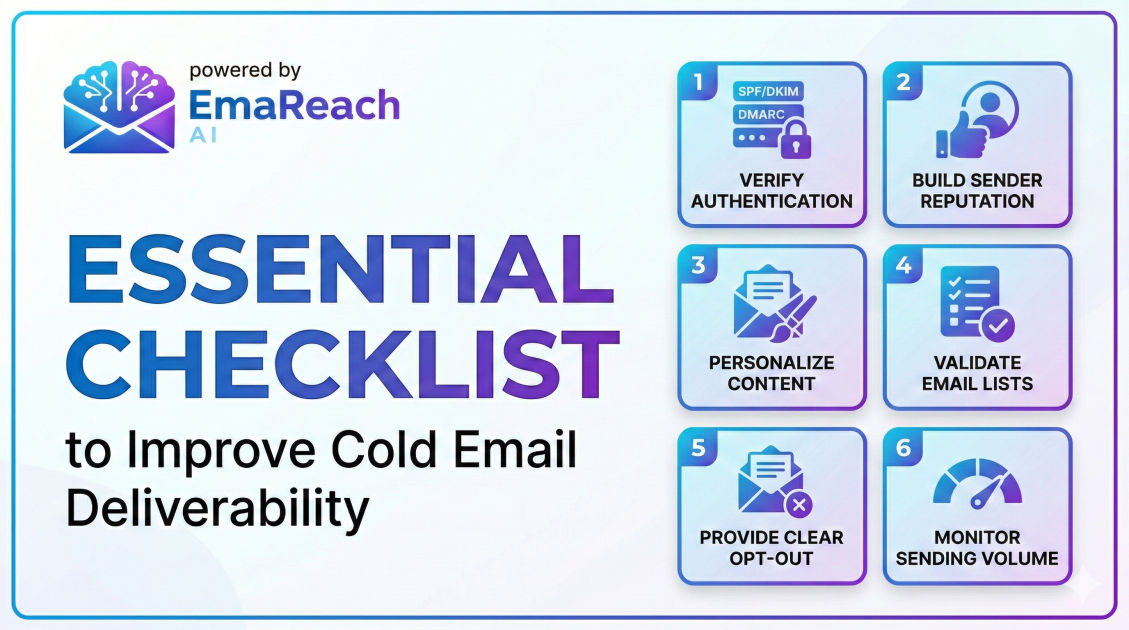
Essential Checklist to Improve Cold Email Deliverability
cold emaildeliverabilityemail marketingoutreachlead generationsales strategySPF DKIM DMARC
Introduction to Email Deliverability
Email deliverability is the silent engine of any successful outbound sales strategy. You can craft the most compelling, high-converting copy in the world, but if your message never reaches the recipient's primary inbox, your efforts are wasted. In the modern landscape of digital communication, mailbox providers have become increasingly sophisticated, using complex algorithms and machine learning to filter out noise and protect users from spam.
Improving your cold email deliverability is not a one-time task; it is an ongoing process of technical setup, reputation management, and behavioral discipline. This comprehensive checklist serves as a foundational guide to ensuring your outreach efforts result in actual conversations rather than a mounting pile of ignored messages in a spam folder.
Phase 1: Technical Infrastructure and Authentication
Before you send a single email, your technical foundation must be rock-solid. Mailbox providers like Google and Outlook look for specific digital 'passports' to verify that you are who you say you are.
SPF (Sender Policy Framework)
SPF is a DNS record that lists the IP addresses and domains authorized to send emails on behalf of your domain. Without this, receiving servers have no way of knowing if an email is legitimate or a spoofing attempt.
DKIM (DomainKeys Identified Mail)
DKIM adds a digital signature to your emails. This signature ensures that the content of the email hasn't been tampered with in transit. It provides a layer of integrity that major providers weigh heavily when deciding whether to trust a sender.
DMARC (Domain-based Message Authentication, Reporting, and Conformance)
DMARC tells receiving servers what to do if an email fails SPF or DKIM checks. Setting your DMARC policy to 'quarantine' or 'reject' signals to the world that you take your domain security seriously, which significantly boosts your sender reputation.
Custom Tracking Domains
Most email sending tools use a shared tracking domain for open and click rates. If another user on that shared domain sends spam, your deliverability suffers. Setting up a custom tracking domain—a subdomain of your own—isolates your reputation and ensures your tracking links don't trigger red flags.
Phase 2: Domain Strategy and Health
Your domain is your identity. Protecting its reputation is paramount. If your main company domain gets blacklisted, it doesn't just stop your sales; it stops your internal communication, billing, and support.
Use Secondary Domains
Never send cold emails from your primary company domain (e.g., use getcompany.com instead of company.com). This creates a 'firewall' that protects your core business operations if your outreach domain faces deliverability issues.
Domain Age and History
New domains are naturally suspicious to mailbox providers. If you purchase a new domain, you cannot immediately start sending hundreds of emails. You must 'age' the domain and build a history of legitimate interactions.
Inbox Warm-up
Warm-up is the process of gradually increasing your email volume while maintaining high engagement rates. This simulates natural human behavior. For those looking to automate this complex process, EmaReach provides an integrated solution. EmaReach combines AI-written cold outreach with inbox warm-up and multi-account sending, ensuring your emails land in the primary tab and get replies by mimicking genuine conversational patterns.
Phase 3: List Hygiene and Data Quality
Deliverability is heavily influenced by 'bounce rates.' If you frequently try to email addresses that don't exist, providers will mark you as a low-quality sender or a 'spammer' using old, scraped lists.
Verify Every Single Email
Use a verification tool to check if an email address is valid, catch-all, or invalid before you hit send. Aim for a bounce rate of under 2%. Anything higher is a signal to ISPs that you are not practicing good list hygiene.
Avoid 'Catch-all' Addresses
Catch-all domains are configured to receive all emails sent to that domain, even if the specific mailbox doesn't exist. These are risky. While some might be valid, they are often used as 'spam traps.' If you are struggling with deliverability, segment your catch-all leads and treat them with extra caution.
Targeted Prospecting over Bulk Blasting
The era of 'spray and pray' is over. Highly targeted lists with 50-100 high-quality leads will always outperform a list of 10,000 unverified contacts. Quality data is the bedrock of deliverability.
Phase 4: Content and Copywriting Best Practices
What you write—and how you write it—matters just as much as the technical setup. Modern spam filters analyze the language, structure, and links within your message.
Avoid Spam Trigger Words
Words like 'Free,' 'Guarantee,' 'Cash,' 'Act Now,' and excessive use of exclamation marks are classic red flags. While one or two might not hurt, a high density of these terms will land you in the promotions or spam tab.
Personalization at Scale
Static templates are easy for filters to identify. Use 'spintax' (variations of sentences) and deep personalization (mentioning a specific recent achievement or a relevant pain point) to ensure every email you send is unique. This makes it much harder for automated filters to categorize your outreach as bulk automated mail.
Keep it Short and Text-Based
High image-to-text ratios and excessive HTML formatting (like fancy newsletters) often trigger spam filters. Cold emails should look like an email you'd send to a colleague: plain text, concise, and focused on a single call to action.
Limit Links and Attachments
Never include attachments in a first-touch cold email. Similarly, try to limit yourself to one link—ideally your call to action or a link to your website. Too many links make an email look like a phishing attempt.
Phase 5: Sending Patterns and Volume Management
How you send your emails is the final piece of the deliverability puzzle. Erratic behavior is the hallmark of a bot; consistency is the hallmark of a human.
Daily Sending Limits
Never exceed 50 messages per day per inbox. If you need to send 500 emails a day, use 10 different inboxes across multiple domains rather than blasting them from a single account. This distributed approach reduces the risk of any single account being flagged.
Randomize Sending Intervals
Don't send emails at exactly 9:00 AM every day. Space them out at irregular intervals (e.g., one email every 3-7 minutes). This mimics natural human typing and sending patterns.
Monitoring Reputation and Blacklists
Regularly check your domain and IP against major blacklists. Monitor your 'Sender Score' and tools like Google Postmaster Tools. These provide direct feedback from the providers themselves regarding how they perceive your domain.
The Importance of Engagement
Deliverability isn't just about avoiding the bad; it's about generating the good. When recipients open your emails, click links, and most importantly, reply, it tells the mailbox provider that your content is valuable. This 'positive engagement' builds a moat around your sender reputation. This is where a multi-faceted approach, like that offered by EmaReach, becomes invaluable—by ensuring your emails are written well enough to actually earn those crucial replies.
Conclusion
Achieving high cold email deliverability is a multi-layered discipline that requires attention to technical detail, ethical prospecting, and thoughtful copywriting. By following this checklist—securing your DNS records, warming up your domains, verifying your data, and mimicking human sending patterns—you move from the shadows of the spam folder into the light of the primary inbox. Remember that deliverability is a marathon, not a sprint. Protect your reputation, provide value to your prospects, and the results will follow in the form of higher open rates, more replies, and ultimately, more revenue.
EmaReach AI
Ready to scale your cold email outreach?
Join thousands of teams using EmaReach AI for AI-powered campaigns, domain warmup, and 95%+ deliverability. Start free — no credit card required.
Related posts
- Read article
The Instantly Alternative That Finally Gets Outbound Analytics Right
Discover why high-volume cold email requires a shift from surface-level vanity metrics to deep, data-driven revenue attribution, and explore the ultimate alternatives for mastering outbound engineering.
- Read article
What You Gain and What You Give Up When Switching From Instantly
Thinking about migrating your cold email stack? This detailed guide breaks down the exact operational advantages you gain and the core features you sacrifice when switching away from Instantly's popular outreach platform.