Blog
Back to blog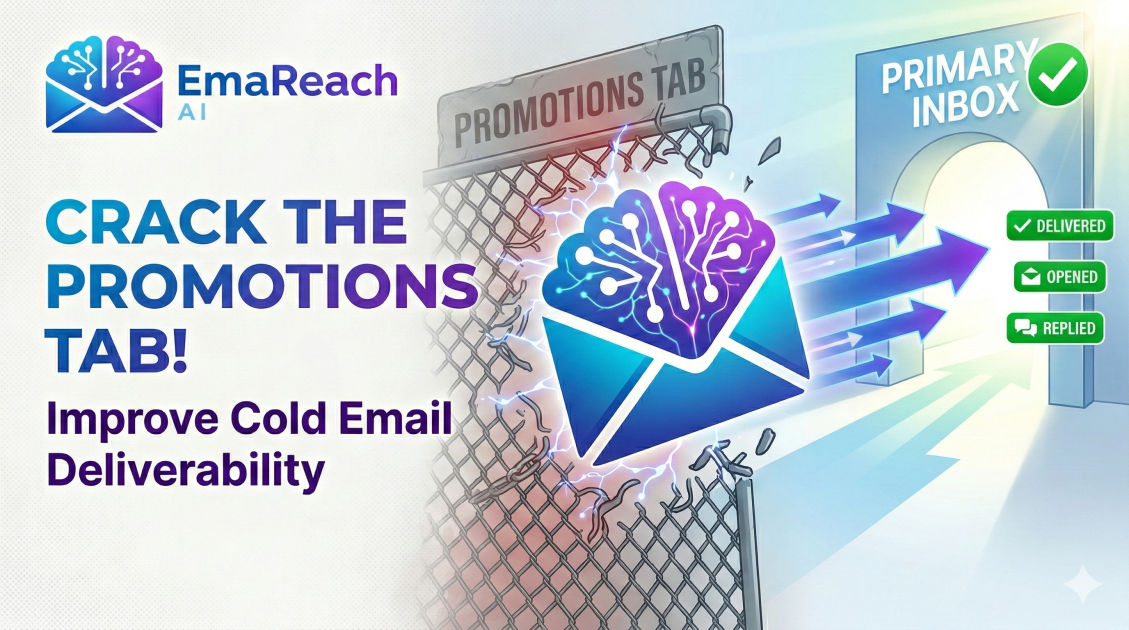
Escaping the Promotions Tab: Improve Cold Email Deliverability
cold emailemail deliverabilitysales outreachinbox placementemail marketinglead generationSPF DKIM DMARC
Introduction
For any modern business relying on outbound sales, the inbox is the ultimate battleground. You can spend weeks crafting the perfect value proposition, identifying the ideal customer profile, and segmenting your lists, but all that effort is rendered invisible if your message never reaches the primary inbox. Landing in the Promotions tab is often viewed as a 'soft' failure, but in the world of cold email, it is practically equivalent to being sent to the spam folder. Most recipients rarely check their Promotions tab for business inquiries, and even fewer engage with them with the same level of attention they give to their main feed.
Achieving high deliverability is not a matter of luck; it is a technical discipline that requires a deep understanding of how Internet Service Providers (ISPs) and email clients like Google and Microsoft filter incoming mail. This guide provides a comprehensive look at how to optimize every layer of your email infrastructure to ensure your cold outreach lands exactly where it belongs: the primary inbox.
The Technical Foundation: Essential Authentication
Before you send a single email, your technical setup must be flawless. ISPs use authentication protocols to verify that you are who you say you are. If these records are missing or misconfigured, filters will immediately flag your emails as suspicious.
SPF (Sender Policy Framework)
SPF is a text record in your DNS that lists the IP addresses and domains authorized to send emails on behalf of your domain. Think of it as a guest list for a party; if your name isn't on the list, the bouncer (the receiving server) won't let you in.
DKIM (DomainKeys Identified Mail)
DKIM adds a digital signature to your emails. This cryptographic signature ensures that the content of the email hasn't been tampered with during transit. It provides an extra layer of trust, proving that the email originated from your domain and remained intact.
DMARC (Domain-based Message Authentication, Reporting, and Conformance)
DMARC tells the receiving server what to do if an email fails SPF or DKIM checks. By setting your DMARC policy to 'quarantine' or 'reject,' you signal to ISPs that you take security seriously, which significantly boosts your sender reputation.
Domain Infrastructure: Why Age and Reputation Matter
One of the most common mistakes in cold outreach is using a primary company domain. If your deliverability takes a hit due to high spam complaints, your entire company’s communication—including internal emails and client support—could suffer.
Using Secondary Domains
Always set up secondary domains (e.g., yourcompany.io or getyourcompany.com) for cold outreach. This protects your main domain's reputation. However, a new domain has zero reputation, which makes it a prime target for filters.
The Warm-up Period
You cannot start sending 50 emails a day from a brand-new domain. You must 'warm up' the domain by gradually increasing the volume of emails sent and ensuring they receive engagement (opens, replies, and being marked as 'not spam'). This process mimics natural human behavior and builds trust with ISPs.
For those looking to automate this complex process, EmaReach provides an integrated solution. It helps you stop landing in spam by combining AI-written cold outreach with automated inbox warm-up and multi-account sending, ensuring your emails land in the primary tab and get the replies you need.
Understanding the Promotions Tab Logic
The Promotions tab was designed to help users declutter their primary inbox from newsletters, discounts, and marketing blasts. While it isn't the spam folder, for a cold emailer, it is a graveyard. Algorithms analyze several factors to decide if an email is 'promotional':
- High Image-to-Text Ratio: Emails with large banners or multiple images are flagged as marketing.
- Tracking Links: Overusing wrapped tracking links (links that redirect through a third-party server for analytics) can trigger filters.
- Unsubscribe Links: While legally required in many regions for newsletters, a standard 'Unsubscribe' link formatted at the bottom is a massive signal to Google that the email is a bulk marketing message.
- Buzzwords: Words like 'Free,' 'Buy Now,' 'Discount,' and 'Limited Time' are instant triggers.
Content Optimization: Writing for Humans and Algorithms
To escape the Promotions tab, your email must look like a one-to-one communication between two professionals. If it looks like a flyer, it will be treated like one.
Personalization Beyond the First Name
Basic personalization (using the recipient's first name) is no longer enough. Sophisticated filters look for 'unique' content. If you send 500 identical emails, you are flagged as a bulk sender. Use liquid syntax or AI to vary your opening lines, references to the prospect’s company, and specific pain points.
The Plain Text Advantage
Rich HTML emails are for newsletters. Cold emails should be plain text or very simple HTML. Avoid bold colors, multiple font sizes, and buttons. A simple, text-based email feels personal and is much more likely to bypass the Promotions algorithm.
Link Hygiene
Limit yourself to one link, or better yet, none at all in the initial touchpoint. If you must include a link, ensure it is not a shortened URL (like Bitly), as these are frequently used by scammers and are heavily scrutinized. Instead, use a clear, direct URL or a custom tracking domain that matches your sending domain.
List Quality and Lead Research
Your deliverability is only as good as your data. High bounce rates are the fastest way to destroy your sender reputation. A bounce rate higher than 3% is a major red flag for ISPs.
Verification is Non-Negotiable
Always run your lead lists through a verification tool before sending. These tools check if the mailbox actually exists without sending a physical email. This prevents 'hard bounces' which are catastrophic for your domain health.
Relevancy and Targeting
If people find your email irrelevant, they will mark it as spam. This manual 'Mark as Spam' action is the most damaging signal possible. Ensure your targeting is surgical. Reaching out to a CTO about a marketing tool isn't just ineffective; it's a threat to your technical infrastructure.
Advanced Strategies: Multi-Account Sending
To scale your outreach without sacrificing deliverability, you should adopt a 'horizontally scaled' approach. Instead of sending 200 emails from one account, send 20 emails from 10 different accounts across multiple domains.
This distribution minimizes the risk. If one account is flagged, the rest of your campaign remains unaffected. It also keeps the volume per IP address low, which is a key metric monitored by Google and Outlook. Tools like EmaReach are designed specifically for this, allowing you to manage multi-account sending seamlessly while maintaining a high primary inbox placement rate.
The Role of Engagement in Deliverability
Deliverability is a feedback loop. When people open your emails, reply to them, and move them from the Promotions tab to the Primary tab, your reputation increases. Conversely, if your emails are ignored or deleted without being opened, your reputation drops.
Encouraging Replies
Your Call to Action (CTA) should be low-friction. Instead of asking for a 30-minute demo, ask a simple question like, "Is this something your team is currently focusing on?" A reply is the strongest signal to an ISP that your email is wanted and valuable.
Monitoring Your Reputation
Use tools like Google Postmaster Tools to monitor your domain's health. It provides direct data from Google on your spam rate, IP reputation, and domain reputation. If you see a dip, pause your campaigns immediately and investigate the cause.
Common Myths About Cold Email Deliverability
There is a lot of misinformation in the sales world. Let’s debunk a few common myths:
- "The more emails I send, the more leads I'll get." False. Quality and deliverability trump volume every time. 50 emails that reach the inbox are worth more than 5,000 that go to spam.
- "I don't need to warm up my domain if I use a reputable provider." False. Even with a top-tier provider, a new domain is a 'cold' domain and must be treated with caution.
- "Including an opt-out link is all I need to be compliant." While it helps with legal compliance, it doesn't guarantee deliverability. How you handle your list hygiene is more important to ISPs.
Maintaining Long-Term Inbox Health
Deliverability is not a "set it and forget it" task. It requires constant maintenance.
- Rotate Your Copy: Regularly update your email scripts to avoid 'content fingerprinting' by filters.
- Prune Your Lists: If a lead hasn't opened your last three emails, remove them from the campaign. Non-engaging leads are dead weight that pull down your overall stats.
- Monitor Blacklists: Occasionally check if your IP or domain has ended up on a public blacklist. If it has, you'll need to follow the specific removal process for that list.
Conclusion
Escaping the Promotions tab and maintaining high cold email deliverability is a combination of technical precision, thoughtful content, and strategic scaling. By securing your SPF, DKIM, and DMARC records, warming up your domains properly, and focusing on high-quality, plain-text communication, you can ensure your message stands out in the primary inbox.
Remember that deliverability is a marathon, not a sprint. Consistency, relevance, and a respect for the recipient's inbox will always yield better results than high-volume, low-quality blasts. With the right infrastructure—and perhaps a boost from AI-driven platforms like EmaReach to handle the heavy lifting of warming and writing—you can turn cold outreach into a reliable, high-performing revenue engine.
EmaReach AI
Ready to scale your cold email outreach?
Join thousands of teams using EmaReach AI for AI-powered campaigns, domain warmup, and 95%+ deliverability. Start free — no credit card required.
Related posts
- Read article
The Instantly Alternative That Finally Gets Outbound Analytics Right
Discover why high-volume cold email requires a shift from surface-level vanity metrics to deep, data-driven revenue attribution, and explore the ultimate alternatives for mastering outbound engineering.
- Read article
What You Gain and What You Give Up When Switching From Instantly
Thinking about migrating your cold email stack? This detailed guide breaks down the exact operational advantages you gain and the core features you sacrifice when switching away from Instantly's popular outreach platform.