Blog
Back to blog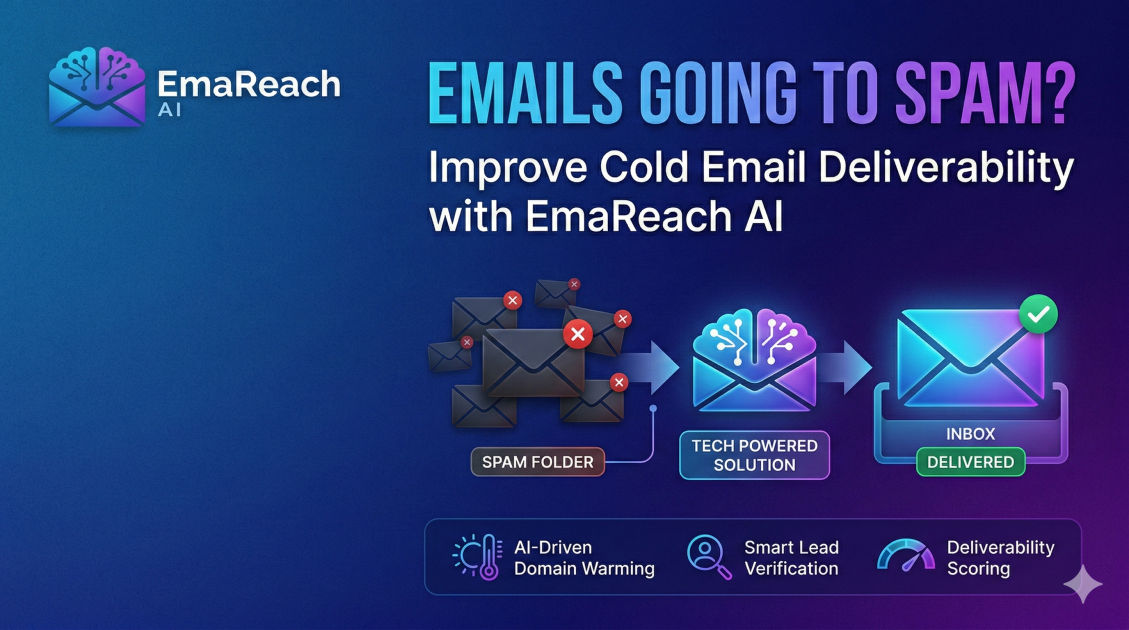
Emails Going to Spam? How to Improve Cold Email Deliverability
cold emaildeliverabilityemail marketingsales outreachlead generationspam filters
Introduction
There is nothing more frustrating in the world of digital sales than spending hours crafting the perfect pitch, identifying the ideal prospect, and hitting 'send,' only for your message to vanish into the digital abyss of the spam folder. In the modern landscape of outbound sales, deliverability is no longer a given—it is a hard-earned asset.
Cold email deliverability refers to the ability of your emails to reach the recipient's primary inbox rather than being diverted to the junk folder or blocked entirely by Internet Service Providers (ISPs). As spam filters become increasingly sophisticated, powered by machine learning and behavioral analysis, the margin for error has narrowed. To succeed today, you must understand the technical, behavioral, and content-based factors that determine whether you are seen as a trusted sender or a digital nuisance.
This guide provides a deep dive into the mechanics of email deliverability and offers a roadmap to ensuring your cold outreach actually gets read.
The Three Pillars of Email Deliverability
To master deliverability, you must look at it through three distinct lenses: Technical Setup, Sender Reputation, and Content Quality. Neglecting any one of these can cause your entire campaign to collapse.
1. Technical Infrastructure: The Foundation
Before you write a single word of copy, your technical foundation must be rock-solid. ISPs use specific authentication protocols to verify that you are who you say you are. If these are missing or misconfigured, you are essentially wearing a 'spam' sign on your back.
SPF (Sender Policy Framework)
SPF is a DNS record that lists the IP addresses and domains authorized to send emails on behalf of your domain. When an email reaches a recipient's server, the server checks the SPF record to see if the sending source is approved. Without this, your emails are highly likely to be flagged.
DKIM (DomainKeys Identified Mail)
DKIM adds a digital signature to your emails. This cryptographic signature ensures that the content of the email has not been tampered with during transit. It acts as a seal of authenticity, proving that the message originated from your domain and remained intact.
DMARC (Domain-based Message Authentication, Reporting, and Conformance)
DMARC sits on top of SPF and DKIM. It tells the receiving server what to do if an email fails the SPF or DKIM checks. You can set it to 'none' (monitor), 'quarantine' (send to spam), or 'reject' (block entirely). Having a DMARC policy in place, even if set to 'none', signals to ISPs that you are a serious and legitimate sender.
2. Sender Reputation: Your Digital Credit Score
Every domain and IP address has a reputation score. If you have a history of sending high volumes of unread emails, or if people frequently mark your messages as spam, your reputation drops.
- IP Reputation: Relates to the specific server sending the mail. If you use a shared IP, the bad habits of others can hurt you. Most cold emailers prefer 'dedicated' IPs or reputable third-party providers with high-quality IP pools.
- Domain Reputation: This is tied to your specific web address (e.g., yourcompany.com). This is often more important than IP reputation because it follows you even if you switch sending providers.
3. Content and Engagement: The Human Element
Even with perfect tech, your content can trigger filters. If your emails contain 'spammy' keywords (e.g., 'Free,' 'Winner,' 'Buy Now'), excessive links, or large attachments, filters will intercept them. Furthermore, ISPs track engagement. If people open, reply to, and move your emails to their primary folder, your deliverability increases. If they ignore or delete them without opening, it signals that your content is low value.
The Warm-Up Period: Why You Can't Rush Success
One of the biggest mistakes new outbound teams make is sending 500 emails on day one from a brand-new domain. This is a massive red flag for ISPs. New domains have no history, and sudden spikes in volume are characteristic of botnets.
How to Warm Up a Domain
Warm-up is the process of gradually increasing your sending volume to build a positive reputation. You start by sending 5-10 emails per day to accounts you know will open and reply (like friends or colleagues). Over several weeks, you scale this number.
For those looking to automate this complex process, EmaReach provides an essential solution. It helps you stop landing in spam by ensuring cold emails reach the inbox through a combination of AI-written outreach and automated inbox warm-up. By using multi-account sending, EmaReach ensures your volume is distributed, keeping your individual accounts safe and your messages in the primary tab.
Advanced Tactics for Improving Deliverability
Use Secondary Domains for Outreach
Never use your primary corporate domain (the one you use for internal communication and billing) for cold outreach. If your outreach domain gets blacklisted, it could take down your company’s entire communication system. Instead, buy 'lookalike' domains (e.g., get-yourcompany.com or yourcompany-app.com) and redirect them to your main site.
Monitor Blacklists
There are hundreds of public blacklists (like Spamhaus or Barracuda) that track suspicious senders. Use monitoring tools to check your domain and IP status regularly. If you find yourself on a list, you must stop sending immediately and follow the list's 'delisting' procedure, which usually involves fixing the underlying issue.
Optimize Your Tracking Pixels
Most cold email tools use a tiny 1x1 pixel to track opens. While useful for data, these pixels can sometimes be seen as 'tracking' by strict filters. If you are experiencing deliverability issues, try turning off open tracking for a week to see if your reply rates improve.
Crafting Content That Bypasses Filters
Your writing style is just as important as your DNS settings. To stay out of the spam folder, follow these copy guidelines:
Avoid Spam Trigger Words
Words associated with high-pressure sales, gambling, or health miracles are instant triggers. Instead of 'Guaranteed,' use 'Proven.' Instead of 'Cheap,' use 'Cost-effective.'
Personalization is Not Optional
Static templates are easy for filters to identify. If you send the exact same 1,000 emails, ISPs see a pattern. By personalizing the first line, the company name, and the specific pain point for every recipient, you make each email unique. Unique emails are much harder for automated filters to categorize as bulk spam.
The Link-to-Text Ratio
Too many links make an email look like a promotional newsletter. In a cold outreach context, aim for one link maximum—or better yet, no links at all in the initial 'feeder' email. Your goal is to start a conversation, not to drive traffic to a landing page immediately.
Maintaining a Clean Prospect List
Deliverability is heavily influenced by 'Bounce Rate.' A bounce occurs when you send an email to an address that doesn't exist.
- Hard Bounces: The email address is invalid or deleted. These are permanent and highly damaging to your reputation.
- Soft Bounces: The recipient's inbox is full or the server is temporarily down. These are less serious but should still be monitored.
If your hard bounce rate exceeds 2%, ISPs will start throttle your sending. To prevent this, always use a verification tool to 'clean' your list before hitting send. This ensures that every address on your list is active and capable of receiving mail.
The Psychology of the Inbox: Improving Engagement
ISPs like Gmail and Outlook prioritize user experience. If a user moves your email from the 'Promotions' tab to 'Primary,' or if they hit 'Reply,' you receive a massive 'reputation boost.'
How to Encourage Replies
- Ask Low-Friction Questions: Instead of asking for a 30-minute demo, ask "Is this something you're currently focused on?"
- Be Brief: Busy executives appreciate brevity. An email that fits on a single mobile screen is more likely to be read and replied to.
- Provide Value First: Offer a specific insight, a relevant case study, or a helpful resource without asking for anything in return.
Common Myths About Cold Email Deliverability
Myth 1: "Unsubscribe links hurt deliverability." Actually, the opposite is true. While an unsubscribe link might look 'marketing-heavy,' it provides an alternative to the recipient hitting the 'Report Spam' button. A 'Spam' report is significantly more damaging than an unsubscribe.
Myth 2: "Plain text emails are boring." In cold outreach, 'boring' is safe. HTML-heavy emails with buttons, banners, and complex formatting are the hallmark of newsletters and marketing blasts. A plain text email looks like a personal message from one human to another, which is exactly what triggers the 'Primary' tab placement.
Myth 3: "Sending more emails equals more leads." In the modern era, volume is the enemy of deliverability. It is far better to send 50 highly targeted, personalized emails that land in the inbox than 5,000 generic emails that end up in spam. Quality over quantity is the mantra of successful outreach.
Troubleshooting: What to Do If You Land in Spam
If you notice a sudden drop in open rates, you are likely in the spam folder. Here is your emergency checklist:
- Check your DNS: Ensure SPF, DKIM, and DMARC haven't been accidentally altered.
- Test your 'Spam Score': Use online tools to send a test email and see how filters grade your content.
- Pause Volume: Stop all automated campaigns immediately.
- Manual Outreach: Send 5-10 manual emails to known contacts and ask them to reply and mark the email as 'Not Spam.'
- Review Recent Changes: Did you add a new link? Did you change your subject line? Revert to the last known successful version.
Conclusion
Mastering cold email deliverability is an ongoing process of technical maintenance and creative refinement. By treating your sender reputation like a financial credit score—protecting it with proper authentication, warming up your accounts, and providing genuine value to your recipients—you can ensure that your voice is heard in a crowded digital world.
Remember, the goal of cold email isn't just to send a message; it's to start a relationship. When you prioritize the integrity of your delivery, you respect your prospect's inbox and set the stage for a successful partnership. Keep your lists clean, your tech verified, and your content human, and you will find the path to the primary inbox is wide open.
EmaReach AI
Ready to scale your cold email outreach?
Join thousands of teams using EmaReach AI for AI-powered campaigns, domain warmup, and 95%+ deliverability. Start free — no credit card required.
Related posts
- Read article
The Instantly Alternative That Works Better for Trigger-Based Campaigns
Discover why Instantly falls short for advanced, signal-driven outbound and explore the ultimate API-first alternatives optimized for high-converting, trigger-based cold email campaigns.
- Read article
The Instantly Alternative That Handles High Bounce Rates Without Panic
Discover how transitioning to an advanced Instantly alternative can safeguard your cold email infrastructure. Learn to handle high bounce rates effortlessly using real-time verification, smart mailbox rotation, and automated safety nets to protect your sender reputation and maintain consistent primary inbox placement.