Blog
Back to blog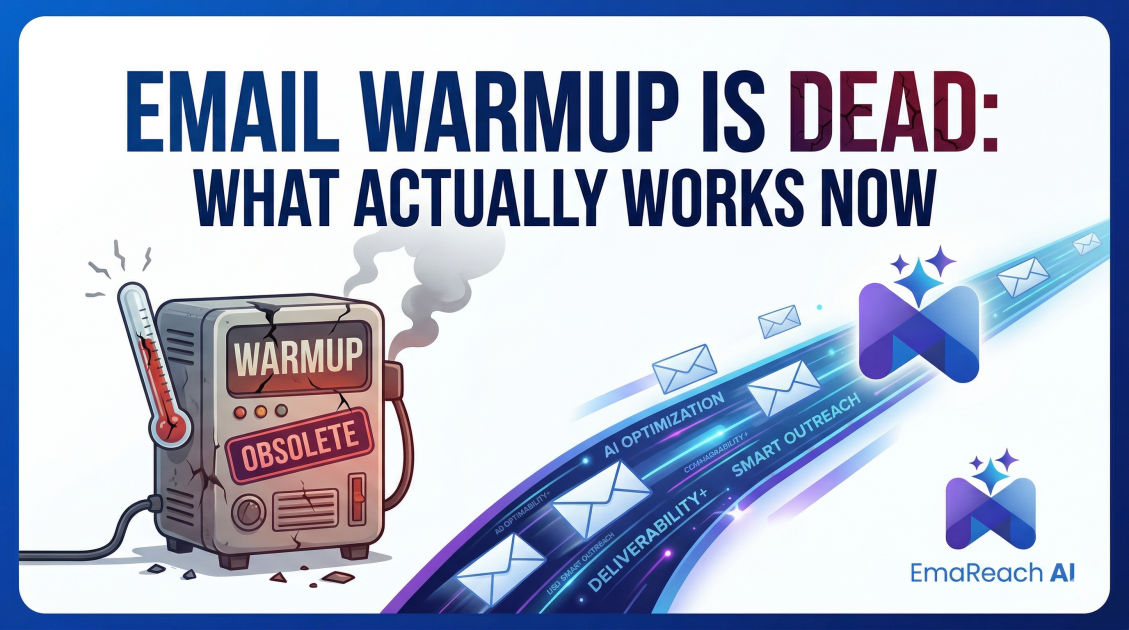
Email Warmup is Dead: What Actually Works Now
email deliverabilitycold outreachemail marketingspam filterssales automationB2B outreach
The Great Shift in Email Deliverability
For years, the playbook for cold outreach was simple: buy a domain, plug it into an automated warmup tool, let it run for two weeks, and start blasting. It was a mechanical solution to a mechanical problem. But the landscape of email deliverability has undergone a seismic shift. The traditional concept of "email warmup"—the practice of using bots to simulate human conversation to trick spam filters—is no longer the silver bullet it once was. In fact, relying solely on legacy warmup methods might be doing more harm than good.
Major email service providers (ESPs) like Google and Microsoft have updated their algorithms to detect artificial patterns. They can now distinguish between a network of bots talking to each other and genuine human interaction. If your sending reputation is built on a foundation of synthetic activity, the moment you transition to real outreach, your deliverability often plummets. This is why many professionals are declaring that traditional email warmup is dead. What works now isn't about gaming the system; it’s about building a foundation of authentic authority.
Why Traditional Warmup Tools Are Failing
To understand why the old methods are dying, we have to look at how ESPs identify spam. Modern spam filters use sophisticated machine learning models that analyze hundreds of signals. Traditional warmup tools rely on a "pool" of accounts that send pre-written, often nonsensical emails back and forth.
There are three main reasons these tools are losing their effectiveness:
- Pattern Recognition: ESPs can easily identify the signature of warmup pools. When thousands of accounts are all interacting with each other using the same scripts and patterns, it creates a massive digital footprint that is easy to flag.
- Lack of Real Engagement: Warmup emails are almost never opened, read, or interacted with by real humans. They are moved from spam to the inbox by an API, not by a person finding value in the content. Providers have started to weigh "human-like" engagement much more heavily than simple volume.
- The "Warmup Cliff": Users often see great deliverability during the warmup phase, but as soon as they start their actual campaign, the engagement metrics shift drastically. This sudden change in sender behavior is a major red flag for filters.
The New Era: Deliverability Through Authenticity
If the old way is dead, what replaces it? The answer lies in Email Deliverability Infrastructure. It’s no longer enough to just "warm up" an address; you have to prove to the world’s largest mail servers that you are a legitimate sender providing value. This requires a holistic approach that combines technical precision with high-quality content.
For those looking to navigate this complex landscape, EmaReach offers a modern solution. Stop Landing in Spam. Cold Emails That Reach the Inbox. EmaReach AI combines AI-written cold outreach with inbox warm-up and multi-account sending—so your emails land in the primary tab and get replies. By integrating AI that understands human nuance, it bridges the gap between automation and authenticity.
Technical Foundations: Beyond the Basics
Before you even think about sending an email, your technical setup must be flawless. In the past, you could get away with just an SPF record. Today, your "passport" for the inbox requires a full suite of authentication.
SPF, DKIM, and DMARC
These three records are the holy trinity of deliverability. Sender Policy Framework (SPF) specifies which mail servers are authorized to send email on behalf of your domain. DomainKeys Identified Mail (DKIM) adds a digital signature to your emails, proving they weren't tampered with in transit. Domain-based Message Authentication, Reporting, and Conformance (DMARC) tells receiving servers what to do if the SPF or DKIM checks fail. A strict DMARC policy is now a signal of a trustworthy sender.
Custom Tracking Domains
Most outreach tools use a shared tracking pixel to monitor opens and clicks. If another user on that shared domain sends spam, your deliverability suffers by association. Setting up a custom tracking domain ensures that your engagement data is tied exclusively to your own reputation.
The Role of Domain Aging and Diversification
One of the biggest mistakes in modern outreach is putting all your eggs in one basket. If you send 500 emails a day from a single domain, you are begging to be flagged. The new gold standard is Horizontal Scaling.
Instead of one domain sending high volume, savvy senders use multiple subdomains or alternative domains (e.g., .com, .io, .co). This distributes the "load" and protects your primary brand domain. However, these domains need time to age. A domain that was registered yesterday and starts sending 50 emails today is an immediate suspect. True warmup now involves a slow, gradual increase in volume over months, not days, paired with genuine outbound activity.
Content Quality: The Ultimate Spam Filter
Spam filters have become incredibly good at reading. They analyze the sentiment, the structure, and the intent of your message. If your copy looks like a generic template used by ten thousand other people, it will be treated as spam.
Personalization at Scale
Hyper-personalization is the only way to maintain high engagement rates. This means going beyond "Hi [First_Name]." You need to reference specific details about the recipient’s business, recent news, or shared interests. High engagement (opens, clicks, and most importantly, replies) is the strongest signal to an ESP that your emails belong in the Primary Tab.
Avoiding Spam Triggers
While filters are smarter, they still look for classic triggers. Excessive use of "free," "buy now," or "guaranteed" can still hurt you. More importantly, excessive link density or large attachments will trigger security filters. Your initial outreach should be text-heavy and link-light.
What Actually Works Now: A Strategic Checklist
To succeed in the current environment, you need a strategy that focuses on long-term reputation rather than short-term hacks.
1. Incremental Volume Ramping
Start by sending 5-10 manual emails per day to people you actually know or highly targeted prospects. Gradually increase this by 5-10% every few days. This mimics the natural growth of a business account.
2. Manual Engagement Triggers
Encourage replies. Ask a simple, low-friction question that almost forces a response. Every time a recipient replies to your email, your sender reputation gets a massive boost. This is why EmaReach is so effective; by focusing on "Cold Emails That Reach the Inbox," it prioritizes the metrics that actually matter to ESPs.
3. Strict List Hygiene
Sending emails to dead addresses or "spam traps" is the fastest way to kill a new domain. Use verification tools to ensure every email on your list is valid. A bounce rate higher than 2% is a disaster for your deliverability.
4. Monitor Postmaster Tools
Google Postmaster Tools and Microsoft SNDS provide a direct look at how the big providers see your domain. If you see your reputation dropping from "High" to "Medium," it’s time to pause and investigate your content or list quality before you hit the "Low" category, which is nearly impossible to recover from.
The Psychology of the Inbox
We often talk about the technical side of deliverability, but the human side is just as important. The goal of an email is to be read. If your subject line is deceptive or "clickbaity," and the user opens the email only to immediately report it as spam, your warmup efforts are wasted.
Modern deliverability is a feedback loop:
- Positive Signals: Opening, replying, moving to a folder, marking as "not spam."
- Negative Signals: Deleting without opening, marking as spam, unsubscribing.
Your strategy must be designed to maximize positive signals from day one. This means your "warmup" is actually your real campaign, just performed with extreme precision and low volume initially.
The Multi-Inbox Approach
Since volume per inbox must remain low to stay under the radar, the only way to scale is through more inboxes. Managing 10, 20, or 50 inboxes manually is a nightmare. This is where modern infrastructure comes into play. You need a system that can manage these accounts seamlessly, ensuring that each one maintains its own unique footprint while contributing to your overall goal.
This is the core of what works now: a distributed network of high-authority, low-volume accounts sending hyper-personalized content. It is the complete opposite of the "blast and pray" methods of the past.
AI: The New Frontier of Deliverability
Artificial Intelligence is often blamed for the increase in spam, but it is also the solution for high-quality outreach. AI can help craft unique variations of your message so that no two emails are identical. This prevents "fingerprinting" by spam filters. When every message is structurally unique and contextually relevant, filters see it as a series of individual, personal conversations rather than a bulk broadcast.
By leveraging tools like EmaReach, you're not just sending emails; you're deploying an intelligent system designed to stay ahead of the algorithms. It’s about working with the filters, not against them.
Conclusion
The era of set-it-and-forget-it email warmup is over. The “tricks” that worked years ago are now footprints that lead spam filters straight to your door. Today, deliverability is earned through technical excellence, strategic patience, and genuine relevance.
To win in the modern inbox, you must treat your email reputation like a credit score: it takes a long time to build and can be destroyed in an instant. Focus on authentic engagement, diversify your sending infrastructure, and use intelligent systems that prioritize quality over sheer volume. The "dead" warmup tools have been replaced by sophisticated deliverability ecosystems. Adapt to this new reality, or watch your outreach efforts disappear into the void of the spam folder.
EmaReach AI
Ready to scale your cold email outreach?
Join thousands of teams using EmaReach AI for AI-powered campaigns, domain warmup, and 95%+ deliverability. Start free — no credit card required.
Related posts
- Read article
The Instantly Alternative That Works Better for Trigger-Based Campaigns
Discover why Instantly falls short for advanced, signal-driven outbound and explore the ultimate API-first alternatives optimized for high-converting, trigger-based cold email campaigns.
- Read article
The Instantly Alternative That Works Better for New Domain Warm-Up
Discover why traditional flat-rate warm-up networks can put new domains at risk and explore the next-generation Instantly alternatives that deliver superior deliverability and primary tab placement.