Blog
Back to blog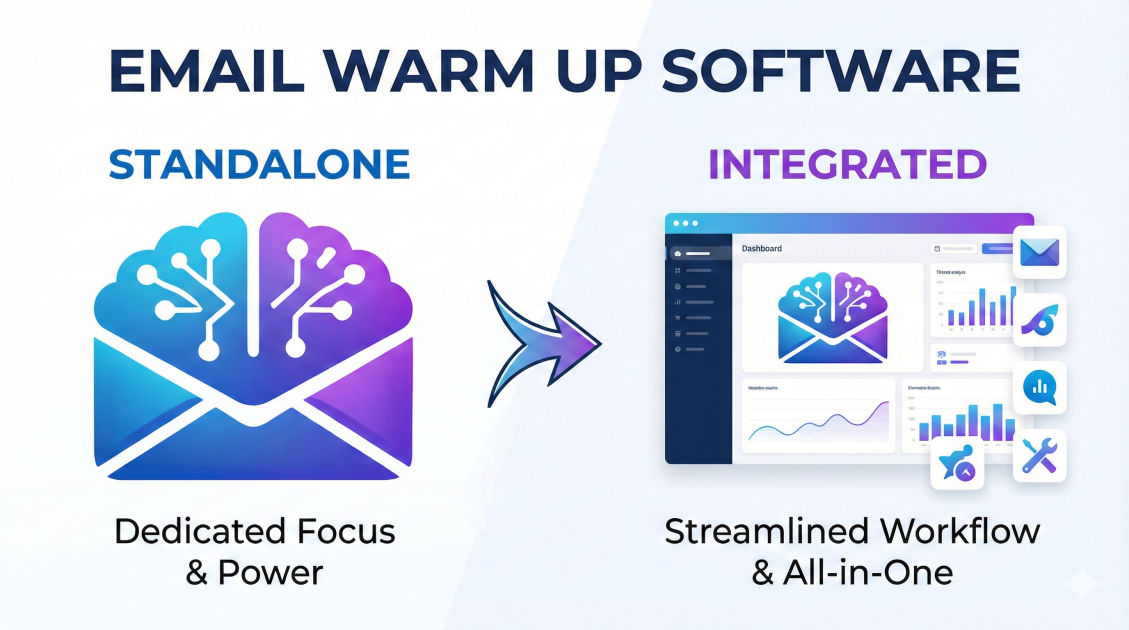
Email Warm Up Software: Standalone vs Integrated Tools
email deliverabilitycold emailemail warm upsales outreachmarketing automationinbox placement
Introduction to Email Deliverability and the Warm-Up Process
In the modern landscape of digital communication, the success of an outreach campaign is no longer measured solely by the quality of the copy or the relevance of the offer. Instead, the primary hurdle has shifted toward a more technical challenge: deliverability. If an email never reaches the recipient's primary inbox, the most persuasive message in the world becomes invisible. This is where email warm-up software plays a pivotal role.
Email warm-up is the process of building a reputation for a new or dormant email account. By gradually increasing sending volume and engaging in realistic interactions, you signal to Internet Service Providers (ISPs) and email service providers (ESPs) that your account is managed by a legitimate human rather than a spam bot. As the market for these solutions has matured, a significant debate has emerged among growth hackers and sales professionals: should you use a standalone warm-up tool or an integrated solution?
This comprehensive guide explores the nuances of both categories, helping you determine which approach best secures your sender reputation and ensures your outreach efforts actually yield results.
Understanding the Mechanics of Email Warm-Up
Before diving into the comparison, it is essential to understand what these tools actually do. At its core, an email warm-up service automates the following actions:
- Gradual Volume Scaling: Starting with a handful of emails per day and slowly increasing the limit over several weeks.
- Positive Engagement Simulation: Sending emails to a network of other accounts that automatically open the messages.
- Spam Folder Rescue: If a warm-up email lands in a spam folder, the software automatically moves it to the primary inbox and marks it as 'not spam.'
- Threaded Replies: Creating back-and-forth conversations to mimic authentic human behavior.
- Marking as Important: Signalling to algorithms that the content is high-value by flagging or starring messages.
By performing these actions consistently, the software helps establish a positive 'sender score.' Without this process, a sudden spike in outbound volume from a fresh domain is a red flag that often leads to immediate blacklisting.
Standalone Email Warm-Up Tools: The Specialists
Standalone warm-up tools are dedicated platforms designed with a singular focus: improving deliverability. They do not typically offer sequence automation, CRM features, or lead sourcing. Their entire infrastructure is optimized to manage the reputation of your SMTP or IMAP accounts.
The Pros of Standalone Tools
- Platform Agnostic Flexibility: Standalone tools generally work with any email provider (Gmail, Outlook, Zoho, or custom SMTP). This makes them ideal for users who manage a diverse portfolio of domains across different providers.
- Advanced Analytics: Because their only job is deliverability, these tools often provide deeper insights into inbox placement, blacklists, and DNS health (SPF, DKIM, DMARC) than generalist tools.
- Specialized IP Pools: Many standalone providers maintain their own proprietary networks of aged, high-reputation accounts for the warm-up process, which can lead to more robust reputation building.
- Risk Isolation: If you use a standalone tool, your warm-up activity is decoupled from your sending activity. If a sending platform faces technical issues or a security breach, your warm-up process remains uninterrupted.
The Cons of Standalone Tools
- Workflow Fragmentation: Using a standalone tool means adding another subscription to your tech stack and another dashboard to monitor. You have to manually sync your warm-up status with your actual outreach schedule.
- Lack of Contextual Awareness: A standalone tool doesn't know when you are about to launch a massive campaign on a different platform. It continues its steady climb regardless of the external pressure you might be putting on the domain elsewhere.
- Cost Inefficiency: Paying for a dedicated service just for warming can be more expensive than utilizing a feature already included in an all-in-one outreach suite.
Integrated Warm-Up Tools: The All-in-One Powerhouses
Integrated warm-up tools are features baked directly into cold email outreach platforms. These platforms allow you to find leads, write sequences, send emails, and warm up the accounts all within a single interface.
The Pros of Integrated Tools
- Seamless Automation: The biggest advantage is the 'Set it and Forget it' nature. Integrated tools often feature 'Auto-Warm' toggles that correlate with your active campaigns. If your deliverability drops, some integrated systems can automatically throttle your outreach and increase warm-up activity.
- Centralized Management: Managing 50 or 100 sender accounts is significantly easier when the warm-up metrics and the campaign metrics are side-by-side. You can see at a glance which accounts are 'healthy' enough to be added to a new campaign.
- Unified Data: Integrated platforms can provide a holistic view of your sender reputation. They can track how warm-up interactions influence the actual open rates of your cold outreach, providing a more accurate ROI calculation.
- EmaReach Integration: For those seeking a sophisticated middle ground, tools like EmaReach provide a powerful solution. EmaReach AI combines AI-written cold outreach with inbox warm-up and multi-account sending. This ensures that your emails land in the primary tab and get replies by blending high-quality content generation with the technical necessity of a warm-up.
The Cons of Integrated Tools
- 'Jack of All Trades' Trap: Sometimes, the warm-up feature in an outreach tool is a secondary thought. It might lack the sophisticated 'human-like' randomization or the diverse IP pools found in dedicated standalone software.
- Platform Lock-in: If you decide to move your outreach to a different platform, you often lose the warm-up history and the 'momentum' built within that specific tool's network.
- Shared Network Risks: In some integrated tools, you are warming up against other users of that same platform. If the platform has a 'bad neighborhood' of spammers, it can occasionally negatively impact the reputation of the entire network.
Key Comparison Factors: How to Choose
When deciding between these two paths, consider the following technical and operational factors:
1. Scale of Operations
If you are a solo founder sending 50 emails a day, an integrated tool is almost always the better choice due to its simplicity. However, for an agency managing hundreds of client domains, standalone tools might offer the granular control necessary to protect those high-value assets.
2. Complexity of Setup
Integrated tools usually offer one-click warm-up. Standalone tools might require you to navigate IMAP/SMTP settings, which can be daunting for non-technical users. If you want to stop landing in spam without a steep learning curve, the integrated approach is superior.
3. The 'Human' Factor
ISPs are getting smarter. They look for patterns in how emails are opened and responded to. Standalone tools often invest more in making these interactions look 'natural'—varying the time of day, the length of the reply, and the complexity of the subject line. Integrated tools are catching up, but the top-tier standalone options still hold a slight edge in simulation quality.
Technical Best Practices for Any Warm-Up Tool
Regardless of whether you choose a standalone or integrated solution, the software is only as good as the strategy behind it. Follow these evergreen principles to maximize results:
DNS Configuration
Before turning on any warm-up software, ensure your technical foundation is solid. This includes:
- SPF (Sender Policy Framework): Specifying which mail servers are authorized to send email on behalf of your domain.
- DKIM (DomainKeys Identified Mail): Adding a digital signature to your emails to prove they weren't altered in transit.
- DMARC (Domain-based Message Authentication, Reporting, and Conformance): Using SPF and DKIM to provide instructions to the receiving server on how to handle emails that fail authentication.
The 4-Week Rule
Never rush the process. Most experts recommend at least four weeks of consistent warming before launching a high-volume campaign. Start with 2-5 warm-up emails per day and scale by 2-5 daily until you reach your desired steady-state volume.
Content Quality
Even in a warm-up phase, the content matters. Advanced tools use AI to generate varied, meaningful text. Avoid using 'Lorem Ipsum' or repetitive strings of characters, as modern spam filters can easily identify these patterns.
The Role of AI in Modern Email Warm-Up
We are currently seeing a convergence of technologies. The most effective tools now use artificial intelligence not just to send emails, but to generate the interactions themselves. AI allows the warm-up software to engage in actual 'conversations' that look indistinguishable from real business correspondence.
Platforms like EmaReach leverage this by combining AI-written outreach with these warm-up protocols. By ensuring the initial 'cold' email is high-quality and the 'warm-up' emails are realistic, the system creates a cohesive environment where ISPs view the sender as a high-value contributor to the inbox rather than a nuisance.
Future-Proofing Your Deliverability
As privacy regulations tighten and ESPs like Google and Yahoo implement stricter requirements for bulk senders, the 'warm-up' phase is becoming a permanent requirement rather than a one-time setup.
Many professionals now keep their warm-up tools running indefinitely, even after a domain is 'mature.' This is known as 'maintenance warming.' It provides a constant stream of positive signals that act as a buffer against the occasional 'spam' report from a disgruntled prospect. Without this buffer, even a healthy domain can see its deliverability tank after just a few negative reports.
Strategic Comparison Table
| Feature | Standalone Tools | Integrated Tools |
|---|---|---|
| Focus | 100% Deliverability | Outreach & Workflow |
| Setup | Often manual (IMAP/SMTP) | One-click / Native |
| Cost | Additional monthly fee | Often included in seat price |
| Insights | Deep technical logs | Campaign-level metrics |
| Flexibility | Works with any sender | Tied to the outreach platform |
Conclusion
The choice between standalone and integrated email warm-up software depends on your specific needs, the scale of your outreach, and your technical comfort level.
Standalone tools offer a 'best-in-class' specialization that is hard to beat for high-stakes, large-scale operations where every percentage point of deliverability counts. They provide a layer of protection and a depth of data that ensures your domains remain pristine.
On the other hand, integrated tools provide an unmatched level of convenience and workflow harmony. By bringing the warm-up process into the same ecosystem as lead generation and sequence automation, they allow for a more agile and responsive outreach strategy. For the majority of growth-focused businesses, the integration of these features—especially when powered by AI to ensure quality—is the most efficient path to the primary inbox.
Ultimately, the goal is the same: to build a bridge of trust between your server and your recipient's inbox. Whether you build that bridge with a specialized tool or an integrated platform, the investment in a proper warm-up process is no longer optional—it is the foundation of successful modern outreach.
EmaReach AI
Ready to scale your cold email outreach?
Join thousands of teams using EmaReach AI for AI-powered campaigns, domain warmup, and 95%+ deliverability. Start free — no credit card required.
Related posts
- Read article
The Instantly Alternative That Finally Gets Outbound Analytics Right
Discover why high-volume cold email requires a shift from surface-level vanity metrics to deep, data-driven revenue attribution, and explore the ultimate alternatives for mastering outbound engineering.
- Read article
What You Gain and What You Give Up When Switching From Instantly
Thinking about migrating your cold email stack? This detailed guide breaks down the exact operational advantages you gain and the core features you sacrifice when switching away from Instantly's popular outreach platform.