Blog
Back to blog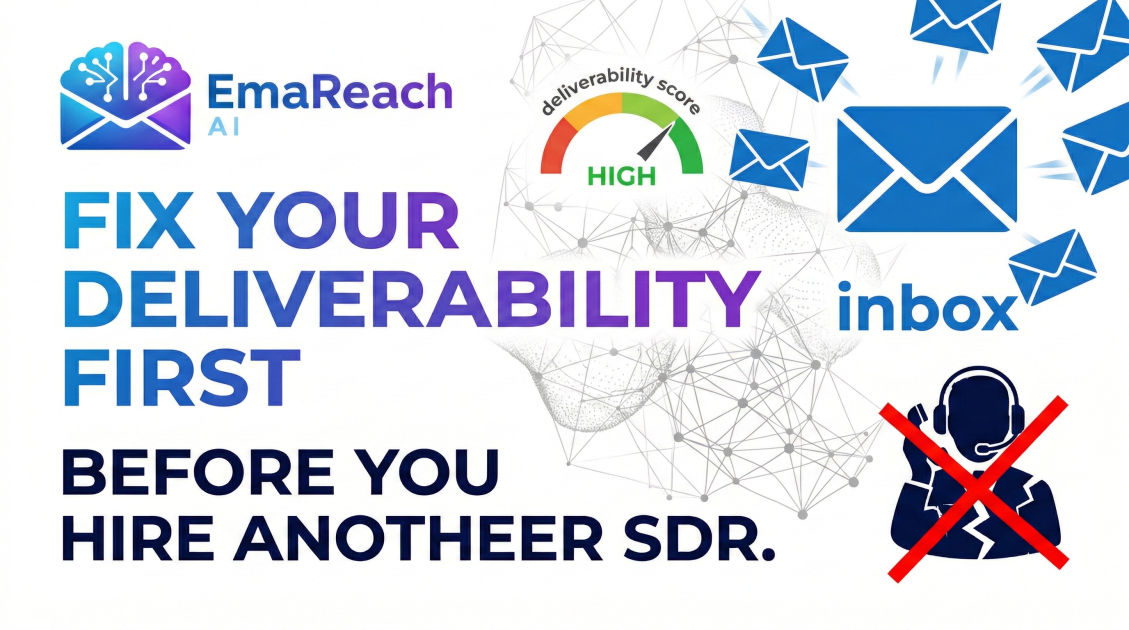
Don't Hire Another SDR. Fix Your Deliverability First
cold emailsales operationsemail deliverabilitySDR strategyoutbound saleslead generation
Introduction
The standard growth playbook for B2B companies is deceptively simple: if you need more pipeline, hire more Sales Development Representatives (SDRs). The logic follows that more head-count equals more activity, and more activity equals more meetings. However, many sales leaders are finding that this traditional scaling model is broken. They double their outbound team only to see their booking rates stay flat or, worse, decline.
The culprit is rarely the talent of the SDR or the quality of the script. More often than not, it is a technical failure happening behind the scenes. Before you sign another offer letter and invest months into onboarding a new rep, you must look at your foundation. Sending more emails into a black hole won't generate revenue. To scale effectively, you must fix your deliverability first.
The SDR Productivity Paradox
When a sales team underperforms, the immediate reaction is often to look at "vanity metrics." How many emails did they send? How many dials did they make? If an SDR sends 1,000 emails a month and generates two meetings, a manager might assume that hiring a second SDR will result in 2,000 emails and four meetings.
This is the SDR Productivity Paradox. In the modern landscape of email filtering, volume is often the enemy of results. Internet Service Providers (ISPs) and email service providers use sophisticated algorithms to detect patterns of mass outreach. When you increase volume without a solid technical infrastructure, you trigger spam filters.
If your emails are landing in the 'Promotions' tab or the 'Spam' folder, it doesn't matter how talented your SDR is. A world-class copywriter cannot sell to a person who never sees the message. By fixing deliverability, you can often triple the results of your existing team without adding a single dollar to your payroll.
Understanding the Modern Spam Filter
To understand why your SDRs are struggling, you have to understand how modern email filters work. Gone are the days when spam filters only looked for keywords like "free" or "act now." Today, filters are behavioral and reputation-based.
Sender Reputation
Your domain has a reputation score, much like a credit score. This score is influenced by your sending history, the quality of your recipient list, and how users interact with your mail. If people regularly delete your emails without opening them, or worse, mark them as spam, your reputation plummets.
Engagement Signals
ISPs look for positive engagement signals: opens, replies, and threads. When an SDR sends hundreds of emails and gets zero replies, the ISP assumes the content is unwanted. This creates a downward spiral where your emails are suppressed further, leading to even lower engagement.
The Technical Foundation: SPF, DKIM, and DMARC
Before scaling your outbound efforts, your technical setup must be bulletproof. Most companies leave this to IT, but sales leaders need to understand these three pillars of authentication:
- SPF (Sender Policy Framework): This is a DNS record that lists the IP addresses or services authorized to send email on behalf of your domain. Without it, receiving servers have no way of knowing if the email is legitimate.
- DKIM (DomainKeys Identified Mail): This adds a digital signature to your emails. it ensures that the content of the email wasn't tampered with during transit. It acts as a seal of authenticity.
- DMARC (Domain-based Message Authentication, Reporting, and Conformance): This tells the receiving server what to do if the SPF or DKIM checks fail. A "reject" policy is the gold standard for protecting your domain's integrity.
If these are not configured correctly, your SDRs are essentially running a race with their shoelaces tied together.
The Danger of the "Primary" Domain
One of the most common mistakes companies make is allowing SDRs to send cold outreach from their primary corporate domain (e.g., name@company.com). This is a high-risk strategy. If your primary domain gets blacklisted due to high spam complaints or poor outreach practices, your entire company loses the ability to communicate.
Imagine your Customer Success team being unable to send invoices, or your CEO’s internal memos landing in the junk folder of employees. To protect your business, you must use secondary domains for outbound activity. These look similar (e.g., name@getcompany.com) but provide a "buffer" that protects your core brand reputation.
Quality Over Quantity: The Death of the Mass Blast
In the past, "spray and pray" worked because filters were weak. Today, high volume is a red flag. If an SDR is tasked with sending 200 emails a day from a single account, that account will likely be flagged within a week.
Instead of hiring more people to send more mail, the focus should shift to multi-account infrastructure. By spreading a lower volume of high-quality, personalized emails across multiple accounts and domains, you mimic natural human behavior. This is where EmaReach provides a competitive edge. Stop Landing in Spam. Cold Emails That Reach the Inbox. EmaReach AI combines AI-written cold outreach with inbox warm-up and multi-account sending—so your emails land in the primary tab and get replies. This approach allows you to maintain total volume without compromising the health of any single inbox.
The Role of Inbox Warm-up
You cannot buy a new domain on Monday and send 500 emails on Tuesday. This is a guaranteed way to get banned. Every new domain and email account requires a "warm-up" period. This involves gradually increasing the volume of mail and ensuring that those emails are opened and replied to.
Automated warm-up tools simulate these interactions, building a history of positive engagement. This signals to ISPs that you are a legitimate sender. If your SDRs are starting from scratch without a warmed-up environment, their first three months of activity will likely be wasted effort.
Data Hygiene: The Hidden Deliverability Killer
Your deliverability is only as good as your data. Every time an SDR sends an email to an invalid address, it results in a "hard bounce." High bounce rates are a primary signal of a spammer. If your bounce rate exceeds 2%, your reputation will begin to suffer.
Before your SDRs ever hit "send," your data must be cleaned. This means:
- Verifying every email address: Use verification tools to ensure the inbox actually exists.
- Checking for "Catch-all" addresses: Some domains accept all mail, making them harder to verify. These require extra caution.
- Monitoring for Spam Traps: These are "decoy" email addresses used by providers to catch illegitimate senders. Buying old, unverified lists is the fastest way to hit a spam trap.
Why Better Copy Won't Save You
Sales managers often spend hours agonizing over the perfect subject line or the most compelling call to action. While copy is important for conversion, it is irrelevant for deliverability. You can have the most persuasive, value-driven email in the history of sales, but if the "From" field is associated with a domain that has poor reputation, the recipient's server will block it before it's even scanned for keywords.
Deliverability is the gatekeeper. Once you are through the gate, the copy takes over. Investing in more SDRs to write "better" copy is a secondary step; the primary step is ensuring the gate is open.
Calculating the True Cost of Poor Deliverability
Let's look at the math.
- Scenario A: You hire a new SDR. Salary, benefits, and tools cost $8,000/month. They send 1,500 emails, but because of poor deliverability, only 20% reach the inbox. They book 3 meetings. Cost per meeting: $2,666.
- Scenario B: You spend $1,000/month on deliverability optimization, secondary domains, and warm-up tools. Your existing SDR sends 1,500 emails, and 90% reach the inbox. They book 12 meetings. Cost per additional meeting: $83.
The ROI of fixing deliverability is exponentially higher than the ROI of adding headcount to a leaky system.
How to Audit Your Deliverability Today
You don't need a technical degree to see if you have a problem. Start with these steps:
1. Check Your Domain Health
Use free online tools to check if your domain is on any major blacklists. If you see your domain listed on Spamhaus or Barracuda, you have an immediate crisis that no amount of hiring will fix.
2. Analyze Your Open Rates
If your open rates are below 20%, you likely have a deliverability issue rather than a subject line issue. In a healthy outbound environment, open rates should hover between 40% and 60%.
3. Monitor "Spam Complaints"
Use tools like Google Postmaster Tools to see how many people are marking your emails as spam. This gives you a direct look into how the world's largest email provider views your traffic.
The Strategic Shift: From Volume to Infrastructure
Scaling a sales team should be treated like building a skyscraper. You don't just keep adding floors; you ensure the foundation can support the weight. Fixing deliverability is the foundational work of modern sales.
Instead of hiring a new SDR, consider investing that budget into:
- Secondary Domain Infrastructure: Setting up 5-10 domains to distribute sending load.
- Advanced Lead Research: Giving your existing SDRs better data so they bounce less.
- Automated Systems: Utilizing platforms that handle the technical heavy lifting of inbox placement.
Conclusion
The pressure to grow often leads to impulsive hiring. However, in the world of cold outreach, more is not always better. Adding more SDRs to a team with poor deliverability is like pouring water into a bucket full of holes—it’s exhausting, expensive, and ultimately futile. By prioritizing your technical setup, protecting your domain reputation, and ensuring your messages actually reach the primary inbox, you empower your current team to achieve results you previously thought required a much larger department. Fix the pipes before you turn up the water pressure.
EmaReach AI
Ready to scale your cold email outreach?
Join thousands of teams using EmaReach AI for AI-powered campaigns, domain warmup, and 95%+ deliverability. Start free — no credit card required.
Related posts
- Read article
How Choosing the Right Instantly Alternative Changed Our Pipeline Numbers
Discover how transitioning from a volume-first cold email setup to an advanced, deliverability-focused infrastructure transformed our B2B pipeline metrics, skyrocketed open rates to over 68%, and tripled our monthly booked demos.
- Read article
The Instantly Alternative That Impressed Even the Biggest Instantly Fans
Discover why top outbound growth marketers and lead generation agencies are migrating from legacy cold email platforms to advanced alternatives built for superior deliverability, white-label client management, and robust API workflows.