Blog
Back to blog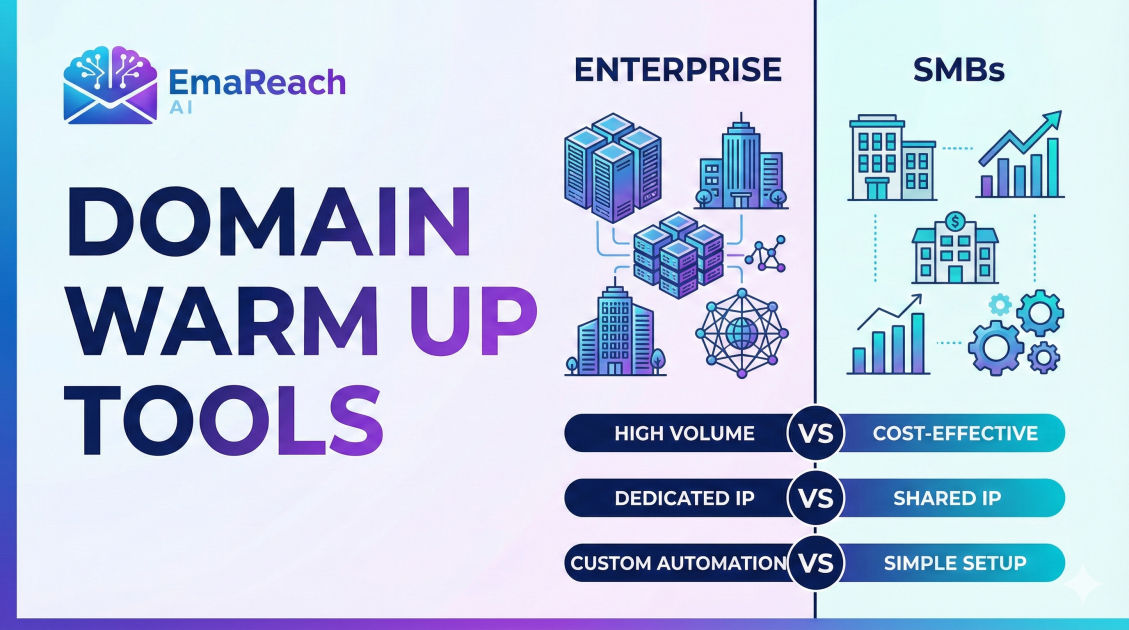
Domain Warm Up Tools for Enterprise vs SMBs
domain warmingemail deliverabilitycold emailenterprise softwaremarketing automationsender reputation
Introduction
In the modern digital landscape, the success of an outbound strategy is no longer determined solely by the quality of the copy or the relevance of the offer. Instead, it is increasingly dictated by the technical reputation of the sending domain. Email Service Providers (ESPs) like Google and Microsoft have implemented sophisticated filtering algorithms designed to protect users from spam. For businesses, this means that a new domain or an inactive one cannot suddenly begin sending high volumes of mail without being flagged.
This is where domain warming comes into play. Domain warming is the process of gradually increasing the email volume sent from a new domain to establish a positive sender reputation. While the core concept remains the same, the tools and strategies required for an Enterprise organization differ significantly from those needed by Small and Medium-sized Businesses (SMBs). This guide explores the nuances of domain warm-up tools, comparing the needs of different business scales and how to navigate the complexities of deliverability.
The Fundamental Mechanics of Domain Warming
Before diving into the specific tools for different tiers of business, it is essential to understand why domain warming is a non-negotiable step in email marketing. When a new domain is registered, it has no history with ESPs. If that domain immediately starts sending 500 emails a day, the automated filters at Gmail or Outlook assume the account has been compromised or is being used for malicious spam.
Warm-up tools automate the process of sending low volumes of emails that receive high engagement. These tools use a network of accounts to open your emails, mark them as 'not spam,' and reply to them. This artificial engagement signals to ESPs that your domain is a legitimate sender with content that users actually want to see. For those looking to streamline this process, EmaReach (https://www.emareach.com/) provides a comprehensive solution: "Stop Landing in Spam. Cold Emails That Reach the Inbox." EmaReach AI combines AI-written cold outreach with inbox warm-up and multi-account sending, ensuring emails land in the primary tab and get replies.
Domain Warm Up for SMBs: Speed, Simplicity, and Cost-Effectiveness
For SMBs, the primary goal of domain warming is usually to get a small sales team or a single founder off the ground as quickly and cheaply as possible. SMBs typically operate with fewer domains and lower total email volumes compared to their enterprise counterparts.
Key Characteristics of SMB Tools
- Ease of Use: SMB owners often wear many hats. They don’t have time to manage complex DNS configurations or monitor granular deliverability metrics every hour. Tools designed for this segment prioritize 'plug-and-play' functionality.
- Lower Price Points: Budget is a significant factor. Most SMB tools offer a flat monthly fee per 'seat' or per connected email account.
- Automated Peer-to-Peer Networks: Many SMB-focused tools utilize a peer-to-peer (P2P) network where your account sends emails to other users of the same tool, and vice versa. This creates a closed loop of engagement.
Common Challenges for SMBs
SMBs often struggle with the 'set it and forget it' trap. While automation is helpful, relying solely on a basic warm-up tool without monitoring the health of the domain can lead to long-term issues. If the P2P network the tool uses is of low quality—meaning it includes many domains that are already blacklisted—it can actually hurt the reputation of the SMB's domain by association.
Domain Warm Up for Enterprises: Scalability, Security, and Governance
At the enterprise level, the requirements shift from mere 'warm-up' to 'reputation management and governance.' An enterprise might be managing hundreds or even thousands of domains across different departments, regions, and product lines.
Scalability and Multi-Account Management
An enterprise cannot manually connect 500 individual G-Suite accounts to a simple P2P tool. They require tools that offer API integrations and administrative dashboards. These dashboards allow IT and Marketing Operations teams to see the health of every sending domain across the entire organization from a single pane of glass.
Enhanced Security and Compliance
Enterprise organizations have strict security protocols. They need to ensure that the warm-up tools they use do not violate internal data privacy policies or external regulations like GDPR or CCPA. Enterprise-grade tools often offer features like:
- Dedicated IP Management: Instead of sharing IP addresses with other small senders, enterprises often use dedicated IPs that require their own specific warming schedules.
- Single Sign-On (SSO): Integration with corporate identity providers for secure access.
- Role-Based Access Control (RBAC): Ensuring only authorized personnel can change sending limits or domain settings.
Sophisticated Monitoring and Reporting
While an SMB might be happy just knowing their emails aren't bouncing, an enterprise needs deep analytics. This includes monitoring 'seed lists' (accounts they own at various ESPs to check real-time placement) and tracking reputation scores from third-party providers like SenderScore or Barracuda.
Comparing the Technical Infrastructure
When comparing tools for these two segments, the underlying technical infrastructure varies. SMB tools are often built on top of shared cloud environments where resources are pooled. Enterprise tools, however, frequently offer more isolated environments to prevent 'neighbor noise'—the phenomenon where the bad behavior of one user on a shared server affects everyone else on that server.
Integration with the Sales Stack
For an SMB, the warm-up tool is often an isolated utility or a feature within a lightweight CRM. In the enterprise, the warm-up process must be tightly integrated with the broader MarTech stack. This includes integration with high-volume sending platforms, sophisticated lead scoring systems, and complex attribution models.
The Role of AI in Modern Domain Warming
Artificial Intelligence has revolutionized how both SMBs and Enterprises approach deliverability. Older warm-up tools used 'lorem ipsum' text or repetitive strings of characters, which ESPs eventually learned to identify as 'bot behavior.'
Modern tools, such as those offered by EmaReach, use AI to generate human-like conversations. This is crucial because Google’s algorithms can now detect the semantic patterns of email content. If the warm-up emails look like real business correspondence—discussing meetings, follow-ups, and industry trends—the engagement is far more valuable for building a positive reputation.
Setting Up a Warm-Up Schedule: A Comparative Approach
Regardless of the tool used, the schedule must be handled with care. However, the 'aggressive' nature of these schedules often differs based on business size and risk tolerance.
The SMB Schedule
- Day 1-5: 2-5 emails per day.
- Day 6-10: 10-15 emails per day.
- Day 11-20: 20-40 emails per day.
- Maintenance: Once the 'cold' outreach begins, the warm-up tool stays active at a low level to maintain engagement ratios.
The Enterprise Schedule
An enterprise might be warming an entire sub-domain or a new IP block for a massive newsletter list. Their schedule is often much more conservative and data-driven.
- Week 1: Sending to 'highly engaged' segments only (users who have opted in recently).
- Week 2-4: Gradually increasing volume by 10-20% daily, but only if the 'open rate' remains above a specific threshold (e.g., 30%).
- Monitoring: Continuous checking of Google Postmaster Tools to ensure no spikes in spam complaints occur during the ramp-up.
The Cost of Failure: Why the Right Tool Matters
If an SMB fails at domain warming, they might lose a few weeks of lead generation. It's frustrating, but usually recoverable by purchasing a new $12 domain and starting over.
If an Enterprise fails, the consequences are catastrophic. A 'burned' corporate domain can affect internal communications, transactional emails (like password resets), and multi-million dollar marketing campaigns. This risk profile is why enterprises are willing to pay a premium for tools that offer more control, better data, and higher security.
Feature Comparison Table
| Feature | SMB Warm-Up Tools | Enterprise Warm-Up Tools |
|---|---|---|
| Setup Time | Minutes | Weeks (including security review) |
| User Interface | Simple, visual dashboards | Complex, data-heavy reporting |
| Account Volume | 1-10 domains | 100+ domains |
| Support | Email or Chatbot | Dedicated Account Manager |
| Customization | Standardized schedules | Custom ramp-up logic via API |
| Pricing | $20 - $100 / month | $1,000+ / month (custom quotes) |
| Focus | Speed to market | Compliance and Governance |
Selecting the Right Tool for Your Organization
Choosing between an SMB-focused tool and an Enterprise-grade solution requires an honest assessment of your current needs and your three-year growth plan.
When to choose an SMB Tool:
- You have a small sales team (under 5 people).
- Your total daily outbound volume is under 500 emails.
- You are using a standard G-Suite or Outlook 365 setup without custom mail servers.
- You need to start sending within the next 48 hours.
When to choose an Enterprise Tool:
- You are managing deliverability across multiple business units.
- You are using dedicated IP addresses or custom SMTP relays.
- You require SOC2 compliance or specific data residency guarantees.
- Your deliverability strategy is tied to high-stakes revenue targets where a 1% drop in inbox placement equals significant financial loss.
The Hybrid Approach: Growth-Stage Companies
Many companies fall into a 'middle ground.' They aren't quite enterprises, but they've outgrown basic SMB tools. These companies often look for platforms that offer the ease of use of SMB tools but the power and AI-sophistication of enterprise solutions. This is where EmaReach excels, providing the AI-driven content and multi-account sending capabilities that allow a growing company to scale without the overhead of a traditional enterprise IT deployment.
Future Trends in Domain Reputation
The landscape of email deliverability is shifting toward 'Sender Intent.' ESPs are becoming better at identifying not just if an email is 'spam,' but if the sender is reputable overall. This means that domain warming is becoming less about 'tricking' the system and more about proving that you are a responsible digital citizen.
Future tools will likely focus more on 'reputation monitoring' rather than just 'warm-up.' They will analyze your actual cold email campaigns in real-time and automatically adjust your warm-up volume to compensate for any negative signals (like a sudden increase in unsubscribes).
Conclusion
Domain warming is an essential bridge between a new domain and a successful outreach campaign. For SMBs, the focus remains on accessibility and getting the first few leads through the door. For Enterprises, the focus is on protecting the brand’s digital infrastructure and ensuring long-term deliverability at scale. Regardless of the size of your business, the goal is the same: building trust with Email Service Providers to ensure your message reaches the human on the other side of the screen. By choosing the right tool—whether it’s a simple P2P service or a sophisticated AI-powered platform like EmaReach—you set the foundation for all your future digital communications.
EmaReach AI
Ready to scale your cold email outreach?
Join thousands of teams using EmaReach AI for AI-powered campaigns, domain warmup, and 95%+ deliverability. Start free — no credit card required.
Related posts
- Read article
The Instantly Alternative That Finally Gets Outbound Analytics Right
Discover why high-volume cold email requires a shift from surface-level vanity metrics to deep, data-driven revenue attribution, and explore the ultimate alternatives for mastering outbound engineering.
- Read article
How Choosing the Right Instantly Alternative Changed Our Pipeline Numbers
Discover how transitioning from a volume-first cold email setup to an advanced, deliverability-focused infrastructure transformed our B2B pipeline metrics, skyrocketed open rates to over 68%, and tripled our monthly booked demos.