Blog
Back to blog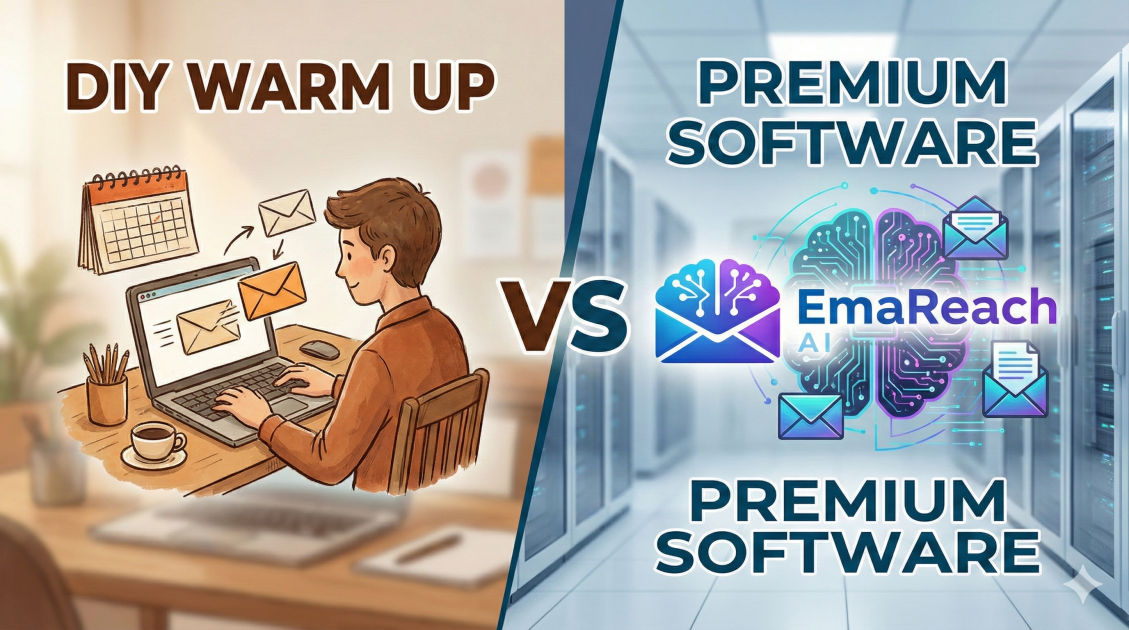
DIY Warm Up vs Premium Email Warm Up Software
email deliverabilitycold emailemail marketingsender reputationemail automationoutreach strategy
Introduction to Email Warm Up
In the world of digital outreach, your reputation is your currency. When you register a new domain or set up a new email account, you are essentially a stranger to Internet Service Providers (ISPs) like Google and Microsoft. To them, a sudden burst of activity from an unknown sender looks like one thing: spam. This is where email warm up becomes the most critical phase of your outreach strategy.
Email warm up is the process of gradually increasing the volume of emails sent from a new account to establish a positive sender reputation. The goal is to prove to ISPs that you are a legitimate human sender providing value, rather than a bot blasting thousands of unsolicited messages.
Today, marketers and sales professionals face a fundamental choice: do they take the manual, hands-on approach (DIY) or do they invest in premium, automated software? This guide explores the intricate nuances of both methods to help you decide which path leads to the primary inbox.
The Anatomy of Sender Reputation
Before diving into the comparison, it is essential to understand what is being 'warmed up.' Your sender reputation is a score assigned by ISPs based on several factors:
- Sending Volume: Sudden spikes trigger red flags.
- Engagement Rates: Do people open, click, and reply to your emails?
- Spam Complaints: If users mark your email as spam, your reputation plummets.
- Bounce Rates: High numbers of undeliverable emails suggest a poor-quality list.
- Authentication: Proper setup of SPF, DKIM, and DMARC records.
The DIY Approach: Manual Email Warming
DIY email warming involves a human-centric, manual process of mimicking organic growth. This was the industry standard for years before automation became accessible.
How DIY Warm Up Works
To warm up an email manually, you start by sending a handful of emails to people you know—colleagues, friends, or existing clients. You ask them to open the email, perhaps click a link, and most importantly, reply.
Over the course of several weeks, you follow a strict schedule:
- Week 1: Send 5–10 emails per day. Focus on accounts you know will interact with you.
- Week 2: Increase to 20 emails per day. Start including a mix of different providers (Gmail, Outlook, Yahoo).
- Week 3: Move to 30–50 emails. Ensure you are receiving replies to at least 25% of these messages.
- Week 4: Reach your target daily volume, but monitor deliverability tools constantly.
The Pros of DIY Warming
- Zero Software Cost: The primary advantage is that it is free, barring the cost of your time.
- Genuine Conversations: Because you are emailing real contacts, the conversations are 100% authentic, which ISPs find highly favorable.
- Full Control: You know exactly who is receiving your mail and what the content says.
The Cons of DIY Warming
- Time Intensive: It requires a disciplined daily routine that can take hours away from actual sales work.
- Scalability Issues: While you can manually warm one or two accounts, warming 10 or 20 domains simultaneously is a logistical nightmare.
- Human Error: Forgetting to send emails for a few days can stall the progress, forcing you to restart the schedule.
Premium Email Warm Up Software: The Automated Alternative
Premium software has revolutionized the process by creating a 'peer-to-peer' network of accounts that automatically interact with one another. Tools like EmaReach take this a step further by integrating AI to ensure the interactions look as human as possible.
How Premium Software Works
When you connect your email account to a premium warm-up tool, it joins a network of thousands of other accounts. The software then automatically sends emails from your account to others in the network. These recipient accounts are programmed to:
- Open the email.
- Mark the email as 'Important.'
- Remove the email from the Spam folder if it lands there (a powerful signal to ISPs).
- Reply to the email using natural-sounding language.
The Pros of Premium Software
- Automation: You set it and forget it. The software handles the daily volume increases and engagement cycles.
- Spam Folder Extraction: This is the 'secret sauce.' If a manual email goes to spam, it stays there. Premium tools detect this and move the email to the inbox, telling the ISP that the message was categorized incorrectly.
- Large Scale Networks: These tools provide interaction with thousands of unique IPs and domains, creating a much more robust reputation than a handful of friends could provide.
- Detailed Analytics: Most platforms provide health scores and deliverability reports, so you know exactly when your account is ready for 'prime time.'
The Cons of Premium Software
- Subscription Costs: There is a monthly fee associated with these services.
- Pattern Recognition: If a tool uses poor logic, ISPs may eventually identify the 'warm-up pattern,' though top-tier tools combat this with AI-generated content.
Comparing the Two: A Side-by-Side Analysis
| Feature | DIY Manual Warm Up | Premium Warm Up Software |
|---|---|---|
| Setup Time | High (ongoing daily effort) | Low (one-time connection) |
| Effectiveness | Moderate (limited by network size) | High (leverages large networks) |
| Spam Removal | Impossible unless you have access | Automated and frequent |
| Cost | Free ($0) | $20 - $100+ per month |
| Reliability | Prone to human forgetfulness | Consistent and algorithmic |
| Risk | Low (if done correctly) | Low (with reputable providers) |
The Technical Limitations of DIY
One of the biggest hurdles for the DIYer is the lack of variety in the 'warm-up pool.' ISPs look at the diversity of the domains you interact with. If you only email five friends who all use Gmail, your reputation on Outlook or Zoho servers remains non-existent.
Furthermore, DIY warming lacks the 'negative signal' reversal. In the eyes of an ISP, if an email lands in spam and is ignored, it is a vote of no confidence. Premium software acts as a corrective force by actively dragging emails out of the spam folder, which is the fastest way to train a filter that your content belongs in the primary tab.
Why AI Changes the Game
Modern deliverability is no longer just about volume; it's about the quality of the content. ISPs use Natural Language Processing (NLP) to scan for 'spammy' phrases. If your DIY warm-up emails all say 'Testing 123' or 'Hello,' they may be flagged as low-value.
Premium platforms like EmaReach utilize AI to generate unique, contextually relevant email bodies for the warm-up process. This ensures that every interaction looks like a real business discussion. By combining AI-written cold outreach with inbox warm-up, these tools create a seamless transition from the warming phase to the active campaign phase.
The Hybrid Strategy: Is it Worth It?
Some marketers attempt a hybrid approach: using software for the bulk of the work while sending manual emails to a few high-value colleagues. While this provides a 'cherry on top' for your reputation, for most businesses, the premium software alone is more than sufficient. The time saved is better spent on perfecting the offer and researching prospects.
When Should You Choose DIY?
You should consider the DIY route only if:
- You are a solo freelancer with a $0 budget.
- You only send 5–10 emails per week total.
- You have a pre-existing list of 50+ loyal contacts who will definitely engage with you every day for a month.
For everyone else—especially agencies, B2B sales teams, and founders—the risk of burning a domain and the sheer labor cost of manual warming make premium software the logical choice.
Common Pitfalls to Avoid in Both Methods
Regardless of the method you choose, certain mistakes will sabotage your deliverability:
- Skipping the Technical Setup: Neither DIY nor software can fix a broken SPF or DKIM record. Ensure your 'technical trio' is verified before you start.
- Warming Too Fast: Patience is the only way forward. Trying to send 100 emails on day three will lead to a permanent ban.
- Using Low-Quality Content: Even in the warm-up phase, avoid words like 'Free,' 'Buy Now,' or 'Winner.'
- Ignoring the Bounce Rate: If you start your actual campaign and your bounce rate exceeds 2%, stop immediately. High bounces signal to ISPs that you are using a scraped, unverified list.
The Long-Term Maintenance of Deliverability
Email warming is not a one-time event; it is ongoing maintenance. Even after your account is 'warm,' keeping a baseline level of warm-up activity is beneficial. It acts as a buffer. If a few prospects mark your actual sales emails as spam, the automated positive interactions from the warm-up software help 'dilute' those negative signals, keeping your overall reputation stable.
This is why many professionals keep their premium software running in the background even during active campaigns. It provides a constant stream of positive engagement that protects the account from the natural 'wear and tear' of cold outreach.
Conclusion
The choice between DIY and premium email warm up comes down to a simple calculation: the value of your time versus the cost of the software. While DIY is a viable path for those with more time than money, it lacks the sophisticated 'spam-extraction' capabilities and the scale of professional tools.
In the modern landscape of email marketing, where filters are becoming increasingly aggressive, having a robust sender reputation is the only way to ensure your message is heard. Investing in a premium solution is not just an expense; it is insurance for your outreach. By leveraging the power of automated networks and AI-driven content, you can move away from the uncertainty of the spam folder and into the reliability of the primary inbox.
EmaReach AI
Ready to scale your cold email outreach?
Join thousands of teams using EmaReach AI for AI-powered campaigns, domain warmup, and 95%+ deliverability. Start free — no credit card required.
Related posts
- Read article
The Instantly Alternative That Finally Gets Outbound Analytics Right
Discover why high-volume cold email requires a shift from surface-level vanity metrics to deep, data-driven revenue attribution, and explore the ultimate alternatives for mastering outbound engineering.
- Read article
What You Gain and What You Give Up When Switching From Instantly
Thinking about migrating your cold email stack? This detailed guide breaks down the exact operational advantages you gain and the core features you sacrifice when switching away from Instantly's popular outreach platform.