Blog
Back to blog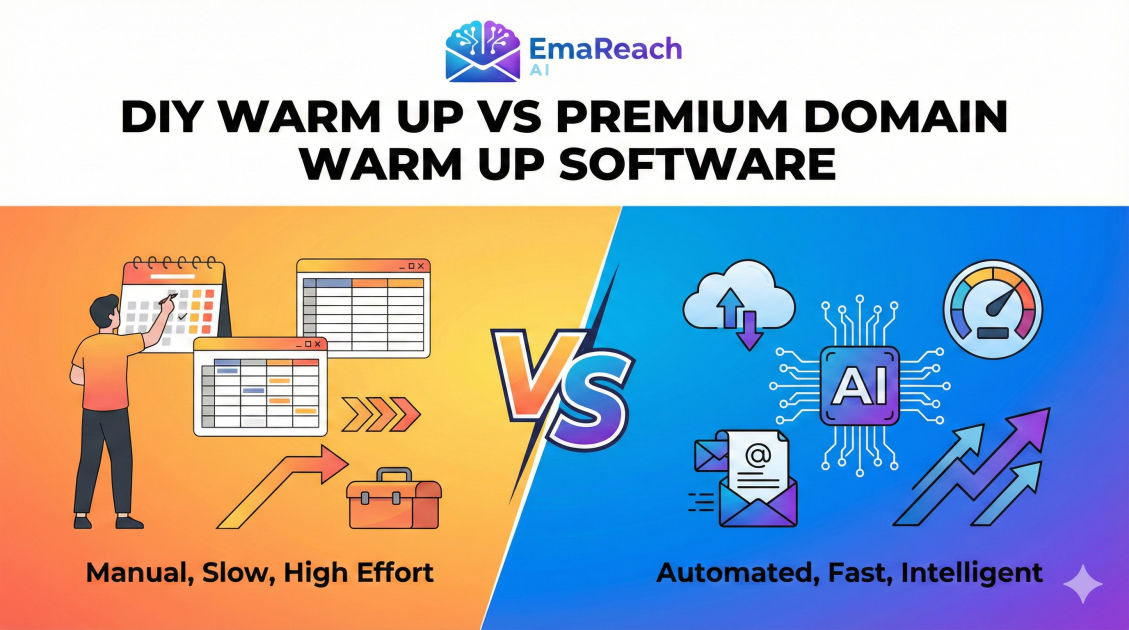
DIY Warm Up vs Premium Domain Warm Up Software
cold emailoutreachdeliverabilitydomain reputationemail marketingspam filters
Introduction
Launching a cold email outreach campaign is an incredibly effective way to generate leads, build partnerships, and grow a business. However, the most brilliantly crafted email copy and the most meticulously researched prospect list are entirely useless if your messages never actually reach the recipient's primary inbox. In the modern digital landscape, internet service providers (ISPs) and email service providers (ESPs) have deployed sophisticated algorithms to protect their users from spam, phishing, and unsolicited bulk mail. To navigate this strict filtering system, senders must systematically establish trust with these providers. This process of building trust is universally known as domain warm-up.
At its core, domain warm-up is the practice of gradually increasing your email sending volume while maintaining high engagement rates (opens, replies, forwards) to prove to mailbox providers that you are a legitimate human sender, not a spammer. When deciding how to execute this crucial phase of email marketing, businesses typically face a crossroads: should they handle the process manually (the DIY approach), or should they invest in specialized, automated platforms (Premium Domain Warm-Up Software)?
This comprehensive guide will break down the mechanics of email deliverability, explore the intricacies of both DIY and premium software methods, weigh their respective advantages and disadvantages, and help you determine the optimal strategy for your outreach infrastructure.
The Crucial Role of Domain and IP Reputation
Before analyzing the methods of warming up a domain, it is essential to understand why the process exists in the first place. Mailbox providers like Google (Workspace/Gmail), Microsoft (Office 365/Outlook), and Yahoo rely on reputation systems to filter incoming traffic. Your sender reputation is effectively a credit score for your email domain and IP address.
When you purchase a brand-new domain, its reputation is completely neutral. Mailbox providers view new domains with extreme suspicion. If a sender suddenly registers a domain and blasts out hundreds or thousands of emails on the first day, the ESPs' algorithms will immediately flag this as anomalous, bot-like behavior. Consequently, the emails will be routed directly to the spam folder, or worse, the domain could be permanently blacklisted.
To build a positive reputation, mailbox providers monitor several key engagement metrics:
- Open Rates: Are recipients actually opening your emails?
- Reply Rates: Is your email initiating a two-way conversation? (This is the strongest positive signal).
- Spam Complaints: Are recipients actively clicking the "Mark as Spam" button? (This is the strongest negative signal).
- Spam Retrieval: Are recipients checking their spam folder, finding your email, and moving it to the primary inbox? (This is a massive positive signal).
- Forwarding and Starring: Are users interacting with the email in meaningful ways?
Domain warm-up strategies, whether manual or automated, are designed to artificially or organically simulate these positive engagement metrics until your "credit score" is high enough to handle your actual campaign volume.
The DIY Domain Warm-Up Method
Do-It-Yourself (DIY) domain warm-up is the manual, grassroots approach to building sender reputation. It involves human operators personally sending emails, reading replies, and managing the daily sending limits without the assistance of automated software.
How the DIY Process Works
To manually warm up a domain, a sender must adhere to a strict, gradually escalating schedule. The process usually looks something like this:
- The Seed List: The sender creates a "seed list" of trusted contacts. This list typically consists of personal alternative email addresses (Gmail, Yahoo, Outlook accounts), colleagues, friends, and family members.
- Manual Sending (Week 1): On day one, the sender might manually write and send 2 to 5 emails to the seed list. The content must look natural—asking questions, sharing links, or discussing casual topics.
- Forced Engagement: The sender then contacts the recipients via Slack, text message, or phone, asking them to open the email. Crucially, if the email landed in the spam folder, the recipient must manually click "Report as not spam" and move it to the primary inbox. They must also send a conversational reply.
- Gradual Escalation (Weeks 2-4): Every few days, the sender incrementally increases the volume. By week two, they might be sending 10 to 15 emails a day. By week three, 20 to 30. They must continually orchestrate the replies and spam retrievals with their network.
- Newsletter Subscriptions: To generate inbound email traffic (which also looks natural to ESPs), the sender manually subscribes the new email address to various high-quality industry newsletters.
Pros of the DIY Approach
- Zero Additional Software Cost: The most obvious benefit of the DIY approach is that it is entirely free. You are only paying for your core Google Workspace or Microsoft 365 license.
- Authentic Human Interaction: Because real humans are writing and replying to the emails, the content is completely natural. There is zero risk of an algorithm generating nonsensical or easily detectable boilerplate text.
- Total Control: You have absolute oversight over every single email sent and received. You control the exact pacing and the specific domains you interact with.
Cons of the DIY Approach
- Extremely Time-Intensive: Manually writing dozens of emails, coordinating with colleagues to reply, and managing daily limits takes hours of focused work every single week. This is time diverted from actual sales and business development.
- Severe Scalability Limits: The DIY method is feasible for warming up a single email inbox. However, modern outreach often requires "horizontal scaling"—using 10, 20, or 50 different inboxes across multiple secondary domains to send high volumes safely. Manually warming up 50 inboxes is physically impossible for a small team.
- Inconsistent Behavior: Human beings take weekends off, go on vacations, and forget to follow schedules. Mailbox providers favor consistent, predictable behavior. A sudden drop in volume followed by a spike can harm your deliverability.
- Limited Network Diversity: Your personal seed list probably only contains a few dozen IPs and domains. Mailbox providers want to see engagement across a vast, diverse network of different servers and locations.
Premium Domain Warm-Up Software
Premium domain warm-up software eliminates the manual labor of the DIY approach by fully automating the reputation-building process. These platforms utilize advanced algorithms, artificial intelligence, and massive peer-to-peer (P2P) networks to simulate perfectly optimized human email behavior at scale.
How Premium Software Works
When you connect your email account to a premium warm-up tool via API or App Passwords, you are effectively joining a massive network of thousands of other users who are also trying to warm up their domains.
[Image comparing manual vs automated email warmup]
- Automated Peer-to-Peer Sending: The software automatically sends emails from your account to other real accounts within the network.
- AI-Generated Content: To bypass spam filters that look for repetitive text, the software uses AI to generate unique, realistic-looking conversational threads. These emails cover various topics and use natural language processing to sound like authentic business or personal correspondence.
- Automated Engagement: When another user's software sends an email to your inbox, the tool automatically opens it, reads it, and sends a realistic reply.
- Algorithmic Spam Rescue: This is the most critical feature. If an email sent from your account lands in the spam folder of a network peer, the software automatically detects it, marks it as "Not Spam," moves it to the primary inbox, stars it, and replies. This sends the ultimate positive signal to Google and Microsoft.
- Smart Pacing: The software manages the daily ramp-up mathematically. It will start at 2 emails a day, increase by 1 or 2 daily, and plateau at a safe limit (e.g., 30 to 40 warm-up emails per day), ensuring perfect consistency even on weekends and holidays.
Pros of Premium Software
- Massive Time Savings: Once the initial five-minute setup is complete, the software runs entirely in the background. Your team reclaims countless hours that would have been spent on manual orchestration.
- Infinite Scalability: Whether you need to warm up one inbox or one thousand, the software handles it effortlessly. You can scale your outreach infrastructure as aggressively as your budget allows.
- Unmatched Network Diversity: Premium tools connect your domain with thousands of unique IPs, domains, and provider types (Google, Outlook, Yahoo, private servers) across the globe, creating a highly robust sender reputation.
- Real-Time Analytics and Deliverability Tracking: These platforms provide dashboards showing exactly what percentage of your emails are landing in the inbox versus the spam folder, allowing you to monitor your domain health objectively before launching a real campaign.
Cons of Premium Software
- Financial Cost: Premium tools require a monthly or annual subscription, which scales up as you add more email accounts to the network.
- Variable Network Quality: Not all software is created equal. If a platform allows low-quality or heavily blacklisted domains into its peer-to-peer network, interacting with them could potentially harm your reputation rather than help it.
Direct Comparison: Making the Choice
To synthesize the debate, let's compare the two approaches across the most critical business metrics:
1. Resource Allocation (Time vs. Money)
The DIY approach is free but costs heavy human capital. It requires discipline, scheduling, and manual labor. Premium software requires financial investment but completely frees up your human capital. For any business where an employee's hourly rate exceeds the cost of a software subscription, premium tools offer an immediate and massive return on investment.
2. Effectiveness and Spam Rescue
While getting colleagues to manually pull your emails out of spam is effective, it is statistically insignificant. You might manage 5 or 10 "spam rescues" a week. Premium software orchestrates hundreds of these critical positive signals across a vastly more diverse network, resulting in a much stronger, more resilient sender reputation.
3. Scalability and Outreach Volume
Modern outbound sales relies on volume. Sending 500 emails a day from a single inbox will trigger spam filters. The modern strategy is to buy 10 secondary domains, set up 2 inboxes on each, and send 25 emails per day per inbox. Warming up 20 inboxes manually is an impossible administrative nightmare. Premium software is the only viable path for scalable outreach.
Elevating Your Outreach with All-in-One Solutions
As deliverability becomes increasingly complex, relying on disparate, disconnected tools can create operational bottlenecks. Managing one subscription for warm-up, another for data scraping, and a third for sequence sending leads to inefficiencies.
This is where comprehensive, AI-driven platforms revolutionize the workflow. If you are serious about cold outreach, you need tools that integrate reputation management with actual campaign execution.
Stop Landing in Spam. Cold Emails That Reach the Inbox. EmaReach AI combines AI-written cold outreach with inbox warm-up and multi-account sending—so your emails land in the primary tab and get replies. Platforms like EmaReach (https://www.emareach.com/) take the burden off your shoulders by providing a seamless ecosystem. By blending an extensive warm-up network with intelligent sending algorithms, you ensure that the positive reputation you build translates directly into high open rates and booked meetings for your actual sales campaigns.
Essential Technical Foundations (Regardless of Your Method)
It is vital to understand that neither manual DIY warm-up nor the most expensive premium software can save your domain if you lack the fundamental technical setup. Before you send a single warm-up email, you must authenticate your domain. Mailbox providers look for three specific DNS records to verify your identity:
SPF (Sender Policy Framework)
SPF is a DNS record that acts as a public guest list for your domain. It explicitly tells mailbox providers which IP addresses and services (e.g., Google Workspace, your CRM, your cold email tool) are authorized to send emails on behalf of your domain. If an email arrives from an IP not listed in your SPF record, it is immediately treated as fraudulent.
DKIM (DomainKeys Identified Mail)
DKIM adds a cryptographic signature to every email you send. This signature acts as a tamper-evident seal. When the receiving server gets your email, it checks the signature against a public key in your DNS records. This proves that the email was genuinely sent by you and that the contents were not altered in transit by a malicious third party.
DMARC (Domain-based Message Authentication, Reporting, and Conformance)
DMARC is the policy layer that ties SPF and DKIM together. It instructs the receiving server on what to do if an email fails the SPF or DKIM checks. Setting up a DMARC policy (even a relaxed one like p=none) is now a strict, non-negotiable requirement by major providers like Google and Yahoo for anyone sending bulk mail.
Additional Trust Signals
Beyond the primary authentication protocols, you should also:
- Set up a Custom Tracking Domain: If you track open and click rates, use a custom tracking domain rather than the default shared tracking domain provided by your outreach software. Shared domains are often penalized because they are used by thousands of different senders, some of whom may be spammers.
- Add Profile Pictures: Add a legitimate profile picture to your Google Workspace or Microsoft accounts. Emails with profile pictures are psychologically trusted more by recipients and mathematically trusted more by ESP algorithms.
- Complete the Workspace Setup: Ensure your secondary domains have basic, legitimate-looking websites hosted on them. A simple redirect to your main company website is often sufficient to prove the domain isn't a shell.
Conclusion
The debate between DIY and Premium Domain Warm-Up software ultimately comes down to the scale and ambition of your outreach efforts. For a solo freelancer setting up a single email address with an absolute zero-dollar budget and plenty of spare time, the manual DIY method is a viable, albeit tedious, starting point.
However, for startups, agencies, established B2B enterprises, and any business looking to generate predictable revenue through cold email, Premium Domain Warm-Up software is not just a luxury; it is a fundamental necessity. The sheer volume of positive engagement signals, the unmatched network diversity, and the massive time savings provided by automated platforms make them an indispensable component of the modern sales stack. By combining a flawless technical setup with automated reputation building, you guarantee that your carefully crafted outreach lands exactly where it belongs: directly in your prospect's primary inbox.
EmaReach AI
Ready to scale your cold email outreach?
Join thousands of teams using EmaReach AI for AI-powered campaigns, domain warmup, and 95%+ deliverability. Start free — no credit card required.
Related posts
- Read article
The Instantly Alternative That Finally Gets Outbound Analytics Right
Discover why high-volume cold email requires a shift from surface-level vanity metrics to deep, data-driven revenue attribution, and explore the ultimate alternatives for mastering outbound engineering.
- Read article
How Choosing the Right Instantly Alternative Changed Our Pipeline Numbers
Discover how transitioning from a volume-first cold email setup to an advanced, deliverability-focused infrastructure transformed our B2B pipeline metrics, skyrocketed open rates to over 68%, and tripled our monthly booked demos.