Blog
Back to blog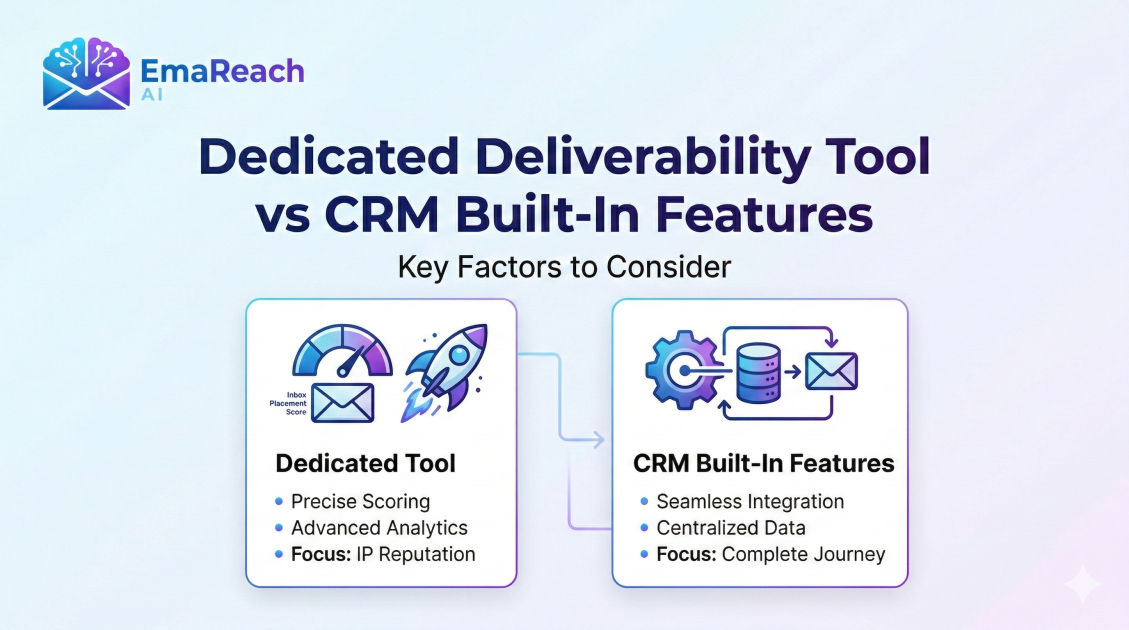
Dedicated Deliverability Tool vs CRM Built-In Features
email deliverabilitycrm featurescold outreachmarketing automationinbox placementsales tools
Introduction
In the modern digital landscape, the success of any email marketing or cold outreach campaign hinges on one critical metric: deliverability. You can spend thousands of dollars on high-quality lead lists and hundreds of hours crafting the perfect copy, but if your emails are landing in the spam folder, your Return on Investment (ROI) effectively drops to zero. This has sparked a long-standing debate among growth hackers, sales leaders, and marketing professionals: Should you rely on the built-in email features of your Customer Relationship Management (CRM) platform, or is it time to invest in a dedicated deliverability tool?
As CRMs have evolved from simple databases into all-in-one marketing suites, they have integrated robust email sending capabilities. However, as internet service providers (ISPs) like Google and Microsoft tighten their security algorithms, the 'all-in-one' approach often hits a ceiling. This article explores the nuanced differences between these two paths, helping you decide which infrastructure will protect your sender reputation and ensure your message reaches the primary inbox.
The Anatomy of CRM Built-In Email Features
Most modern CRMs offer an integrated email experience. The logic is simple: keep your data and your communication in one place. When you send an email directly from your CRM, the activity is automatically logged, the contact's timeline is updated, and you can see open rates alongside deal stages.
Convenience and Data Centralization
The primary advantage of using a CRM for email is the seamless flow of data. There is no need for third-party integrations or manual data syncing. If a lead unsubscribes through a CRM-sent email, their status is instantly updated across your entire sales pipeline. This prevents the nightmare scenario of a salesperson calling a lead who just opted out of communication.
Basic Reporting and Automation
CRM email features are usually designed for 'transactional' or 'nurture' workflows. They excel at sending an automated follow-up when a lead fills out a form or triggers a specific lifecycle stage. You get basic metrics like opens, clicks, and bounces. For many small to mid-sized businesses, this level of functionality is sufficient for standard newsletters and basic lead nurturing.
The Shared IP Dilemma
The hidden catch with many CRMs is how they actually send your mail. To keep costs low and simplify setup, many CRMs put their users on shared IP addresses. This means your deliverability is tethered to the behavior of every other user on that IP. If another company using the same CRM starts sending low-quality, spammy content, the reputation of that IP drops, and your 'clean' emails might start heading to the spam folder by association.
The Rise of Dedicated Deliverability Tools
Dedicated deliverability tools are built with a single, laser-focused purpose: ensuring emails land in the inbox. Unlike CRMs, which view email as one feature among many, these tools view email delivery as a complex technical science that requires constant monitoring and adjustment.
Advanced Technical Monitoring
Dedicated tools offer deep dives into technical authentication protocols such as SPF (Sender Policy Framework), DKIM (DomainKeys Identified Mail), and DMARC (Domain-based Message Authentication, Reporting, and Conformance). While a CRM might tell you if these are 'connected,' a dedicated tool will monitor them in real-time for any configuration errors that could trigger ISP filters.
Inbox Placement Tests and Seed Lists
One of the most significant differences is the ability to perform 'seed list' testing. A dedicated tool sends your email to a controlled group of real inboxes across different providers (Gmail, Outlook, Yahoo, Zoho). It then reports back exactly where those emails landed—Primary Tab, Promotions, or Spam. CRMs generally only report if an email was 'delivered' (meaning the receiving server accepted it), not where it actually ended up in the user's view.
Reputation Management and Warm-up
Maintaining a high sender reputation requires a consistent volume of high-quality mail. Dedicated tools often include 'inbox warm-up' features. These automated systems exchange emails between a network of real accounts to show ISPs that your domain is involved in healthy, two-way conversations. This is particularly crucial for new domains or those trying to recover from a spam penalty.
Comparing Key Functionalities
To better understand which path fits your business, let's break down the core functionalities side-by-side.
1. Reputation Monitoring
- CRM Built-In: Usually limited to bounce rate tracking. If your bounce rate exceeds a certain threshold (often 2-5%), the CRM may temporarily suspend your sending privileges to protect their own IP reputation.
- Dedicated Tool: Monitors blacklist status across hundreds of global databases. It tracks your 'Sender Score' and provides alerts the moment your domain is flagged, allowing you to remediate the issue before your entire campaign is compromised.
2. Personalization and AI-Driven Content
- CRM Built-In: Uses basic merge tags like
{{first_name}}or{{company}}. While effective, these patterns are easily recognized by modern spam filters as automated bulk mail. - Dedicated Tool: Often incorporates advanced AI to vary the content of each individual email. For those serious about scaling outreach without losing the human touch, platforms like EmaReach provide a significant edge. EmaReach AI combines AI-written cold outreach with inbox warm-up and multi-account sending—so your emails land in the primary tab and get replies. By rotating accounts and using AI to unique-ify the copy, it bypasses the footprint-based filtering that often plagues CRM-sent bulk mail.
3. Scalability and Multi-Account Sending
- CRM Built-In: Typically links one user to one email account. If you need to send a high volume of cold emails, sending them all from one account is a fast track to being blacklisted.
- Dedicated Tool: Designed for 'inbox rotation.' These tools allow you to connect multiple sending accounts and distribute your daily volume across them. This keeps the per-account volume low and mimics natural human behavior, which is much more favorable to ISP algorithms.
When a CRM is Enough
It is important to note that a dedicated tool isn't always a requirement for every business. You might stick with your CRM's built-in features if:
- You primarily send opt-in newsletters: If your list is 100% double-opt-in and highly engaged, your reputation should remain stable without heavy-duty monitoring.
- Your volume is low: If you are sending fewer than 50 personalized emails a day manually, the risk of triggering spam filters is minimal.
- Budget is the primary constraint: High-end deliverability tools represent an additional monthly expense that may not be justifiable if email isn't a primary revenue driver for you.
When You Must Use a Dedicated Deliverability Tool
You should transition to a dedicated tool or a specialized outreach platform when:
- Cold Outreach is your main lead source: Cold emailing is high-risk. ISPs are inherently suspicious of unsolicited mail. You need every technical advantage to prove you aren't a 'spammer.'
- You are using a new domain: Sending 500 emails a day from a domain registered last week is a recipe for disaster. You need a tool to manage the warm-up process.
- Your open rates are declining: If your content hasn't changed but your open rates have dropped from 40% to 10%, you likely have a deliverability issue that a CRM cannot diagnose or fix.
- You need to bypass the 'Promotions' tab: CRMs often use 'tracking pixels' and bulk-sending headers that signal to Gmail that your email belongs in the Promotions tab. Dedicated tools allow for 'plain-text' style sending and custom tracking domains to keep you in the Primary inbox.
The Technical Deep Dive: Why CRMs Struggle with Cold Outreach
Understanding why CRMs often fail at deliverability requires looking at the headers of an email. When a CRM sends an email, it often includes 'via' or 'sent on behalf of' headers. These headers tell the receiving server that a third-party application is sending the mail. While perfectly fine for a receipt or a newsletter, it is a red flag for cold outreach.
Dedicated tools often use 'Direct SMTP' or 'API' connections to your actual workspace (Google Workspace or Microsoft 365). This makes the email appear as if it was sent directly from your outbox, manually, by a human. This lack of 'bulk-mail fingerprints' is the secret sauce of high-performing outreach campaigns.
Strategy: The Hybrid Approach
Many high-growth companies don't choose just one; they use a hybrid approach. This strategy leverages the strengths of both systems:
- The CRM (e.g., Salesforce, HubSpot): Used as the 'System of Record.' It stores the master lead list, tracks deal progress, and handles inbound support tickets and marketing newsletters to existing customers.
- The Dedicated Outreach/Deliverability Tool: Used as the 'System of Action' for outbound. All cold prospecting is done here to protect the main domain. Once a lead responds and becomes a 'qualified' prospect, they are pushed into the CRM for the sales team to manage.
This separation of concerns ensures that if your outreach domain gets blacklisted, it doesn't affect your ability to send crucial invoices or support emails from your primary corporate domain.
The Cost of 'Free' CRM Email
Many businesses see the email feature in their CRM as 'free' because it's included in their subscription. However, the true cost of deliverability issues is staggering.
Consider this math:
- Scenario A (CRM): Send 1,000 emails, 20% land in the inbox, 5% open rate = 10 opens.
- Scenario B (Dedicated Tool): Send 1,000 emails, 90% land in the inbox, 30% open rate = 270 opens.
Even if the dedicated tool costs $100 per month, the difference in potential revenue from 260 additional people seeing your message is massive. Deliverability tools don't just 'monitor'; they unlock the potential of your existing lead list.
Actionable Checklist for Deliverability Success
Regardless of which route you choose, ensure you are following these non-negotiable best practices:
- Set up Custom Tracking Domains: Do not use the default tracking domain provided by your CRM. Create a CNAME record so that tracking links use your own domain.
- Avoid 'Spam Trigger' Words: Words like 'Free,' 'Guarantee,' and 'Earn Money' in subject lines are instant red flags.
- Optimize Your Signature: Keep HTML in your signature to a minimum. Large images or excessive links can hurt deliverability.
- Regular List Cleaning: Use a validation service to remove 'catch-all' or 'invalid' emails before you ever hit send.
- Enable DMARC: Set your DMARC policy to at least 'p=none' initially to monitor who is sending mail on your behalf, then move toward 'quarantine' or 'reject.'
Conclusion
The choice between a dedicated deliverability tool and CRM built-in features isn't just about functionality; it's about your business model. If your business relies on nurturing existing relationships and sending low-volume, permission-based mail, the convenience of a CRM is hard to beat.
However, if your growth strategy involves outbound prospecting, cold outreach, or high-volume sales, relying solely on a CRM is a strategic risk. A dedicated tool provides the visibility, technical protection, and specialized features needed to navigate the increasingly hostile environment of modern inboxes. By treating deliverability as a dedicated pillar of your marketing stack rather than an afterthought, you ensure that your voice is actually heard by the people who matter most—your future customers. Stop Landing in Spam. Cold Emails That Reach the Inbox is not just a slogan; it's a prerequisite for success in the digital age.
EmaReach AI
Ready to scale your cold email outreach?
Join thousands of teams using EmaReach AI for AI-powered campaigns, domain warmup, and 95%+ deliverability. Start free — no credit card required.
Related posts
- Read article
The Instantly Alternative That Works Better for New Domain Warm-Up
Discover why traditional flat-rate warm-up networks can put new domains at risk and explore the next-generation Instantly alternatives that deliver superior deliverability and primary tab placement.
- Read article
What the Cold Email Community Actually Says About Instantly Alternatives
Discover what growth marketers, agency owners, and outbound practitioners across major cold email communities are saying about the top alternatives to Instantly. This comprehensive, research-driven guide breaks down the real-world pros, cons, and technical features of tools like Smartlead, EmaReach, Saleshandy, and Lemlist based on community consensus.