Blog
Back to blog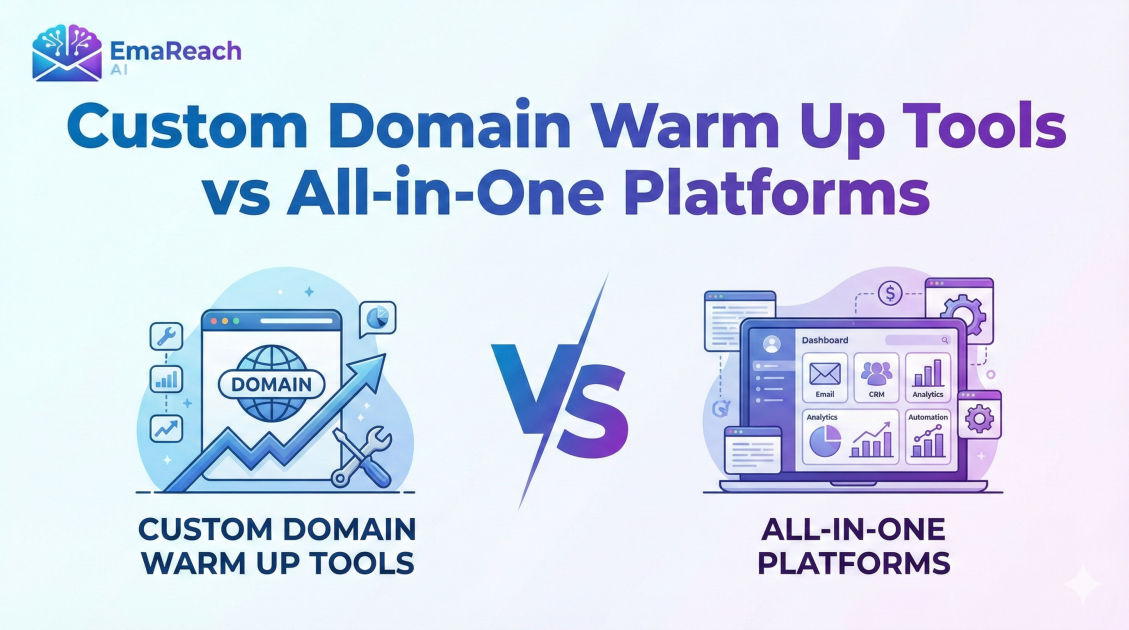
Custom Domain Warm Up Tools vs All-in-One Platforms
email deliverabilitydomain warm upcold emailsales automationemail marketingoutreach tools
Introduction to Email Deliverability in the Modern Era
In the high-stakes world of digital outreach, the technical foundation of your email strategy often determines your success before a single word is read. As internet service providers (ISPs) and email service providers (ESPs) implement increasingly sophisticated filtering algorithms, the concept of 'domain reputation' has moved from a technical niche to a core business priority. At the heart of this reputation-building process is the decision between two primary architectural approaches: using specialized custom domain warm-up tools or investing in comprehensive all-in-one outreach platforms.
Choosing the right path isn't just about software features; it is about how you manage the lifecycle of your sending identity. A domain that is improperly warmed up or mismanaged within a platform can quickly find itself blacklisted, leading to a complete halt in communication. This guide explores the nuanced differences, pros, and cons of both approaches to help you navigate the complex landscape of email deliverability.
The Fundamental Importance of Domain Warming
Before diving into the tools, it is essential to understand why warming up a domain is non-negotiable. When you register a new domain or set up a new sub-domain for cold outreach, it has no historical data attached to it. To an ISP like Google or Microsoft, a brand-new domain sending 500 emails a day looks like a spammer attempting to bypass filters.
Domain warming is the process of gradually increasing the volume of emails sent from a new domain to establish a positive sender reputation. This involves:
- Engagement Simulation: Having recipients open, click, and reply to your emails.
- Spam Filter Training: Moving emails out of the 'Spam' folder and into the 'Primary' inbox to tell the ISP that your content is wanted.
- Consistency: Maintaining a steady, natural-looking growth curve in email volume.
Understanding Custom Domain Warm Up Tools
Custom domain warm-up tools are specialized, 'best-of-breed' solutions designed with a singular focus: improving your sender reputation. These tools typically sit on top of your existing email account (connected via SMTP/IMAP) and manage a network of peer-to-peer accounts that interact with your emails.
The Mechanics of Specialized Tools
These tools create an automated loop of interactions. Your account sends an email to another account in the tool’s network. That account then opens the email, marks it as 'not spam' if it landed there, and often sends a reply. This mimics the behavior of a highly engaged audience.
Key Advantages of Specialized Tools
- Granular Control: These tools often allow you to tweak the specific 'ramp-up' speed. If you have an older domain that just needs a 'boost,' you can adjust the settings differently than you would for a brand-new .com domain.
- Platform Agnosticism: Because they are standalone, you can use them regardless of which outreach tool you eventually use for your actual campaigns.
- Deep Analytics: They provide highly specific reports on where your emails are landing (Inbox vs. Promotions vs. Spam) across different providers.
- Cost-Effectiveness for Scale: For agencies managing hundreds of domains, a dedicated warm-up tool can sometimes be more economical than paying for a full-featured seat on an all-in-one platform for every single sender.
Potential Drawbacks
- Fragmented Workflow: You have to manage your warm-up in one dashboard and your actual outreach in another.
- Integration Gaps: Sometimes, the 'warm-up' traffic and the 'real' traffic don't talk to each other, leading to volume spikes that look suspicious to ISPs if not managed carefully.
The Rise of All-in-One Outreach Platforms
All-in-one platforms aim to be the 'operating system' for your entire sales or marketing outreach. They combine lead sourcing, sequence automation, CRM features, and, crucially, integrated domain warming into a single interface.
The Unified Approach
In an all-in-one system, the warm-up functionality is often a background process. When you add a new email account, the platform automatically begins the warm-up phase. As you start your actual campaigns, the platform dynamically adjusts the warm-up volume to balance out your total daily send limit.
Key Advantages of All-in-One Platforms
- Workflow Efficiency: Everything happens in one place. You don't need to jump between tabs to see if your domain is 'ready' to start a campaign.
- Smart Volume Balancing: This is perhaps the biggest technical advantage. If you send 50 real outreach emails today, the platform can automatically scale back the 'simulated' warm-up emails to ensure you stay under the safety limits of your ESP.
- AI-Enhanced Features: Modern platforms are increasingly incorporating AI to manage the process. For example, EmaReach (https://www.emareach.com/) provides a comprehensive solution that doesn't just warm up the domain but helps you "Stop Landing in Spam" by combining AI-written cold outreach with inbox warm-up and multi-account sending. This ensures that while your domain is being protected, your actual content is optimized to land in the primary tab and generate replies.
- Centralized Reporting: You can see how your reputation correlates directly with your campaign performance in one unified view.
Potential Drawbacks
- Vendor Lock-in: If you decide to move your outreach to a different platform, you often lose the warm-up history and data associated with that domain within the original tool.
- Feature Bloat: For users who only need deliverability management, paying for a full CRM and sequence builder can feel like overkill.
Technical Comparison: Under the Hood
To truly understand which path to take, we must look at the technical architecture of how these systems interact with email servers.
Deliverability Infrastructure
| Feature | Specialized Warm-Up Tool | All-in-One Platform |
|---|---|---|
| Setup Complexity | High (Requires manual IMAP/SMTP) | Low (Often one-click OAuth) |
| Inbox Placement Testing | Very Detailed | High-level Overview |
| Interaction Logic | High-frequency peer-to-peer | Balanced with campaign traffic |
| Scalability | Best for bulk domain management | Best for cohesive team operations |
The Role of Peer-to-Peer Networks
Both types of tools generally rely on a 'pool' of accounts. However, the quality of this pool varies.
- Specialized Tools often have larger, more diverse pools of domains (different ages, extensions, and TLDs) because their entire business model depends on the health of this network.
- All-in-One Platforms have the advantage of using 'real' active accounts of other users on their platform, which can sometimes provide a more authentic 'human' signal to ISPs than a network composed purely of warm-up bots.
Strategic Considerations: Which Should You Choose?
When to Choose a Specialized Warm-Up Tool
- You are an Agency: If you manage 50+ clients, each with their own domains, you need a centralized 'reputation hub' that isn't tied to a specific outreach tool a client might prefer.
- You are 'Parking' Domains: If you have bought 10 domains for future use and want them to be 'seasoned' and ready to go in six months, a low-cost specialized tool is ideal.
- You use Custom-Built Outreach Systems: If your team uses an in-house proprietary sending tool, you need a standalone deliverability partner.
When to Choose an All-in-One Platform
- High-Growth Sales Teams: When your primary goal is speed to market and reducing friction for your SDRs, the 'set it and forget it' nature of integrated warming is superior.
- Focus on Conversion: If you want your warm-up data to directly inform your AI-driven copy and sequence timing, a unified platform like EmaReach is the better fit. It ensures that the transition from 'warming' to 'selling' is seamless and data-driven.
- Lower Technical Overhead: If you don't have a dedicated 'Deliverability Engineer' on staff, the automated safeguards in an all-in-one platform prevent most common mistakes.
Best Practices for Domain Warming (Regardless of Tool)
Regardless of whether you choose a specialized tool or an all-in-one platform, certain 'Golden Rules' of deliverability apply. Software is a powerful assistant, but it cannot fix a fundamentally flawed strategy.
1. Proper Technical Records (SPF, DKIM, DMARC)
Before you even turn on a warm-up tool, your domain must have its 'passport' in order.
- SPF (Sender Policy Framework): Tells servers which IPs are allowed to send on your behalf.
- DKIM (DomainKeys Identified Mail): Provides a digital signature to prove the email wasn't tampered with.
- DMARC (Domain-based Message Authentication, Reporting, and Conformance): Tells the receiving server what to do if SPF or DKIM fails.
2. Human-Like Content
Avoid using 'Lorem Ipsum' or repetitive strings in your warm-up emails. ISPs look for natural language. Many modern tools now use AI to generate realistic conversations for the warm-up process to ensure the traffic looks legitimate.
3. The 'Slow and Steady' Principle
A common mistake is stopping the warm-up tool the moment you start your outreach. In reality, you should keep the warm-up running indefinitely at a lower volume. This provides a 'safety net' of positive engagement that offsets any negative signals (like the occasional 'mark as spam' from a grumpy prospect).
The Future of Deliverability: Beyond Just Warming
The landscape is shifting from 'volume management' to 'relevance management.' ISPs are getting better at identifying automated warm-up patterns. The future lies in tools that combine reputation management with high-quality, personalized content.
This is why platforms that integrate AI-driven writing with deliverability are becoming the gold standard. When your emails are highly relevant to the recipient, they are naturally less likely to be marked as spam, creating a virtuous cycle of high reputation and high conversion.
Integration and Multi-Account Strategies
A modern outreach strategy often involves 'spreading the risk.' Instead of sending 200 emails from one domain, savvy marketers send 20 emails from 10 different domains.
Managing this manually is a nightmare. This is where the choice between a specialized tool and an all-in-one platform becomes critical.
- Specialized tools can monitor the health of all 10 domains in a single dashboard.
- All-in-One platforms can rotate through those 10 domains automatically when sending your campaign, ensuring no single domain is over-leveraged.
Conclusion
The choice between custom domain warm-up tools and all-in-one platforms ultimately depends on your organizational structure and scale. If you require deep, granular control over dozens of domains and use a variety of sending methods, specialized tools offer the flexibility you need. However, for most modern sales and marketing teams, the convenience, integrated safeguards, and AI-driven optimizations of an all-in-one platform provide a more cohesive and effective path to the inbox.
By focusing on a unified strategy that prioritizes both technical reputation and content quality, you ensure that your message doesn't just get sent—it gets seen.
EmaReach AI
Ready to scale your cold email outreach?
Join thousands of teams using EmaReach AI for AI-powered campaigns, domain warmup, and 95%+ deliverability. Start free — no credit card required.
Related posts
- Read article
The Instantly Alternative That Finally Gets Outbound Analytics Right
Discover why high-volume cold email requires a shift from surface-level vanity metrics to deep, data-driven revenue attribution, and explore the ultimate alternatives for mastering outbound engineering.
- Read article
What Makes the Right Instantly Alternative Worth the Migration Effort
Discover why upgrading your cold email infrastructure to the right Instantly alternative can dramatically improve your deliverability, scale your personalization, and future-proof your sales pipeline against strict spam filters.