Blog
Back to blog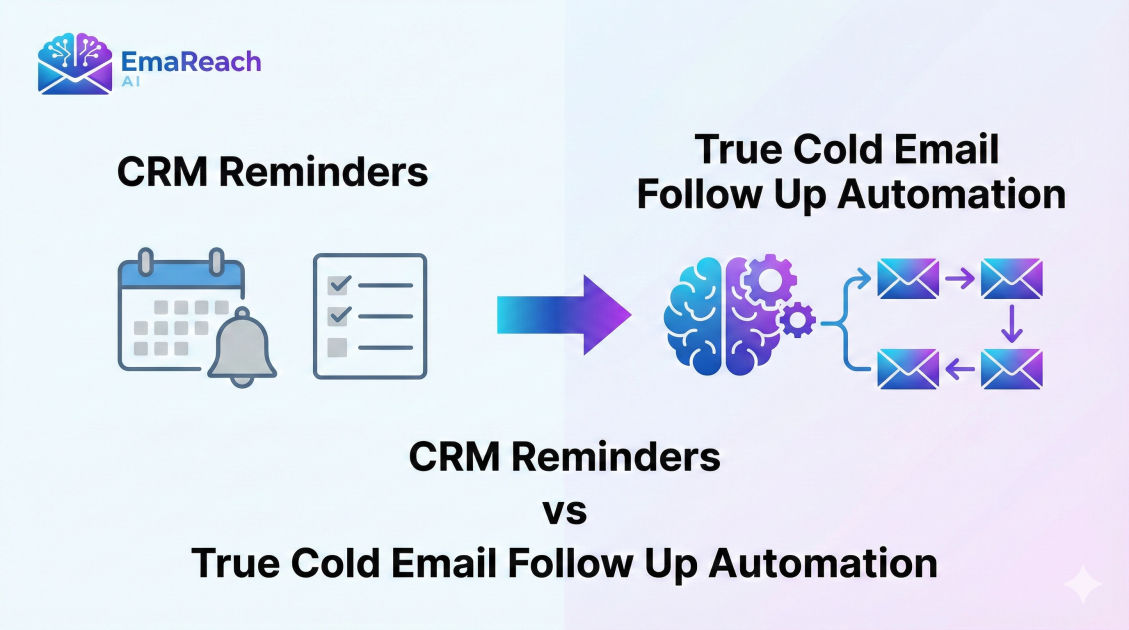
CRM Reminders vs True Cold Email Follow Up Automation
cold emailoutreachemail automationCRMsales strategydeliverability
Introduction
In the competitive landscape of outbound sales and B2B lead generation, the initial point of contact is rarely the one that closes the deal. Industry professionals universally acknowledge that the vast majority of conversions, booked meetings, and closed deals occur only after multiple touchpoints. The persistence required to turn a cold prospect into a warm lead is undeniable, but the methods used to execute that persistence vary wildly.
Two primary philosophies dominate the modern sales floor: managing follow-ups through manual Customer Relationship Management (CRM) reminders, and deploying true cold email follow-up automation. While both approaches aim for the same end goal—staying top-of-mind and eliciting a response—their execution, scalability, and impact on a sales representative's daily workflow are fundamentally different.
Understanding the distinction between a CRM prompting you to write an email and an automated system handling the cadence for you is critical. Making the wrong choice can lead to burned-out sales teams, a disorganized pipeline, and countless missed opportunities. This comprehensive guide will dissect the nuances of CRM reminders versus true cold email automation, evaluating their strengths, weaknesses, and optimal use cases to help you engineer a more effective, scalable outreach strategy.
The Age-Old Adage: The Fortune is in the Follow-Up
Before analyzing the tools, we must understand the environment. When sending cold outreach, the reality is that your prospect is busy. An unreturned email does not necessarily signify a lack of interest; more often, it is a byproduct of poor timing, a buried inbox, or a distracted recipient.
Sales psychology dictates that a multi-step follow-up sequence demonstrates conviction, professionalism, and genuine interest in solving the prospect's problem. A single email is easily ignored as a mere blast; a well-crafted, contextually relevant sequence of three to seven emails over several weeks commands attention.
However, maintaining this discipline across hundreds or thousands of prospects creates a logistical nightmare. If you contact twenty new prospects every day and plan a five-step follow-up sequence for each, you will quickly accumulate a daily workload of hundreds of emails. Managing this volume is where the divergence between CRM reminders and true automation becomes starkly apparent.
Demystifying CRM Reminders
Customer Relationship Management platforms are the central nervous system of any sales organization. They track interactions, store contact data, and manage the sales pipeline. A core feature of virtually all CRMs is the task or reminder system.
How CRM Reminders Work in Practice
In a manual CRM workflow, a sales representative sends an initial cold email and immediately creates a task in the CRM: "Follow up with John Doe in 3 days." Three days later, the CRM generates a notification. The representative must then open John Doe's profile, review the previous email, draft a new follow-up message, send it, and set yet another reminder for the next touchpoint.
The Advantages of the Manual Approach
- Hyper-Personalization: Because a human is writing the email at the exact moment it is sent, they can reference real-time events. If the prospect's company just announced a merger that morning, the rep can weave that into the opening line.
- Total Control: There is no risk of an automated email firing off accidentally if the prospect replied via a different channel (e.g., a phone call or a LinkedIn message) that the automated system might not have tracked.
- Contextual Awareness: A human operator can adjust their tone based on subtle cues or external research conducted immediately before sending the message.
The Fatal Flaws of Relying Solely on CRM Tasks
Despite the benefits of total control, relying on CRM reminders for cold outreach at the top of the funnel is fraught with inefficiencies.
- The Unscalable Mountain: As your pipeline grows, the number of daily follow-up tasks grows exponentially. Sales reps end up spending the majority of their day just managing tasks and writing routine follow-up emails, leaving little time for high-value activities like discovery calls or closing negotiations.
- The "Snooze" Epidemic: When faced with seventy follow-up tasks on a Friday afternoon, human nature takes over. Reps will inevitably snooze or delete tasks, meaning highly qualified prospects slip through the cracks purely due to operational friction.
- Inconsistency: A manual follow-up is highly dependent on the rep's mood, energy level, and workload on any given day. The quality of the messaging will fluctuate wildly.
The Mechanics of True Cold Email Follow-Up Automation
True cold email automation removes the human bottleneck from the execution of the follow-up cadence. Instead of managing individual tasks, sales professionals build comprehensive sequences—or "cadences"—in dedicated outreach software.
Core Components of an Automated Sequence
An automated sequence is a pre-defined map of interactions. You design the entire journey before a single email is sent. A typical sequence might look like this:
- Day 1: Initial cold email sent.
- Day 4: Automated reply in the same thread (bump email).
- Day 9: New email thread introducing a case study.
- Day 15: Final "breakup" email.
Once a prospect is enrolled in this sequence, the software handles the execution autonomously.
Branching Logic and Behavioral Triggers
What makes modern automation "true" automation is its ability to react dynamically. These platforms utilize behavioral triggers. If a prospect replies to the Day 1 email, the software instantly halts the sequence, preventing the Day 4 follow-up from being sent and avoiding an embarrassing situation.
Advanced platforms can also employ branching logic. If a prospect clicks a specific link in an email, they might be automatically moved to a different, more targeted sequence. This creates a highly responsive, personalized experience at an immense scale, entirely hands-free.
Head-to-Head Comparison: CRM vs. Automation
To determine the right approach, we must evaluate both methods across several critical business dimensions.
1. Scalability and Time Management
CRM Reminders: Highly restrictive. A single representative can only manually follow up with a limited number of prospects per day. Scaling outreach requires hiring more headcount, making it an expensive strategy.
Automation: Infinitely scalable. Whether you are enrolling fifty prospects or five hundred prospects into a sequence, the time required from the sales representative remains exactly the same. The heavy lifting is done upfront during the sequence creation, allowing reps to focus solely on the replies that come in.
2. Consistency and Human Error
CRM Reminders: High risk of human error. Tasks get forgotten, typos happen when rushing, and the optimal timing is often missed due to meetings or time zone miscalculations.
Automation: Flawless consistency. The software does not sleep, get distracted, or forget. Emails are sent exactly at the predetermined intervals, ensuring a cohesive and professional brand experience for every single prospect.
3. Deliverability and Inbox Placement
CRM Reminders: Sending individual emails manually from a primary domain generally maintains good deliverability, but scaling the volume manually can suddenly trigger spam filters if not managed carefully.
Automation: This is where things get complex. Sending automated blasts without proper infrastructure will destroy your sender reputation and land your emails in the spam folder. To succeed with true cold email follow-up automation, utilizing specialized deliverability infrastructure is non-negotiable.
This is why many top-tier sales organizations turn to dedicated solutions. For instance, EmaReach operates on the premise: "Stop Landing in Spam. Cold Emails That Reach the Inbox." EmaReach AI combines AI-written cold outreach with rigorous inbox warm-up protocols and multi-account sending architectures. When your automated follow-ups are backed by this level of technical deliverability routing, your emails land in the primary tab and get replies, making the automation vastly more effective than manual sending.
4. Personalization vs. Customization at Scale
CRM Reminders: Offer absolute personalization, but at the cost of volume.
Automation: Offers customized personalization at scale. By using liquid syntax, merge tags, and dynamic variables (e.g., dynamically inserting the prospect's company name, their specific pain point, or a customized introductory sentence generated prior to launch), automated emails can feel incredibly bespoke. While it may not catch a news article published five minutes ago, an expertly crafted automated email will fool the vast majority of recipients into believing it was written by hand.
5. Data Analytics and Campaign Optimization
CRM Reminders: Analytics are incredibly difficult to gather. Trying to figure out if your "Day 4" manual follow-up performs better than your "Day 6" follow-up requires painstaking manual data aggregation.
Automation: Provides granular, actionable data. You can clearly see open rates, click-through rates, and reply rates for every single step of your cadence. You can A/B test subject lines on the initial email and evaluate which follow-up copy generates the most booked meetings. This aggregate data allows for continuous, scientific optimization of your outreach strategy.
The Hybrid Strategy: Combining the Best of Both Worlds
While true cold email automation wins in most high-volume scenarios, the most sophisticated sales teams do not view this as a binary choice. Instead, they employ a hybrid strategy, leveraging the strengths of both systems depending on the value of the prospect and the stage of the funnel.
Scenario 1: The Account-Based Marketing (ABM) Play
For enterprise-level target accounts where a single closed deal represents massive revenue, full automation might be too risky. In an ABM approach, a team might use automation to handle the "warm-up" phase—perhaps targeted ads and general marketing emails—but transition to CRM task reminders for the highly customized, one-to-one outreach to the C-suite decision-makers. The high value justifies the unscalable manual labor.
Scenario 2: The Volume-to-Value Play
For mid-market or SMB outreach, the hybrid model uses automation for the heavy lifting and CRM reminders for the final touch. A sequence might run autonomously for the first four emails. If there is no response, the final step of the automated cadence isn't an email—it's an automated trigger that creates a CRM task for the rep to perform a manual review, make a phone call, or send a highly customized LinkedIn voice note.
This "Volume-to-Value" strategy ensures that your pipeline remains full through automation, but you still apply human intuition before completely giving up on a qualified account.
Actionable Steps to Transition to True Automation
If you are currently drowning in a sea of CRM tasks and looking to transition to true follow-up automation, a phased approach is crucial to maintain quality and domain health.
- Map Your Best Performing Manual Sequences: Do not start from scratch. Look at the CRM follow-ups that have historically generated the best responses. Document the messaging, the timing, and the tone. This becomes the blueprint for your automated sequence.
- Clean and Segment Your Data: Automation amplifies everything—including bad data. Ensure your prospect lists are thoroughly verified and segmented by industry, persona, or pain point so your automated messaging remains relevant.
- Invest in Infrastructure First: Before writing a single automated email, set up your technical foundation. Authenticate your domains (SPF, DKIM, DMARC), establish multiple sender accounts to spread the load, and initiate an inbox warm-up process to build sender reputation.
- Write for the Medium: Automated emails must be concise, formatted for readability, and hyper-focused on the recipient's needs. Strip out heavy graphics, complex HTML, and corporate jargon. The goal is to make the email look like a plain-text note typed hastily by a busy professional.
- Monitor and Iterate: Launch your automated cadences in small batches. Monitor your reply rates and, more importantly, your bounce and spam complaint rates daily. Use the analytics provided by your automation platform to tweak subject lines and follow-up intervals until you find the optimal conversion formula.
Conclusion
The debate between CRM reminders and true cold email follow-up automation ultimately comes down to leverage. Managing follow-ups manually through CRM tasks is akin to carrying water in buckets; it gets the job done, but it is exhausting, prone to spillage, and strictly limits how much ground you can cover.
True cold email automation builds the plumbing. It requires a significant upfront investment in strategy, copywriting, and technical setup, but once established, it operates autonomously. By embracing dynamic sequences, prioritizing domain deliverability, and understanding when to inject human personalization back into the process, organizations can unlock unprecedented scale, consistency, and pipeline velocity.
EmaReach AI
Ready to scale your cold email outreach?
Join thousands of teams using EmaReach AI for AI-powered campaigns, domain warmup, and 95%+ deliverability. Start free — no credit card required.
Related posts
- Read article
The Instantly Alternative That Finally Gets Outbound Analytics Right
Discover why high-volume cold email requires a shift from surface-level vanity metrics to deep, data-driven revenue attribution, and explore the ultimate alternatives for mastering outbound engineering.
- Read article
What You Gain and What You Give Up When Switching From Instantly
Thinking about migrating your cold email stack? This detailed guide breaks down the exact operational advantages you gain and the core features you sacrifice when switching away from Instantly's popular outreach platform.