Blog
Back to blog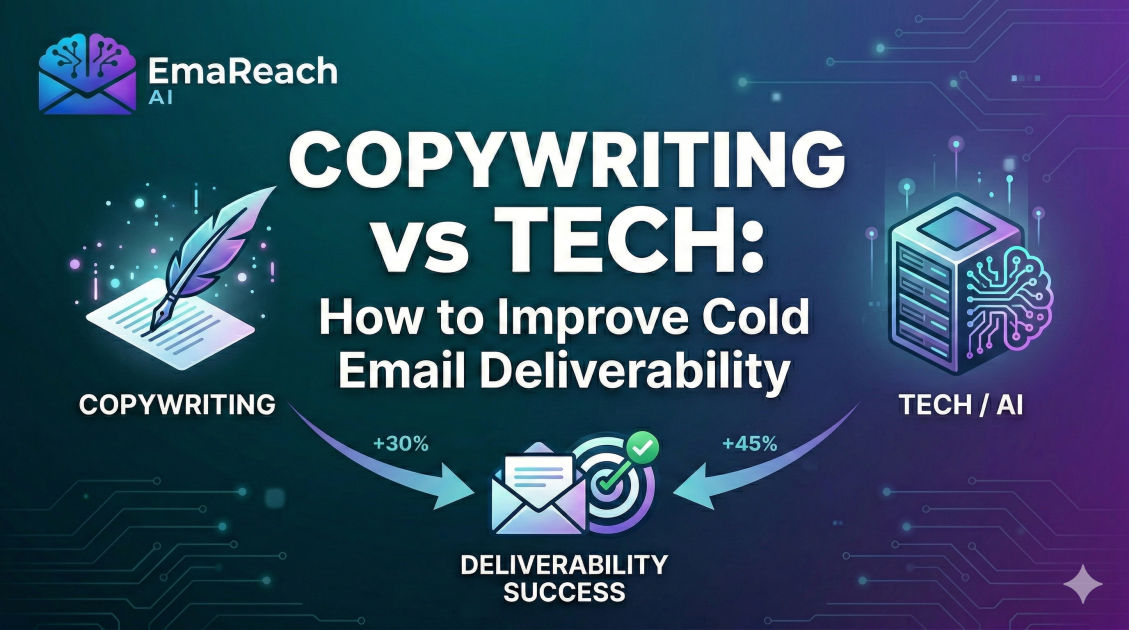
Copywriting vs Tech: How to Improve Cold Email Deliverability
cold emaildeliverabilitycopywritingemail marketingoutreach strategysales automation
Introduction
In the world of outbound sales, there is a constant debate between the art of the message and the science of the delivery. On one side, we have the copywriters, who argue that a compelling, personalized hook is the only way to get a response. On the other side, we have the technical specialists, who maintain that even the most brilliant prose is useless if it ends up in the spam folder.
The truth is that cold email success is not a choice between copywriting and technology; it is a synergistic relationship where both must function at a high level. High-performance deliverability requires a foundational technical setup to navigate the filters of major email service providers (ESPs), while copywriting must be optimized to avoid 'soft' triggers that cause users to mark messages as junk.
This guide explores how to balance these two pillars to ensure your outreach actually reaches the inbox and generates the ROI your business deserves.
The Technical Foundation: Why Your Infrastructure Matters First
Before a single word is written, the technical infrastructure determines the fate of your campaign. If your technical setup is flawed, you are essentially trying to run a marathon with your shoelaces tied together.
Domain Authentication: SPF, DKIM, and DMARC
Email service providers use three primary protocols to verify that you are who you say you are. Without these, you are an unauthenticated stranger in the eyes of Google and Outlook.
- SPF (Sender Policy Framework): A text record in your DNS that lists the IP addresses authorized to send emails on behalf of your domain.
- DKIM (DomainKeys Identified Mail): Adds a digital signature to your emails, proving the content wasn't tampered with during transit.
- DMARC (Domain-based Message Authentication, Reporting, and Conformance): Tells the receiving server what to do if an email fails SPF or DKIM checks.
The Importance of Domain Aging and Warming
Sending 500 emails from a brand-new domain is a guaranteed way to get blacklisted. Systems need to see a slow, organic increase in volume to trust a new sender. This process, known as 'warming,' involves sending small batches of emails and ensuring they are opened and replied to.
To automate this delicate balance, many professionals turn to advanced solutions. EmaReach provides an integrated approach to this, offering inbox warm-up and multi-account sending capabilities. By spreading your volume across multiple authenticated accounts, you reduce the 'thermal' footprint on any single inbox, significantly improving your chances of landing in the primary tab.
Tracking Links and Custom Tracking Domains
Default tracking links provided by some email tools are often shared among thousands of users. If one user sends spam, that shared link becomes 'burnt,' affecting everyone else using it. To solve this, technical-minded senders use Custom Tracking Domains, which wrap the tracking link in their own branded URL, isolating their reputation from the 'bad neighbors' on shared infrastructure.
Copywriting as a Deliverability Variable
Many marketers view copywriting solely through the lens of conversion. However, the words you choose directly impact whether your email is filtered. Modern spam filters use Natural Language Processing (NLP) to scan for patterns associated with low-quality outreach.
Avoiding 'Spammy' Keywords
While there is no secret list of 'banned' words that will automatically trigger a spam filter, a high density of aggressive sales language is a major red flag. Words like 'Free,' 'Guarantee,' 'Cash,' 'Urgent,' and 'Act Now' contribute to a high spam score.
Instead of aggressive claims, focus on value-based language. Instead of saying "Get a free consultation today," try "I’d love to share some insights on how we helped a similar company scale their outbound volume."
The Danger of Over-Formatting
Copywriters often want to use bold text, different colors, and multiple links to make their call-to-action (CTA) pop. From a technical perspective, this is a mistake. High HTML-to-text ratios are a common characteristic of marketing newsletters and phishing attempts.
To improve deliverability, your cold emails should look like an email you would send to a friend or a colleague:
- Use plain text or minimal HTML.
- Limit yourself to one or two links max.
- Avoid embedding large images or heavy attachments.
Spintax: The Copywriter’s Technical Tool
One of the biggest triggers for spam filters is 'bulk' behavior—sending the exact same string of text to 1,000 people at once. Copywriters can combat this using 'Spintax' (Spinning Syntax). This involves creating variations of sentences within a single template.
Example: {Hi|Hello|Hey} {Name}, I {noticed|saw|came across} your profile on LinkedIn.
By using Spintax, every email sent is unique, preventing the ESPs from identifying a repetitive pattern that signals an automated bot.
The Psychology of the Inbox: Engagement as a Technical Signal
Deliverability is no longer a static score; it is a dynamic reputation based on engagement. If people open your emails, click your links, and—most importantly—reply to them, your reputation goes up. If they delete your email without opening it or mark it as spam, your reputation plummets.
Subject Lines: The First Impression
A deceptive or 'clickbaity' subject line might get a high open rate, but if the content doesn't match the promise, the user will mark it as spam. This 'negative engagement' tells the ESP to send your future emails to the junk folder for everyone else too.
Effective subject lines for deliverability are:
- Short: 2-4 words.
- Relevant: Specifically mentions something about the prospect.
- Low-pressure: Avoids all-caps and exclamation points.
The Power of the Reply
In the eyes of Google and Outlook, a 'Reply' is the ultimate gold star. It signifies a two-way conversation, which is what email was designed for. Copywriters should focus their CTAs on starting a conversation rather than closing a sale. Asking a simple, low-friction question like "Is this something your team is currently focusing on?" encourages a quick 'Yes' or 'No' reply, which technically boosts your sender reputation.
Managing the Unsubscribe
Technically, you must provide a way to opt-out. Copywriters often fear the unsubscribe link, but it is actually your best friend. A user who unsubscribes is someone who didn't mark you as spam. Make your unsubscribe process easy and clear to protect your long-term deliverability.
Harmonizing Technical Setup and Copy Strategy
To achieve elite-level results, you must merge these two disciplines into a single cohesive strategy. Here is how that looks in practice:
Step 1: Decentralized Sending (Tech)
Instead of sending 100 emails a day from ceo@company.com, set up five secondary domains (e.g., company-growth.com, get-company.com). Use a tool like EmaReach to manage these accounts and perform automated warm-ups. This technical diversification ensures that if one account hits a snag, the rest of your operation remains functional.
Step 2: Hyper-Personalization (Copy)
Move beyond {First_Name}. Use snippets that reference a recent podcast the prospect was on, a specific technology their website uses, or a recent company milestone. High personalization reduces the likelihood of being marked as spam because the recipient recognizes that the message was crafted specifically for them.
Step 3: Monitoring Technical Health (Tech)
Regularly check your sender reputation using tools that monitor blacklists and 'Postmaster' tools. If you see a dip in open rates, it’s a sign that your technical health is failing, likely due to a copy-related issue (like high spam reports) or a technical one (like a failed DMARC check).
Step 4: Iterative Testing (Copy)
A/B test your copy, but do it scientifically. Test one variable at a time—the subject line, the lead-in, or the CTA. By identifying which copy drives the most positive engagement, you are effectively using copywriting to improve your technical deliverability status.
The Role of AI in Bridging the Gap
Artificial Intelligence has fundamentally changed the 'Copywriting vs Tech' debate by making it possible to do both at scale. In the past, you had to choose between high-quality, manual personalization (Copywriting) and high-volume automation (Tech).
AI now allows for the generation of unique, contextually relevant lines for every prospect in a list of thousands. This means you can maintain the 'human feel' that satisfies spam filters while leveraging the speed of automated systems. Platforms like EmaReach AI are at the forefront of this, combining AI-written cold outreach with the necessary technical safeguards like inbox warm-up. This ensures that the 'Art' of the copy is supported by the 'Science' of the delivery, allowing messages to land in the primary tab where they can actually be read.
Conclusion
Improving cold email deliverability is a multi-dimensional challenge. You cannot ignore the technical requirements of SPF records and domain warming, nor can you ignore the nuance of language, formatting, and engagement-driven copywriting.
When the technical team ensures the pipes are clear and the copywriting team ensures the water is worth drinking, the results are undeniable. By treating deliverability as a shared responsibility between tech and copy, you create a resilient, scalable outbound engine that bypasses filters and builds genuine connections with your prospects. Focus on the foundation, refine the message, and always prioritize the user experience in the inbox.
Success in cold outreach isn't about outsmarting the filters; it's about proving to the filters—and your recipients—that you belong in the conversation.
EmaReach AI
Ready to scale your cold email outreach?
Join thousands of teams using EmaReach AI for AI-powered campaigns, domain warmup, and 95%+ deliverability. Start free — no credit card required.
Related posts
- Read article
The Instantly Alternative That Finally Gets Outbound Analytics Right
Discover why high-volume cold email requires a shift from surface-level vanity metrics to deep, data-driven revenue attribution, and explore the ultimate alternatives for mastering outbound engineering.
- Read article
What You Gain and What You Give Up When Switching From Instantly
Thinking about migrating your cold email stack? This detailed guide breaks down the exact operational advantages you gain and the core features you sacrifice when switching away from Instantly's popular outreach platform.