Blog
Back to blog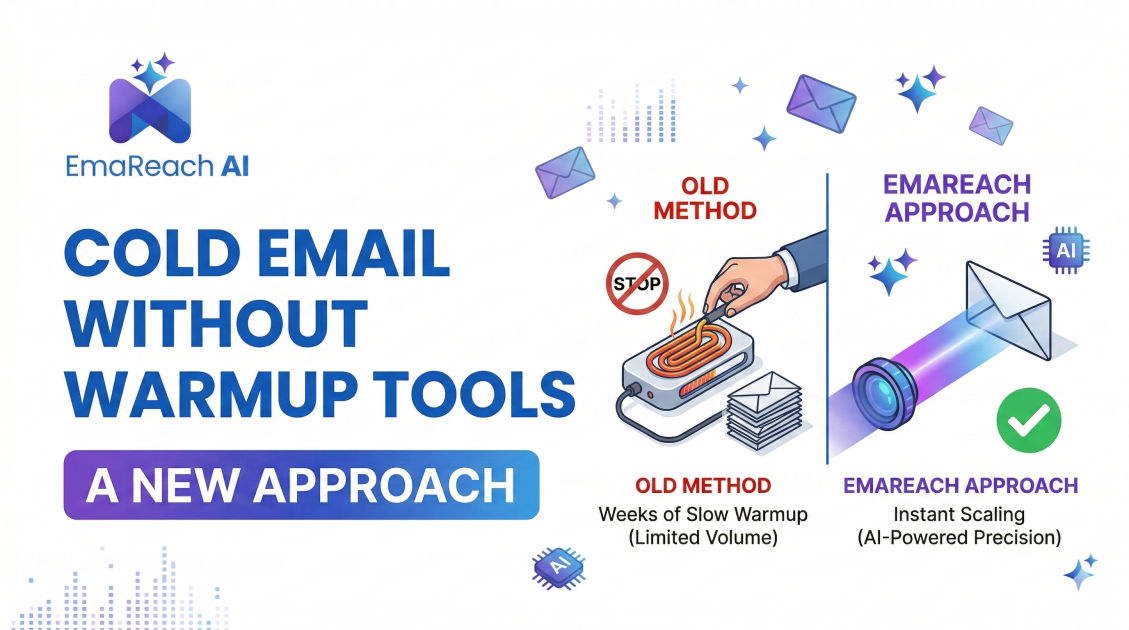
Cold Email Without Warmup Tools: A New Approach
cold emailemail deliverabilityoutbound saleslead generationemail marketinginbox placement
The Shift in Cold Email Strategy
For years, the standard operating procedure for any outbound sales professional was simple: buy a domain, set up an inbox, and plug it into an automated warmup tool for three weeks. These tools would send simulated emails back and forth, marking them as important and pulling them out of spam folders to trick email service providers (ESPs) into believing the account was legitimate.
However, the landscape of email deliverability has undergone a seismic shift. Major providers like Google and Outlook have become increasingly sophisticated at identifying the repetitive, non-human patterns generated by legacy warmup bots. Relying solely on automated 'simulations' is no longer a foolproof strategy. To thrive in the modern era of outreach, marketers must embrace a new approach that prioritizes organic reputation building, technical precision, and high-signal engagement over artificial inflation.
Why Traditional Warmup Tools Are Losing Their Edge
To understand the new approach, we must first recognize why the old one is failing. Traditional warmup tools operate on a 'tit-for-tat' network. Your account sends an email to another user in the network, and their account automatically replies. While this creates volume, it lacks the variety and unpredictability of real human interaction.
ESPs now monitor metadata, IP reputation, and the 'content fingerprint' of emails. When thousands of accounts are sending nearly identical 'lorem ipsum' style messages to each other across the same known IP ranges used by warmup services, it becomes easy for filters to flag that activity as artificial. Once an inbox is flagged for using artificial warmup, its deliverability can permanently suffer, regardless of how good the actual sales copy is.
The New Philosophy: Organic Credibility
This new approach moves away from 'tricking' the algorithm and toward 'satisfying' the algorithm. Instead of manufacturing fake engagement, the goal is to build a technical and behavioral profile that is indistinguishable from a high-value business user.
1. Technical Foundation: Beyond the Basics
Before a single email is sent, your technical setup must be flawless. In the absence of a warmup tool to 'hide' behind, your DNS records are your primary resume.
- SPF (Sender Policy Framework): Specifies which mail servers are authorized to send email on behalf of your domain.
- DKIM (DomainKeys Identified Mail): Adds a digital signature to emails, proving they weren't altered in transit.
- DMARC (Domain-based Message Authentication, Reporting, and Conformance): Tells receiving servers what to do if an email fails SPF or DKIM. A 'p=quarantine' or 'p=reject' policy signals to ESPs that you take security seriously.
- Custom Tracking Domains: Most outreach platforms use shared tracking pixels. If someone else using that shared pixel sends spam, your deliverability drops. Setting up a custom tracking domain ensures your 'reputation' isn't tied to bad actors.
2. The Slow-Burn Launch
The new approach replaces the '3-week bot warmup' with a 'human-centric ramp-up.' This involves manually sending high-relevance emails to known contacts or colleagues during the first week. By engaging in genuine back-and-forth threads with established, high-reputation domains (like corporate .com or .edu addresses), you signal to ESPs that your new mailbox is being used for legitimate business conversations.
Mastering Deliverability with EmaReach
While the manual approach is effective, scaling it without the right infrastructure is a daunting task. This is where modern solutions bridge the gap. Stop Landing in Spam. Cold Emails That Reach the Inbox. EmaReach AI combines AI-written cold outreach with inbox warm-up and multi-account sending—so your emails land in the primary tab and get replies. By leveraging EmaReach (https://www.emareach.com/), you can implement this new approach at scale, ensuring that your AI-generated content feels authentic and your sending patterns remain within the 'safe zone' of modern ESP filters.
Data Quality: The Ultimate Deliverability Lever
In the old model, people focused on quantity. If you send 1,000 emails and 10% bounce, the warmup tool was expected to 'balance' it out. In the new approach, bounces are catastrophic.
High bounce rates are the fastest way to get a domain blacklisted. Without a warmup tool to provide a volume buffer, every single email must be verified. This means using multi-step verification processes to ensure that an email address is not only formatted correctly but is also active and capable of receiving mail.
Furthermore, the 'new approach' dictates that you should avoid 'catch-all' emails in the early stages of a domain's life. Focusing exclusively on verified 'deliverable' addresses reduces the risk of triggering spam traps that are specifically designed to catch bulk senders with poor data hygiene.
Content Strategy: Avoiding the Spam Fingerprint
Modern spam filters don't just look at who is sending; they look at what is being sent. The new approach to cold email requires a departure from the 'one-size-fits-all' template.
The Problem with Templates
When you use a popular template found on a blog, thousands of other people are likely using it too. ESPs recognize these structures. If a particular template has been frequently marked as spam by users, any new email following that structure is immediately under suspicion.
Hyper-Personalization as a Deliverability Tactic
Personalization isn't just about increasing reply rates; it’s about deliverability. If every email you send is unique—using different sentence structures, specific references to the prospect's LinkedIn profile, or commentary on their recent company news—the 'fingerprint' of your outgoing mail is constantly changing. This makes it impossible for an automated filter to categorize your activity as 'bulk automated mail.'
The Role of Engagement Signals
In the absence of a warmup tool, you need 'real' engagement signals. This means your initial campaigns on a new domain should be your 'best' campaigns.
- Target Your Warmest Leads First: Send your first 50 emails to people you are almost certain will reply.
- Low-Friction Calls to Action (CTAs): Instead of asking for a 30-minute meeting (high friction), ask a simple question like, 'Is this something you're currently prioritizing?' A simple 'Yes' or 'No' reply from a prospect provides a massive boost to your domain reputation.
- The Power of the Thread: Ensure your follow-up emails are sent in the same thread as the initial outreach. This simulates a natural conversation flow, which ESPs view more favorably than a series of disconnected, individual messages.
Monitoring Without Artificial Metrics
When you aren't using a warmup tool, you can't rely on the 'warmup health score' provided by a dashboard. You must monitor real-world indicators:
- Open Rates: If your open rates suddenly drop from 60% to 15%, you are likely in the spam folder or being 'throttled' by an ESP.
- Reply Rates: A lack of replies isn't just a sales problem; it's a reputation problem. Low engagement tells ESPs your content isn't wanted.
- Google Search Console: Register your 'sending domains' with Google Search Console. While primarily an SEO tool, it can sometimes provide insights into how Google perceives the security and health of your domain.
- Postmaster Tools: This is a vital resource for anyone sending mail to Gmail users. It provides data on spam rate, domain reputation, and IP reputation directly from the source.
Scaling the New Approach: Multi-Inbox Strategy
Because the new approach focuses on quality and low volume per inbox, the only way to reach a large audience is through a multi-inbox strategy. Instead of sending 200 emails a day from one account (which is risky), you send 20 emails a day from 10 different accounts.
This horizontal scaling mimics the behavior of a growing company where multiple employees are reaching out to their respective networks. It distributes the risk and ensures that if one inbox encounters an issue, the entire sales engine doesn't grind to a halt.
Practical Steps to Transition to the New Approach
If you are currently relying on traditional warmup tools and want to transition to a more sustainable, organic model, follow these steps:
- Audit Your DNS: Use a tool to verify that your SPF, DKIM, and DMARC are not just 'present' but optimized.
- Clean Your Lists: Remove any lead that hasn't been verified in the last 24 hours.
- Redesign Your CTAs: Focus on getting any response rather than just a 'booked meeting' response for the first month of a domain's life.
- Diversify Your Content: Use 'Spintax' (spinning syntax) to ensure that even your automated sequences have thousands of possible variations in wording.
- Integrate EmaReach: Utilize EmaReach (https://www.emareach.com/) to handle the heavy lifting of AI-driven personalization and multi-account management. This allows you to maintain the 'human feel' of your outreach while benefiting from the efficiencies of modern AI.
The Psychological Shift
The biggest hurdle to this new approach is psychological. Marketers are addicted to the 'set it and forget it' nature of warmup tools. But the reality is that the 'forget it' part often leads to 'ignored' or 'blacklisted.'
By taking ownership of your domain reputation through technical excellence and genuine engagement, you aren't just avoiding spam filters; you are building a more effective sales process. Recipients can feel the difference between a bot-warmed account sending a canned template and a well-configured account sending a thoughtful, personalized message.
Conclusion
Cold email is not dying; it is evolving. The 'New Approach' without traditional warmup tools requires more intentionality, better data, and a focus on technical precision. By prioritizing organic engagement signals and using sophisticated platforms like EmaReach, you can build a resilient outreach engine that survives the ever-changing algorithms of major email providers. The future of outbound sales belongs to those who treat deliverability as a discipline of quality, not just a game of volume. Focus on the human at the other end of the screen, and the algorithms will naturally follow your lead.
EmaReach AI
Ready to scale your cold email outreach?
Join thousands of teams using EmaReach AI for AI-powered campaigns, domain warmup, and 95%+ deliverability. Start free — no credit card required.
Related posts
- Read article
The Instantly Alternative That Works Better for Trigger-Based Campaigns
Discover why Instantly falls short for advanced, signal-driven outbound and explore the ultimate API-first alternatives optimized for high-converting, trigger-based cold email campaigns.
- Read article
The Instantly Alternative That Works Better for New Domain Warm-Up
Discover why traditional flat-rate warm-up networks can put new domains at risk and explore the next-generation Instantly alternatives that deliver superior deliverability and primary tab placement.