Blog
Back to blog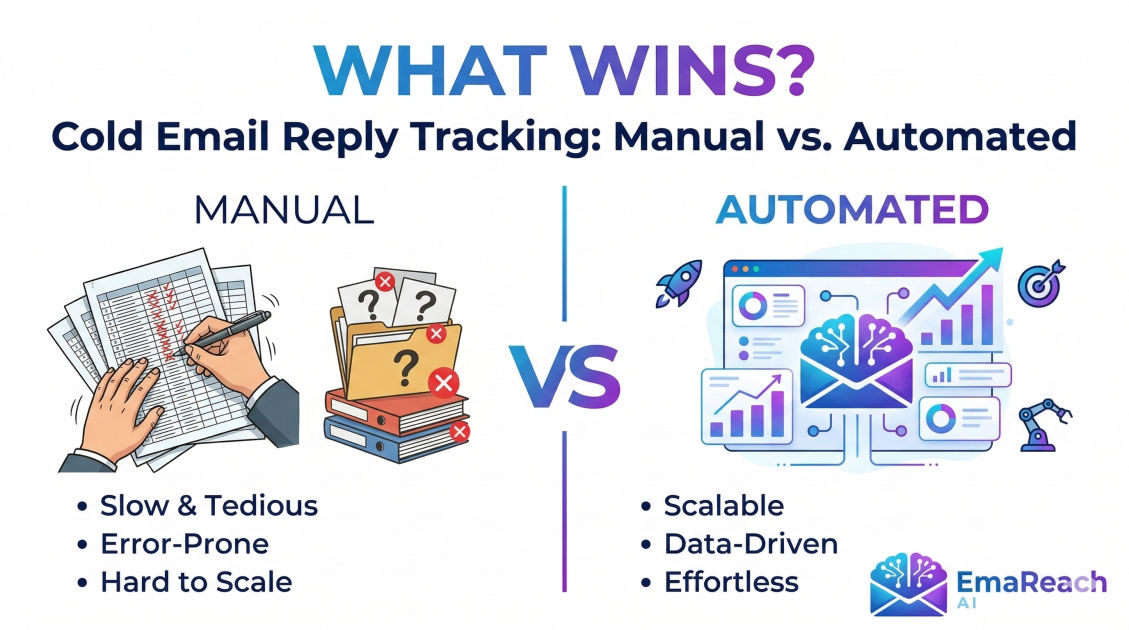
Cold Email Reply Tracking: Manual vs. Automated — What Wins?
cold emailsales automationlead trackingemail marketingoutreach strategyCRM integrationdeliverability
Introduction
In the high-stakes world of outbound sales, the journey doesn't end when you hit 'send.' In fact, that is precisely where the real work begins. Cold email outreach is a game of persistence, timing, and data. However, many sales professionals and business owners overlook the most critical component of the funnel: reply tracking.
Knowing exactly who responded, when they responded, and the sentiment of their message is the difference between a closed deal and a lost opportunity. Without a robust system to track replies, leads fall through the cracks, follow-ups are missed, and your ROI plummets. This brings us to a pivotal debate in the industry: Should you track your cold email replies manually, or is automation the only way forward?
In this comprehensive guide, we will dissect the pros, cons, and operational realities of both manual and automated reply tracking to help you determine which approach wins for your specific business needs.
The Fundamentals of Reply Tracking
Before diving into the comparison, it is essential to understand what reply tracking actually entails. It isn't just about seeing an email land in your inbox. True reply tracking involves:
- Sentiment Analysis: Categorizing the reply as positive, negative, or a request for more information.
- Sequence Termination: Ensuring that once a prospect replies, they are immediately removed from an automated follow-up sequence to avoid embarrassing and unprofessional double-messaging.
- CRM Integration: Updating your lead status in a central database so the entire team has visibility.
- Data Attribution: Linking the reply back to a specific campaign, subject line, or lead list to measure performance.
Why Tracking is Non-Negotiable
If you send 50 emails a week, you might remember every conversation. If you send 5,000, human memory becomes a liability. Effective tracking ensures that your 'warm' leads are nurtured and your 'cold' leads are archived, keeping your sales pipeline clean and your deliverability high.
Manual Reply Tracking: The Traditional Approach
Manual reply tracking involves a human—usually a Sales Development Representative (SDR) or a founder—checking the inbox, reading every response, and manually updating a spreadsheet or CRM.
The Benefits of Manual Tracking
1. Unmatched Nuance and Context AI and algorithms are getting better, but they still struggle with sarcasm, complex objections, or subtle buying signals. A human can read between the lines. If a prospect says, "Not right now, check back in three months," a human knows to set a specific calendar reminder. An automated system might simply flag it as a 'neutral' response.
2. Zero Technical Setup Cost For a startup or a solo entrepreneur, manual tracking requires no expensive software subscriptions. You just need a spreadsheet (like Google Sheets or Excel) and a dedicated block of time.
3. High Degree of Control Manual tracking gives you total control over the data. You aren't reliant on a third-party tool's API or its ability to sync correctly with your email provider.
The Drawbacks of Manual Tracking
1. The Scalability Wall This is the biggest hurdle. As your volume increases, manual tracking becomes a full-time job. Spending four hours a day updating spreadsheets is a poor use of a high-value salesperson's time.
2. Human Error People get tired. They skip rows in a spreadsheet, forget to remove a lead from a sequence, or misinterpret a reply. These small errors can lead to major brand damage if a prospect who said "No" keeps getting automated follow-ups.
3. Delayed Response Times In sales, speed to lead is everything. If you only check your tracking sheet once a day, you might be missing the window of opportunity when a prospect is most engaged.
Automated Reply Tracking: The Modern Standard
Automated reply tracking utilizes software to monitor your inboxes. These tools use webhooks or IMAP/SMTP connections to detect incoming mail, categorize it, and trigger actions in other software.
The Benefits of Automated Tracking
1. Instant Sequence Termination One of the most powerful features of automation is 'auto-stop.' The moment a reply is detected, the software pauses the sequence for that specific contact. This prevents the cardinal sin of cold emailing: sending a "Hey, did you see my last email?" message to someone who already replied.
2. Real-Time Data and Analytics Automated tools provide dashboards that show you exactly which campaigns are performing best. You can see your reply rates, positive sentiment rates, and bounce rates at a glance.
3. Seamless CRM Syncing Automation allows for a 'set it and forget it' workflow where replies are automatically pushed to your CRM (like Salesforce, HubSpot, or Pipedrive), creating a new 'Deals' stage without any manual entry.
4. Enhanced Deliverability Many automated systems are built into platforms that also handle inbox health. For instance, using a specialized service ensures your emails reach the primary tab. EmaReach (https://www.emareach.com/) is a prime example of this synergy; it combines AI-written outreach with inbox warm-up and multi-account sending, ensuring your emails land where they are seen—and then tracks those replies to keep your pipeline moving.
The Drawbacks of Automated Tracking
1. The 'False Positive' Problem Sometimes an out-of-office (OOO) reply or an automated bounce notification can be misidentified as a human reply, causing the sequence to stop prematurely when it shouldn't have.
2. Complexity and Cost High-quality automation tools come with a monthly subscription fee. For very small operations, this might feel like an unnecessary overhead, though the time saved usually offsets the cost.
Comparison Table: Manual vs. Automated
| Feature | Manual Tracking | Automated Tracking |
|---|---|---|
| Scalability | Low - Hard to maintain at high volume | High - Handles thousands of leads easily |
| Accuracy | High (Context) / Low (Data Entry) | High (Data Entry) / Medium (Context) |
| Speed | Slow - Depends on human checking | Instant - Real-time updates |
| Cost | Low (Financial) / High (Time) | High (Financial) / Low (Time) |
| Integration | Manual copy-pasting required | Automatic API syncing |
The Strategic Intersection: A Hybrid Model?
For many growing businesses, the answer isn't purely one or the other. The most successful sales teams often employ a hybrid approach.
In a hybrid model, automation handles the heavy lifting: it stops sequences, logs the reply in the CRM, and alerts the salesperson. The human then steps in to perform the sentiment analysis and craft a personalized, manual response.
How to Transition from Manual to Automated
If you are currently tracking manually and feeling the strain, follow these steps to automate:
- Audit Your Volume: If you are sending more than 200 emails per week, it is time to automate.
- Choose the Right Stack: Look for tools that offer robust 'Reply Detection.' Ensure they can distinguish between an OOO message and a real person.
- Standardize Your CRM: Before turning on the automation, ensure your CRM stages are clearly defined (e.g., 'Replied - Interested', 'Replied - Not Interested', 'Do Not Contact').
- Test the Trigger: Send a test email to yourself, reply to it, and ensure the sequence stops immediately.
Common Pitfalls in Reply Tracking (And How to Avoid Them)
Regardless of which method you choose, there are several traps that can ruin your data integrity.
1. Ignoring the 'Master Suppression' List
When someone asks to be removed from your list, they must be removed globally, not just from one campaign. Manual trackers often forget to update the master list, leading to legal risks and spam complaints. Automation handles this via global opt-out features.
2. Failing to Track 'Invisible' Replies
Sometimes prospects don't reply directly but instead reach out via LinkedIn or your website's contact form. A manual tracker might miss the connection between the cold email and the website lead. Automated systems that track 'click-throughs' can help bridge this gap.
3. Mismanaging Multiple Inboxes
Scaling outreach often requires using multiple email accounts to protect your domain reputation. Tracking replies across 10 different inboxes manually is a nightmare. This is where automation truly wins, as it can aggregate all replies into a single 'Unibox.'
Technical Considerations for High Performance
To ensure your tracking is accurate, you need to pay attention to the technical health of your email setup.
- SPF, DKIM, and DMARC: Without these records properly set, your emails may never reach the inbox, making reply tracking a moot point.
- Custom Tracking Domains: If you use automation to track clicks or opens, ensure you use a custom tracking domain. Using the software's default domain can hurt your deliverability.
- Inbox Warm-up: If you are moving to an automated system to increase volume, you must warm up your inboxes first. Services like EmaReach provide this as a core feature, ensuring that when you scale, you aren't scaling your way into the spam folder.
The Verdict: What Wins?
When we ask "What Wins?", the answer depends on your stage of growth.
- Manual wins for the 'Boutique' Approach: If you are a high-ticket consultant reaching out to only 10 CEOs a month, manual tracking is superior. The level of personalization and attention to detail required at that level cannot be replicated by software.
- Automated wins for 'Growth and Scale': For any business looking to generate a consistent stream of leads, automation is the clear winner. The risks of human error, the cost of lost time, and the inability to analyze large datasets make manual tracking a liability for scaling companies.
Ultimately, Automated Tracking wins the majority of the time in the modern sales landscape. It allows sales teams to focus on what they do best—closing deals—while the software ensures that no lead is ever forgotten.
Conclusion
Cold email reply tracking is the pulse of your outbound strategy. Choosing between manual and automated tracking is essentially a choice between micro-management and scalability. While manual tracking offers a sense of control and nuanced understanding for very low volumes, it quickly becomes a bottleneck that prevents business growth.
Automation, when implemented correctly with the right tools and a focus on deliverability, provides a foundation for predictable, repeatable revenue. By leveraging technology to handle the repetitive tasks of logging and monitoring, you empower your sales team to engage in meaningful conversations that drive results. Whether you are just starting or looking to optimize a massive outreach operation, prioritizing a sophisticated tracking system is the most significant upgrade you can make to your sales process.
EmaReach AI
Ready to scale your cold email outreach?
Join thousands of teams using EmaReach AI for AI-powered campaigns, domain warmup, and 95%+ deliverability. Start free — no credit card required.
Related posts
- Read article
The Instantly Alternative That Works Better for Trigger-Based Campaigns
Discover why Instantly falls short for advanced, signal-driven outbound and explore the ultimate API-first alternatives optimized for high-converting, trigger-based cold email campaigns.
- Read article
The Instantly Alternative That Handles High Bounce Rates Without Panic
Discover how transitioning to an advanced Instantly alternative can safeguard your cold email infrastructure. Learn to handle high bounce rates effortlessly using real-time verification, smart mailbox rotation, and automated safety nets to protect your sender reputation and maintain consistent primary inbox placement.