Blog
Back to blog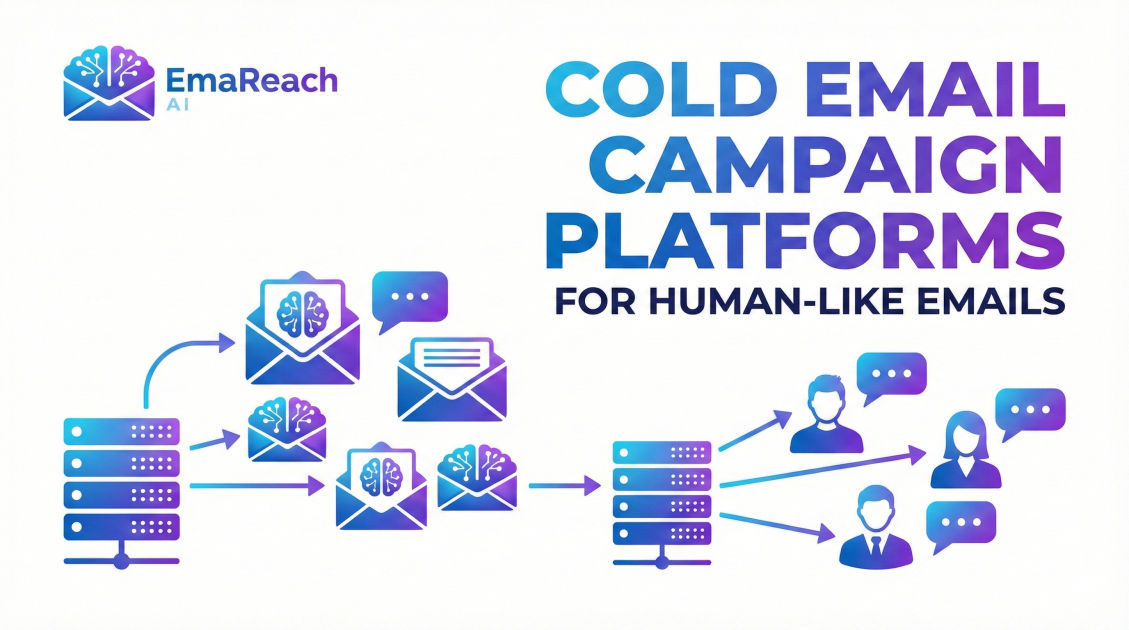
Cold Email Campaign Platforms for Human-Like Emails
cold emailemail marketingdeliverabilitysales engagementlead generationoutreach automationAI writing
Introduction
The era of spray-and-pray email marketing is effectively over. In the early days of digital outreach, volume was the primary metric of success. Sales development representatives and marketers would blast thousands of identical templates to a purchased list, hoping for a 1% conversion rate. Today, that strategy is not just ineffective; it is dangerous. Modern spam filters, powered by sophisticated artificial intelligence, can sniff out generic, bulk-sent emails with frightening accuracy. If your outreach behaves like a bot, it gets treated like a bot—which means it lands squarely in the spam folder.
The antidote to this algorithmic crackdown is "human-like" emailing. This isn't just about writing better copy; it is about utilizing platforms that mimic human behavior in every technical aspect, from sending cadence to server interaction. The goal is to scale your outreach without losing the authenticity of a one-to-one message.
This comprehensive guide explores the sophisticated landscape of cold email campaign platforms designed to simulate human interaction. We will dissect the features that matter, the technology behind "human" sending algorithms, and how to leverage these tools to build relationships rather than just metrics.
The Anatomy of a "Human-Like" Email Campaign
Before diving into platform specifics, it is crucial to understand what distinguishes a robotic campaign from a human-like one. It comes down to three core pillars: Variability, Personalization, and Infrastructure.
1. Variability in Sending Patterns
Humans do not send emails at exact 30-second intervals. They do not send 500 emails between 9:00 AM and 9:05 AM. A human sends an email, reads a reply, goes to grab coffee, drafts another, and perhaps responds to a Slack message.
Platforms designed for human-like delivery use randomized sending intervals. Instead of a fixed heartbeat, the software introduces random delays between sends. One email might go out 45 seconds after the previous one, while the next might wait 6 minutes. This staggering prevents the receiving mail servers (like Google or Outlook) from detecting a bulk API signature.
2. Hyper-Personalization Beyond the "First Name"
"Hi {FirstName}" is no longer enough. That is the baseline. True human-like emails reference specific context. If you were writing to a prospect manually, you would mention their recent LinkedIn post, a specific challenge their company is facing, or a mutual connection.
Advanced platforms now integrate with Generative AI to scrape prospect data and generate unique opening lines for every single email. This means that even if you are sending 100 emails, no two distinct message bodies are identical. This uniqueness is a strong signal to spam filters that the content is genuine correspondence, not a mass broadcast.
3. Plain Text vs. HTML
Marketing newsletters are heavy with images, HTML buttons, and tracking pixels. Personal emails are mostly text. Human-like campaign platforms prioritize plain-text formats. They strip away the glossy design elements that scream "marketing" and mimic the standard formatting of a regular Gmail or Outlook message. This simple switch significantly improves deliverability rates.
Key Features of Human-Emulating Platforms
When evaluating software for your cold outreach, look for these specific capabilities that drive human simulation.
Inbox Rotation and Sender Pools
Scaling volume while maintaining a human footprint requires horizontal scaling, not vertical. You cannot send 5,000 emails a day from one address without being flagged.
Top-tier platforms utilize Inbox Rotation. This feature allows you to connect multiple email accounts (e.g., ten different sender domains) to a single campaign. The platform then distributes the sending load across these accounts. If you need to send 500 emails, the system might send 50 emails from 10 different accounts. To the outside world, this looks like ten distinct individuals sending a modest volume of mail, which is perfectly normal behavior, whereas one account sending 500 emails is suspicious.
Automated Email Warm-Up
A brand-new email domain has no reputation. If it suddenly starts sending cold outreach, it looks like a burner account used by spammers.
Warm-up pools are networks of real inboxes that interact with each other automatically. Your platform sends emails to other users in the pool, and their systems automatically open your emails, mark them as "important," and reply to them. This artificial engagement builds a high sender reputation with ESPs (Email Service Providers). When you eventually launch your campaign, your domain has a history of positive interactions, ensuring your cold emails land in the primary inbox.
Spintax (Spinning Syntax)
Spintax is a coding format that allows you to create variations of sentences. For example:
{Hi|Hello|Hey} {there|friend|prospect},
A platform supporting advanced Spintax will rotate through these variations. If you have enough Spintax variations in your subject line and body copy, you can generate thousands of unique permutations of your script. This prevents your email content from having a consistent "hash" or digital fingerprint that spam filters can blacklist.
The Role of AI in Human-Like Outreach
Artificial Intelligence has transformed cold email from a numbers game into a relevance game. The latest platforms are not just delivery trucks; they are smart assistants.
Intent Detection
Old-school platforms tracked "opens" and "clicks." Modern human-like platforms track intent. By analyzing the sentiment of replies using Natural Language Processing (NLP), these tools can categorize responses (e.g., "Interested," "Out of Office," "Not Interested," "Wrong Person").
This allows the system to stop follow-up sequences automatically if a sentiment is negative, just as a human would. It prevents the embarrassment of sending a "Just bumping this up!" email to someone who already angrily asked to be removed from your list.
Dynamic Content Injection
Some platforms can now ingest a CSV file containing a prospect's company URL, scrape the website in real-time, and inject a relevant sentence about their business into the email body.
Example: "I noticed on your homepage that you recently launched a new sustainability initiative..."
This level of specificity was previously impossible without manual research. Now, automation layers this "human" observation into scale campaigns.
Technical Foundations: The Invisible "Human" Elements
Even the best platform cannot save you if your technical foundation is flawed. Human-like delivery requires strict adherence to authentication protocols.
The Holy Trinity: SPF, DKIM, and DMARC
- SPF (Sender Policy Framework): A DNS record that lists the IP addresses authorized to send email on your behalf. It tells the recipient server, "Yes, this platform is allowed to send mail for me."
- DKIM (DomainKeys Identified Mail): A digital signature attached to your email. It proves that the email hasn't been tampered with during transit.
- DMARC (Domain-based Message Authentication, Reporting, and Conformance): The policy that tells receiving servers what to do if an email fails SPF or DKIM checks.
Platforms that prioritize human-like delivery often provide built-in tools to monitor these records. If your DMARC policy is missing, your carefully crafted "human" email looks like a spoofing attempt.
Custom Tracking Domains
When you track clicks in an email, the URL is usually redirected through the platform's domain. If that platform's domain is shared with thousands of other users (some of whom might be spammers), your reputation suffers by association.
High-quality platforms insist on Custom Tracking Domains. This allows you to use your own subdomain (e.g., link.yourcompany.com) for tracking. It isolates your reputation from other users and looks more professional and trustworthy to security filters.
Strategy: How to Run a Campaign That Feels Personal
Once you have the right platform, how do you execute?
1. The "Soft" Call to Action (CTA)
Robotic sales emails often push hard: "Can we meet Tuesday at 2 PM?"
Human interactions are usually lower pressure. A "Interest-Based" CTA often performs better and feels more natural.
- Instead of: "Book a demo here."
- Try: "Is this something that is currently a priority for you?"
2. The Break-Up Email
In a sequence of emails, the final email is crucial. A bot keeps hammering until it hits a limit. A human eventually creates a respectful exit. The "Break-Up" email acknowledges that the prospect is busy and states that you will stop following up. Paradoxically, this "pull away" technique often generates the highest response rate because it removes the pressure.
3. Multi-Channel Touchpoints
Humans exist in multiple places. The best outreach platforms are now Sales Engagement Platforms that integrate LinkedIn steps and cold calling tasks alongside emails.
A human-like cadence might look like this:
- Day 1: Email 1 (Personalized intro)
- Day 2: View LinkedIn Profile (Soft touch)
- Day 4: Email 2 (Value add, no ask)
- Day 7: LinkedIn Connection Request
- Day 9: Email 3 (Short bump)
This integrated approach mimics how a real networker builds a relationship.
Conclusion: The Future is Authentic
The cold email landscape has come full circle. We moved from manual one-to-one emails to mass automation, and now technology is forcing us back to the quality of one-to-one interactions, but at scale.
Platforms for human-like emails are not just tools for evading spam filters; they are engines for relevance. They enforce the discipline of quality. By limiting sending volumes, mandating authentication, and utilizing AI for deep personalization, these tools ensure that cold outreach remains a viable and respectful channel for business growth.
As algorithms become smarter, the definition of "human-like" will continue to evolve. However, the core principle will remain unchanged: treat the recipient like a person, not a record in a database, and the technology will handle the rest.
EmaReach AI
Ready to scale your cold email outreach?
Join thousands of teams using EmaReach AI for AI-powered campaigns, domain warmup, and 95%+ deliverability. Start free — no credit card required.
Related posts
- Read article
The Instantly Alternative That Finally Gets Outbound Analytics Right
Discover why high-volume cold email requires a shift from surface-level vanity metrics to deep, data-driven revenue attribution, and explore the ultimate alternatives for mastering outbound engineering.
- Read article
What You Gain and What You Give Up When Switching From Instantly
Thinking about migrating your cold email stack? This detailed guide breaks down the exact operational advantages you gain and the core features you sacrifice when switching away from Instantly's popular outreach platform.