Blog
Back to blog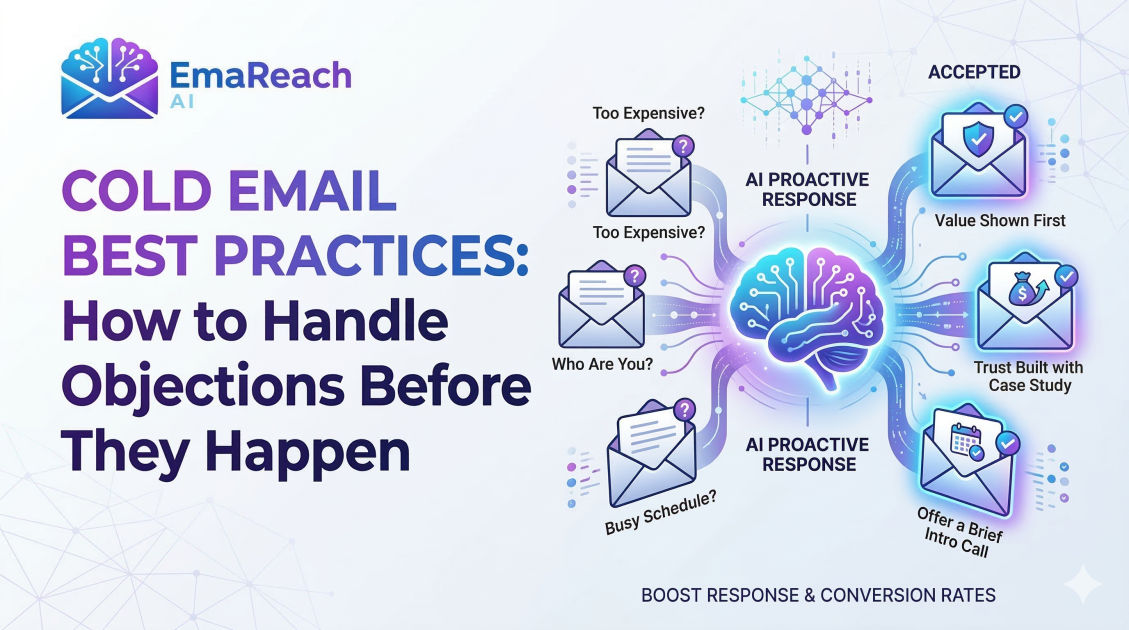
Cold Email Best Practices: How to Handle Objections Before They Happen
cold emailsales strategyoutreach tipslead generationemail deliverabilityobjection handling
Introduction: The Psychology of the Unspoken No
Cold email is often treated as a numbers game, but in reality, it is a game of psychology and friction reduction. When a prospect opens an unsolicited email, their brain is wired to find a reason to hit 'delete.' This instinctual resistance isn't necessarily a reflection of your product's value; it is a defensive mechanism against time-wasting and irrelevance.
Traditional sales teaching focuses on overcoming objections during a live call. However, in the world of cold outreach, if a prospect has an objection, they usually don't voice it—they simply ignore you. To succeed, you must shift your strategy from objection handling to objection prevention. By identifying the most common mental hurdles your prospect faces and addressing them within the body of your email, you transform a 'cold' intrusion into a 'warm' opportunity.
Understanding the 'Silent Objections'
Before you can preempt objections, you must understand what they are. In a cold email context, objections usually fall into four main categories:
- Relevance: "Why are you emailing me specifically?"
- Trust: "Who are you, and why should I believe you?"
- Value: "Is the benefit worth the time it takes to read this?"
- Risk: "What happens if I click this link or agree to a call?"
If your email fails to address even one of these silently, the thread dies. Handling these before they happen requires a blend of deep research, strategic copywriting, and technical excellence.
1. Radical Personalization: Solving the Relevance Objection
The first objection every prospect has is: "This is a mass-blasted template." If they feel like one of a thousand, they will treat your email like junk mail.
The 'Why You, Why Now' Framework
To preempt the relevance objection, your opening line must prove you’ve done your homework. Avoid generic compliments like "I love your website." Instead, focus on a specific business trigger.
- Trigger: A recent round of funding.
- Preemptive Strike: "I noticed you just expanded your engineering team by 20%, which usually introduces significant bottlenecks in project management documentation."
By mentioning a specific pain point associated with their current situation, you answer the "Why me?" question before they even ask it.
Segmenting by Persona
Objections differ by job title. A CFO objects to cost; a CTO objects to integration complexity. Preempting these means tailoring your value proposition. If you are emailing a Head of Sales, address the objection of "my team is too busy to learn new tools" by mentioning your 15-minute setup time immediately.
2. Building Instant Credibility: Solving the Trust Objection
Trust is the most expensive commodity in a cold inbox. The prospect is thinking, "I’ve never heard of this company; they’re probably a scam or a waste of time."
Social Proof That Doesn't Brag
Instead of saying "We are the best marketing agency," use 'name-dropping' as a bridge.
- Example: "We recently helped [Competitor Name] reduce their churn by 15% using the same framework I’d like to show you."
This preempts the "Does this actually work?" objection by showing it has worked for someone they recognize and respect.
The Power of Specificity
Vague claims breed suspicion. Specific numbers build trust. Saying you "help companies grow" is an invitation for an objection. Saying you "generated $1.2M in pipeline for a SaaS company with a 4-person sales team" is a data point that is hard to ignore. Specificity acts as a preemptive strike against skepticism.
3. High-Level Deliverability: The Technical Objection
An objection you never hear is the one from the email server. If your email lands in the spam folder, the objection is handled by an algorithm before the human even sees it. Technical friction is the ultimate silent killer of outreach.
To ensure your message reaches the inbox, you need a sophisticated setup. This is where EmaReach becomes essential. Stop Landing in Spam. Cold Emails That Reach the Inbox. EmaReach AI combines AI-written cold outreach with inbox warm-up and multi-account sending—so your emails land in the primary tab and get replies. By automating the warm-up process and managing deliverability, you preempt the 'technical objection' of being flagged as a spammer.
4. Value-First Outreach: Solving the 'Time' Objection
Your prospect's most valuable asset is their time. Their internal objection is: "This looks like work."
Give Before You Ask
Most cold emails ask for a 30-minute demo immediately. This triggers a massive "too much effort" objection. To preempt this, offer a "Lead Magnet" or a small piece of value first.
- The Strategy: "I put together a brief 2-minute teardown of your current checkout process. Would you like me to send it over?"
By offering a low-friction, high-value asset, you remove the objection of a time commitment. You are proving value before asking for a withdrawal from their time bank.
The 'Short and Scannable' Rule
If an email looks like a wall of text, the objection is "I don't have time to read this." Use short sentences, plenty of white space, and bullet points. A scannable email is a 'yes-able' email.
5. Risk Mitigation: Solving the 'Change is Hard' Objection
Even if a prospect likes your idea, they fear the friction of implementation. They are thinking: "Changing our process will be a nightmare."
Addressing Implementation Anxiety
You can preempt this by including a single sentence about ease of use.
- Example: "Our implementation takes less than 30 minutes and doesn't require any dev resources."
This small addition kills the "this sounds complicated" objection before the prospect can even formulate it.
The "No-Pressure" Call to Action (CTA)
Standard CTAs like "Book a call here [Link]" can feel aggressive. A preemptive approach uses an 'Interest-Based CTA.'
- Preemptive CTA: "Are you open to learning more about how we solved this for [Company]? If not, no worries at all."
By giving the prospect an easy "out," you lower their defensive barriers. You are signaling that you are a professional, not a desperate salesperson.
6. Identifying and Neutralizing Common Rebuttals in the Script
There are certain objections that are almost universal. You can bake the answers to these directly into your P.S. line or a brief sentence in the body.
"We already use a competitor"
Preemptive Strike: "Most of our happiest clients were previously using [Competitor], but they switched because they needed [Specific Feature Competitor Lacks]."
"We don't have the budget"
Preemptive Strike: "I'm not looking to sell you anything today; I simply want to share the data we found regarding your [Department] so you can use it for your next quarterly planning."
"Timing isn't right"
Preemptive Strike: "I know Q4 is usually chaotic for retail brands, which is why we designed our system to run entirely in the background without needing oversight."
7. The Role of Multi-Channel Touchpoints
Objections often stem from a lack of familiarity. If a prospect sees your name on LinkedIn, then receives a helpful email, and then sees a relevant comment on their post, the "Who are you?" objection disappears.
Consistency across channels builds a 'surround sound' effect. It moves you from being a 'cold stranger' to a 'recognized expert.' This familiarity handles the trust objection more effectively than any single email ever could.
8. Analyzing Data to Refine Preemption
To master the art of preempting objections, you must treat your outreach as a scientific experiment. If you notice a high open rate but a zero percent reply rate, your email is likely triggering an objection in the first two sentences.
- Low Replies: You haven't solved the 'Value' or 'Risk' objection.
- High Opt-outs: You haven't solved the 'Relevance' objection.
- Low Opens: You haven't solved the 'Deliverability' or 'Subject Line' objection.
By iterating based on these signals, you can refine your script until it flows past every mental gatekeeper the prospect has in place.
Conclusion
Handling objections before they happen is the difference between being a nuisance and being a partner. It requires you to step out of your shoes and into the shoes of a busy, skeptical executive. When you address relevance, trust, value, and risk proactively, you remove the friction that prevents deals from moving forward.
Remember, the goal of a cold email isn't to close the sale—it's to close the objection. Once the objections are gone, the conversation can finally begin. Focus on building a foundation of deliverability, lead with genuine value, and always respect the prospect's time. By doing so, you'll find that the 'silent nos' start turning into enthusiastic 'tell me mores.'
EmaReach AI
Ready to scale your cold email outreach?
Join thousands of teams using EmaReach AI for AI-powered campaigns, domain warmup, and 95%+ deliverability. Start free — no credit card required.
Related posts
- Read article
The Instantly Alternative That Works Better for Trigger-Based Campaigns
Discover why Instantly falls short for advanced, signal-driven outbound and explore the ultimate API-first alternatives optimized for high-converting, trigger-based cold email campaigns.
- Read article
The Instantly Alternative That Handles High Bounce Rates Without Panic
Discover how transitioning to an advanced Instantly alternative can safeguard your cold email infrastructure. Learn to handle high bounce rates effortlessly using real-time verification, smart mailbox rotation, and automated safety nets to protect your sender reputation and maintain consistent primary inbox placement.